Key points
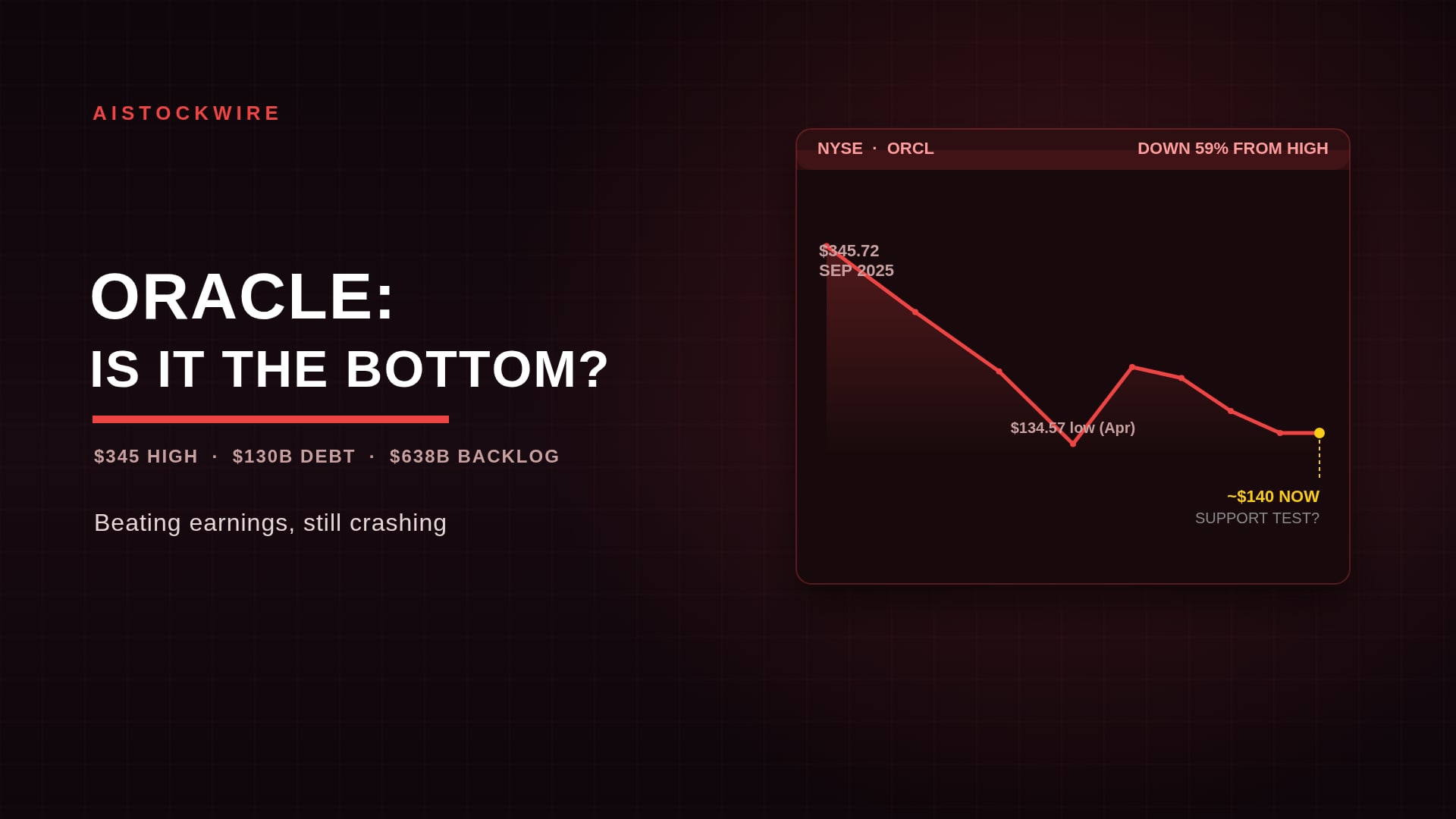
- Oracle (ORCL) has fallen from a 52-week high of $345.72 in September 2025 to around $140 now, a drop of roughly 59%. Late June alone brought a 19% drop in five trading days.
- The stock keeps falling even after beating earnings estimates every quarter this year. The real worry is $130 billion in debt, capital spending up 162% to $55.7 billion, and negative free cash flow of $23.7 billion.
- The bull case: Oracle's cloud backlog has swelled to a reported $638 billion, and Wall Street's average price target sits far above the current price.
- At around $140, the stock sits just above its 52-week low of $134.57, set in April 2026. Whether that holds is the whole question.
Oracle has had one of the ugliest charts in big tech this year, and honestly, it does not make sense on the surface. The company keeps beating earnings. The stock keeps falling anyway. Here is what happened, and why beating earnings has not been enough to stop it. Then I will get into where I think this actually stands.
How bad the drop actually is
Oracle touched $345.72 on September 10, 2025, its 52-week high, back when every cloud and data center stock was catching the same AI wave. Nine months later it was worth less than half that. The stock bottomed at $134.57 on April 10, 2026, spent a few weeks climbing back up toward $190, and then gave nearly all of it back. Late June alone cost the stock 19% in five trading days. By Thursday's close it sat around $140, roughly 59% below that September peak and only a few dollars clear of the April low.
Why it keeps falling even after beating earnings
Here is what confuses people about this one. Oracle put up its fiscal fourth-quarter numbers on June 10 and beat on both revenue and earnings per share, $2.11 against a $1.89 estimate. Shares fell more than 12% that same day anyway. This is not a company missing its numbers. It has topped EPS estimates in five of its last six quarters. What the market is punishing is not the quarter Oracle just reported. It is what Oracle says it needs to spend to keep the next several quarters coming.
Capital spending rose 162% to $55.7 billion in fiscal 2026, almost all of it going into AI and cloud data centers. That is the source of the $130 billion in debt sitting on Oracle's balance sheet, and it is why free cash flow came in negative $23.7 billion for the year, meaning Oracle spent more cash than the business took in. Cloud and software costs climbed 56% against 47% cloud revenue growth, a gap wide enough to compress margins on its own. On top of that, Oracle cut 21,000 jobs over the past year and paid $1.84 billion in severance in fiscal 2026, nearly five times what it spent the year before, and its own SEC filing links part of that directly to AI. None of that is hidden. Oracle is telling investors exactly what this buildout costs. The disagreement is over whether it is worth it.
The bull case nobody should ignore
Here is why I am not writing this stock off. Oracle's remaining performance obligations, the contracted revenue it has booked but not billed yet, have reportedly climbed to about $638 billion. Almost no software company on earth carries a number like that. If even a fraction of that backlog turns into real, billed cloud revenue over the next few years, the spending starts to look like the cost of staying in the AI race, not overreach. Analysts have mostly stuck with that read. Their average target lands near $252, nearly double where the stock sits today, and most of the coverage I have seen has not turned bearish even with the stock cut in half.
Is $140 the bottom, or just a stop along the way
I do not think anyone honestly knows yet, myself included. Oracle trades near 24 times trailing earnings right now, a real discount to where it sat during last year's run, and it is sitting a few dollars above its 52-week low instead of setting a new one. Maybe that means sellers are close to done. Maybe it just means the next earnings report has not landed yet.
Here is the bear case, spelled out: the debt keeps growing, cash flow stays negative, and Oracle slides under $134.57 into territory it has not seen all year. The bull case flips that completely. That $638 billion backlog finally starts showing up as real revenue, the margin bleeding slows down, and anyone who bought around $140 looks smart in a year. I would not bet heavily against either one. Oracle's next earnings report, expected in early September, should tell us which one we are actually on.
This is not investment advice. I do not think this is a simple call either way. Plenty of what I have read sees a company burning through cash it may never fully recover, and that is a fair read of the balance sheet. There is just as fair a case sitting in that $638 billion backlog. I would not fault anyone for landing on either side. Do your own research before you pick one.