Key points
- South Korea's Kospi closed at 7,246.79 on July 8, 2026, down 20.5% from its June 22 record close of 9,114.55 and officially in a bear market.
- The relationship with Wall Street runs both ways. A Wall Street-driven AI selloff hit Korea first on June 23 (Kospi down 10%) and July 2 (Kospi down 7.89%), but Samsung's own earnings reaction on July 7 dragged Micron (MU), SanDisk (SNDK) and Western Digital (WDC) down in the US the same day.
- Samsung Electronics and SK hynix together make up more than half of the Kospi's total weight, so their moves can swing the whole index and ripple into US chip stocks in either direction.
- Japan has coined a term, "Kospi-nirami," for watching the index as a leading signal for global chip sentiment, and TheStreet has called it "an overnight barometer of the fortunes of U.S. chip stocks."
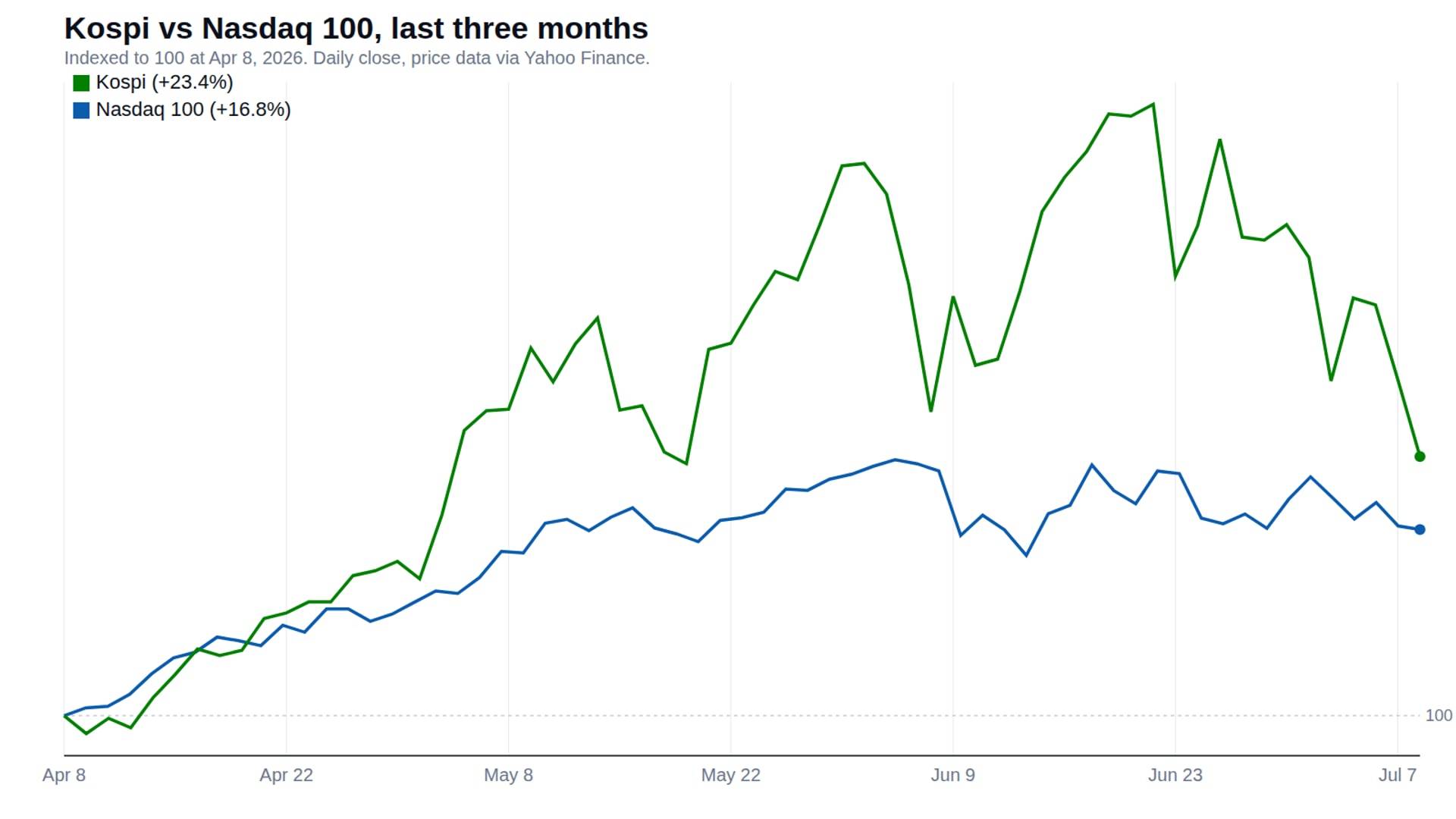
South Korea's Kospi closed at 7,246.79 on Wednesday, July 8, 2026. That is down 20.5% from its June 22 closing record of 9,114.55, which by the standard definition puts Korea's benchmark index in a bear market. It is the latest leg of a stretch that has already triggered six separate trading halts on the Korea Exchange this year, the sixth coming just a day earlier on July 7.
The instinct, watching a chart like that, is to treat the Kospi as a preview of what Wall Street is about to do. That instinct isn't wrong. It's just incomplete. On some days, Korea really is reacting to a scare that started hours earlier on Wall Street. This week ran the tape the other direction, with Seoul setting the mood and Wall Street catching up a few hours later.
When Wall Street's fear hits Korea first
Korea's market runs on a clock that overlaps with the American overnight. KOSPI 200 futures trade a night session that covers most of US regular hours, so when something spooks Wall Street after the Seoul close, Korean traders are often the first ones with a live market open to react to it.
That is roughly what happened on June 23. Samsung Electronics and SK hynix led the Kospi down 10% in a single session, from 9,114.55 to 8,203.84, as a broad AI-spending selloff on Wall Street the prior session spread into Asian trading. It happened again on July 2, when reports that Meta might rent out spare AI computing capacity rattled the idea that chip demand never slows down. The Nasdaq had already wobbled on the news, and the Kospi opened the next Korean session down 7.89%, with SK hynix falling 14.57% and Samsung down 9.06%. By the time US markets opened that same day, Micron (MU) had slipped back under $1,000 in sympathy.
In both cases, the sequence looked like Korea was calling the shot. It was really just the first market open after a US-adjacent scare, doing what any market does when new information arrives while it is trading.
But this week, Korea led Wall Street
Then came July 7. Samsung's preliminary second-quarter operating profit came in at 89.4 trillion won, about $58.5 billion, up roughly 18-fold year over year. That is one of the best quarters in the company's history. The stock fell anyway, hurt by a large employee bonus provision and profit-taking after a huge run into the print. The Kospi dropped 4.91% that day, the same session that triggered the year's sixth trading halt. This time the selling did not stay in Korea. SanDisk (SNDK) and Western Digital (WDC) fell alongside Micron in the US session that followed, even though none of the three had reported anything themselves that day. The story started in Seoul and finished on Wall Street.
The reason a single earnings report in Korea can move stocks on the other side of the planet comes down to index math. Samsung and SK hynix together make up more than half of the Kospi's total weight, so a sharp move in either name drags the whole index with it before the rest of Korea's roughly nine hundred listed companies get a say. And because those two companies supply a large share of the world's memory chips, their results carry information about the same AI buildout that Micron, Nvidia and the rest of the US chip trade are priced on.
Korean financial media have started naming this shift outright. Japan has coined a term for it, Kospi-nirami, blending "Kospi" with the Japanese word for watching something closely. The Korea JoongAng Daily reported that the U.S. outlet TheStreet has called the Kospi "an overnight barometer of the fortunes of U.S. chip stocks." A market that traders once checked to gauge how nervous Wall Street had gotten overnight is now something Wall Street checks right back.
It's the same trade, running on two clocks
None of this means Korea has permanently swapped places with the United States as the market that leads. It means the two are pricing the same thing, the pace and durability of AI-driven chip demand, on schedules that do not overlap cleanly. Whichever session gets the news first sets the tone until the other one opens and gets a chance to respond. This week, that first session was Seoul's. Back on June 23, the same dynamic started in New York instead.
The line between the two markets is about to get blurrier still. SK hynix is adding a direct Nasdaq listing, trading under its own US ticker alongside its home listing in Seoul. Once that starts, one of the two names moving the Kospi the most will also trade in dollars during US hours, no Seoul open required.
The practical takeaway is simple: figure out where the news actually started. A Wall Street story usually reaches Korea first, simply because of the clock. A Samsung or SK hynix story runs the other way, with Wall Street playing catch-up hours later.
This is general market commentary and opinion, not investment advice. Markets can go down as well as up, and you can lose money. Always do your own research and consider speaking with a licensed financial professional before making any investment decision.