Key points
- Iran struck 85 US-allied sites in Bahrain and Kuwait today, and President Trump said the ceasefire is "over." So far the Nasdaq Composite is down only about 0.5%.
- This same war already ran this experiment once. It began February 27-28, 2026, and the Nasdaq Composite fell 8.3% to a March 30 low before closing above 27,000 for the first time ever by June 2.
- Across major geopolitical shocks since 1990, an initial stock selloff of 1% to 10% has typically recovered within weeks, not months.
- The one exception is a sustained oil shock, not the war itself. Oil is up about 7% today, still well under the roughly $120 a barrel Brent hit during this war's worst stretch in March.
Iran struck 85 US-allied military sites in Bahrain and Kuwait today. At the NATO summit in Turkey, President Trump said, "as far as I'm concerned, it's over," referring to the ceasefire. So far: the Nasdaq Composite is down about 0.5%, the S&P 500 a similar amount, the Dow about 1.3%, and the VIX is near 18. Oil is up about 7%.
This war's own track record
The current conflict began the weekend of February 27 and 28, 2026, when the US and Israel struck Iran. Brent crude ran from around $72 a barrel past $100 in early March and peaked near $120 as fighting threatened the Strait of Hormuz, the chokepoint that carries roughly a fifth of the world's oil.
The Nasdaq Composite fell about 8.3% to a low of 20,794.64 on March 30, then closed above 27,000 for the first time in its history by June 2. A ceasefire landed April 8. The war has flared several more times since, including a weekend of strikes in late June and new US strikes yesterday. Each time, stocks dipped and recovered within days.
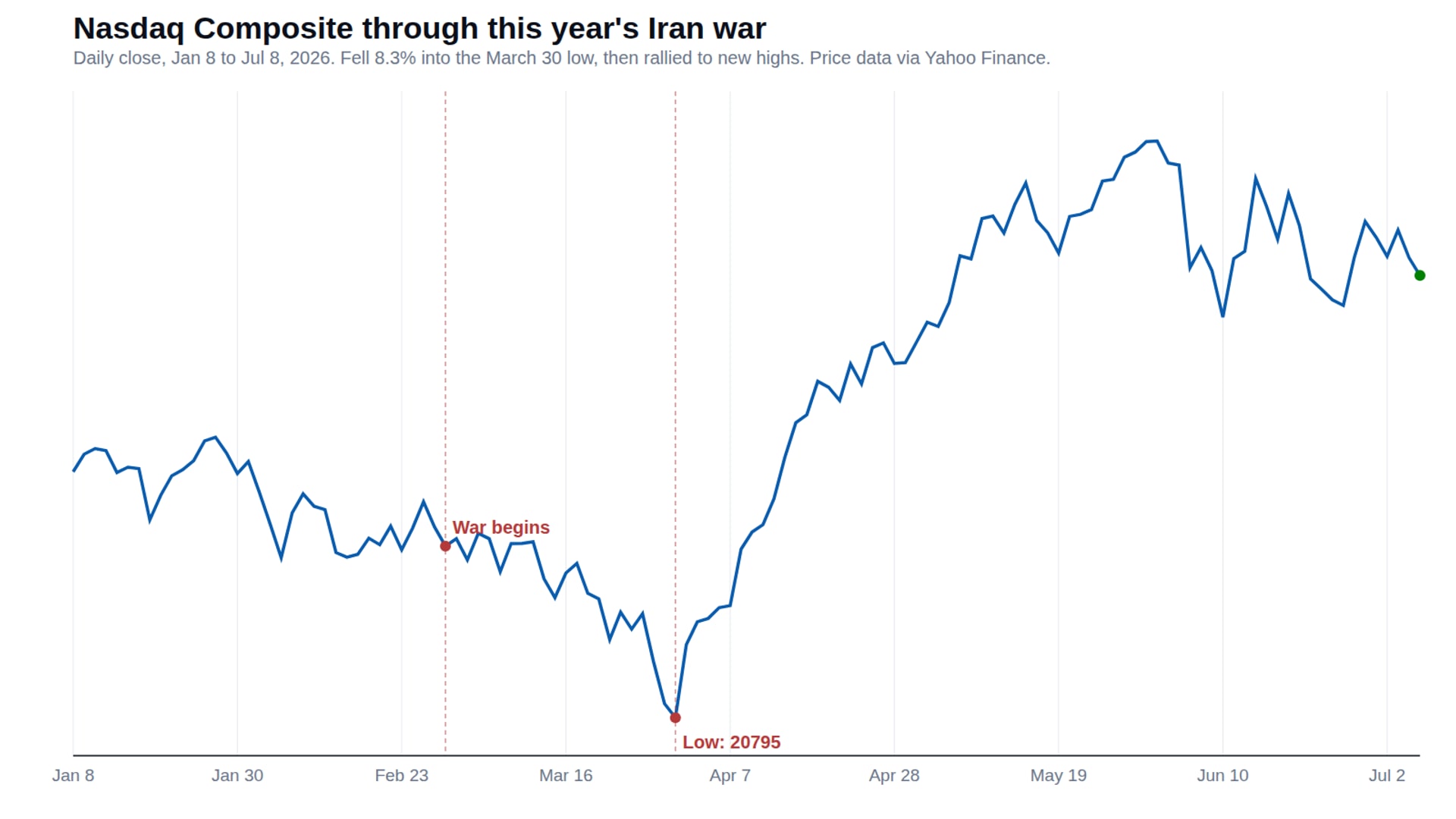
How markets have handled past war shocks
| Event | Date | Initial move | What happened next |
|---|---|---|---|
| Iraq invades Kuwait | Aug 1990 | Oil spiked and held | Stayed elevated for months; US economy tipped into recession. |
| Desert Storm launches | Jan 17, 1991 | S&P 500 up 3.7% same day | Oil crashed 33%. |
| 20+ shocks since (LPL Research) | various | About 1% average first-day move | About 7% worst-case drawdown, recovered inside 39 days on average. |
| This Iran war begins | Feb 27-28, 2026 | S&P down 10%, Nasdaq down 8.3% | Nasdaq at a fresh record by June 2; S&P back near highs in about 6 weeks per J.P. Morgan. |
The one exception
The pattern breaks only when oil supply is actually cut off, not just threatened. That happened in 1990: Iraq's invasion of Kuwait kept crude elevated for months and tipped the US into recession. Today, oil is up about 7%, with WTI crude near $75 a barrel and Brent near $80, still short of the roughly $120 Brent hit in March.
Gold is down about 2.5% today despite the escalation, the second straight day it hasn't reacted like a fear trade, following yesterday's strikes.
This is a live, developing military conflict. Oil is the number to watch from here. This is general market commentary, not investment advice.