Key points
- Stock futures are contracts that let traders bet on where an index like the S&P 500 or Nasdaq-100 is headed, and they trade almost 24 hours a day, five days a week.
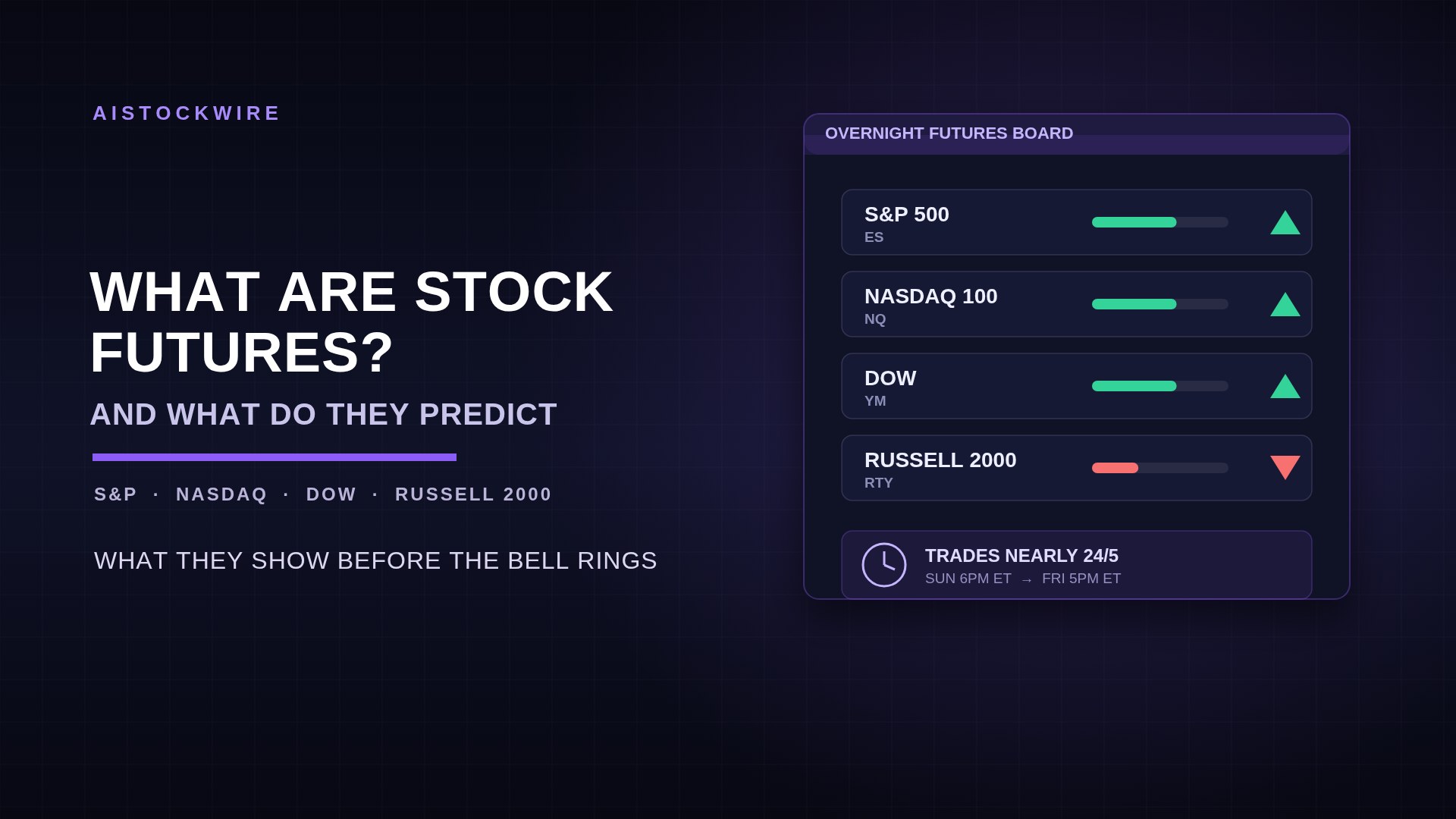
- The main ones, run by CME Group, cover the S&P 500 (ES), Nasdaq-100 (NQ), Dow and Russell 2000. They reopen at 6 p.m. ET Sunday and trade through Friday afternoon, with just a one-hour break each day.
- Nasdaq-100 futures swing harder than S&P futures because a small group of mega-cap tech stocks carries close to half the index's weight.
- Futures are a live sentiment read, not a promise. Overnight volume is thin, and a move can fade or flip completely by the opening bell.
Turn on any financial channel before 9:30 a.m. and someone is talking about where "futures" are pointing. Scroll to the bottom of nearly any page on this site and you will see the same numbers running in a band above the footer: S&P 500, Nasdaq 100, Dow, Russell 2000, gold, crude oil. Most people glance at that ticker without ever learning what it actually measures. Here is what a futures contract actually is, and how much it really tells you about tomorrow's open.
What a futures contract actually is
A futures contract is an agreement to buy or sell something at a set price on a future date. The idea started in agriculture, where a farmer and a buyer would lock in a wheat price months before harvest so neither side got blindsided by a bad season. Stock index futures apply that same logic to the market itself. Instead of wheat, the underlying asset is the value of an index like the S&P 500.
Almost nobody holds an index future all the way to its settlement date. Traders open a position, watch its value move tick by tick, then close it out or roll it into the next contract whenever they want. Gains and losses settle in cash every day, since there is no way to physically deliver 500 companies to a buyer. That cash settlement is also what makes futures a leverage tool. A trader puts up a deposit worth a fraction of the contract's full value, called margin, and controls the full-sized position on top of it. That amplifies both the upside and the downside, which is why futures are treated as a professional instrument rather than a casual one.
The four that matter, plus gold and crude
The futures behind those premarket headlines trade on the CME Group exchange, mostly the electronically traded "E-mini" versions. The S&P 500 future goes by the code ES. The Nasdaq-100 future is NQ. The Dow Jones Industrial Average future is YM, and the Russell 2000 small-cap future is RTY. Each carries its own dollar value per point: a one-point move in the standard S&P E-mini is worth $50, or $5 on the smaller Micro version that individual traders often use instead.
Those four, along with gold and crude oil futures, are the same six instruments tracked in the futures band on this site. They settle in cash on the third Friday of March, June, September and December, and most active traders roll their position into the next contract days before that date rather than let it expire.
Why the Nasdaq one moves harder
Ask a trader which future they watch closest during an earnings-heavy week and most will say NQ. The reason comes down to what is actually inside the Nasdaq-100. A small group of mega-cap technology names, including Nvidia, Apple and Microsoft, carries close to half the index's total weight. When one of those companies moves sharply on an earnings beat or a guidance cut, that single stock can drag the whole Nasdaq-100 future with it. The S&P 500 spreads its weight across 500 companies and eleven sectors, so a bad quarter from any one name barely dents it. That difference in concentration is the whole reason "tech futures" swing wider than the broader market on any given morning.
Trading nearly around the clock, but not quite
Index futures come closer to trading 24 hours a day than almost anything else in traditional finance. The CME's Sunday session opens at 6 p.m. ET and runs through Friday afternoon, pausing for a one-hour maintenance break each day between 5 and 6 p.m. ET. That schedule is why a headline out of Asia or Europe overnight shows up in futures prices hours before the New York opening bell.
What it does not do is trade on weekends. From Friday afternoon until Sunday evening, CME futures sit closed, and that gap is exactly what newer products are trying to fill. We covered one of them this Sunday and again over the July 4 holiday weekend: a platform called Trade[XYZ] runs 24/7 stock perpetuals that track index levels and individual names around the clock, on Hyperliquid, a crypto exchange that never closes. We explained how that setup works in an earlier piece. It is a genuinely useful early read on sentiment, and Trade[XYZ] holds an official S&P Dow Jones Indices license for its S&P 500 contract, but the volume behind it is a sliver of what trades on the real CME futures once they reopen. Treat a Saturday afternoon perpetuals snapshot as a hint, not as the number Monday's open will actually carry.
How "futures are up 200 points" becomes a market call
Financial media converts a futures move into an implied opening level using a concept called fair value: the theoretical price a future should sit at given the index's current level, prevailing interest rates and the dividends expected before expiration. When futures trade above fair value, traders expect the cash market to open higher. When they trade below it, the opposite. The gap between the two, known as the basis, tends to narrow toward zero as expiration approaches, since arbitrage traders step in to correct any big mispricing.
In practice, most people skip the fair value math and just watch the point move itself. "Dow futures down 200 points" is shorthand for the futures contract trading 200 points below its prior settlement, which analysts then translate into roughly how many points the actual Dow might open lower.
What futures actually predict, and where that breaks down
Futures are a genuinely useful real-time gauge of sentiment because they are the only place institutional money can react to news before the stock market physically opens. A strong jobs report at 8:30 a.m. shows up in futures within seconds. So does a surprise earnings warning that drops after the closing bell, the kind of report we break down here, or a rate decision out of Asia while New York sleeps. Most mornings, the direction futures point in the premarket is a fair preview of where the opening bell lands.
Most mornings is doing real work in that sentence. Overnight and premarket volume is a fraction of what trades during the regular session, so a move built on thin liquidity can evaporate once real buyers and sellers show up at 9:30. Algorithms dominate the after-hours tape, and a single large order can push a price further than actual supply and demand would justify. Headline risk does not stop at the opening bell either. A hotter than expected inflation print five minutes into the session, and the whole futures-implied open gets thrown out within minutes.
The bottom line
A stock future is a bet on where an index is headed, cash-settled and traded on margin. It also runs almost around the clock, five days a week. The S&P 500 and Nasdaq-100 versions get the most attention because they are the cleanest snapshot of how the broader market and the tech trade are feeling before the bell. Use them as a weather report, not a forecast you can bank on. They tell you which way the wind is blowing right now. They do not promise it will still be blowing that way by 9:30.
This is not investment advice. Trading futures involves leverage and can result in losses beyond your initial deposit. Do your own research before making any investment decision.