Key points
- Hyperliquid is a 24/7 exchange where you can trade “perps” on a select list of big-name stocks (think IBM, Tesla and Nvidia), plus oil and indexes, using USDC, a dollar stablecoin, instead of cash, even when Wall Street is closed.
- Even the overnight market shuts at 8 PM Friday, so until 8 PM Sunday a 24/7 venue like Hyperliquid is the main place to watch a weekend story build, until Blue Ocean reopens Sunday at 8 PM and the price catches up.
- The IBM (IBM) frenzy is the textbook case: an old Trump clip went viral on a Saturday, and IBM closed up 7.6% that Monday at $320.42, on its way to an all-time high near $332.
- It can be a useful early read on sentiment, but it is thin and hype-driven (the IBM clip was from 2025), so treat it as a signal, not gospel.
On the last weekend of May, a years-old video of President Trump calling IBM’s CEO a “legend” started ripping around X. By the time the stock market opened that Monday, IBM (IBM) had already gapped higher, on its way to a roughly 30 percent run that week and a fresh all-time high. Here is the strange part: you could have watched that move build over the weekend, while the New York Stock Exchange was dark, on a crypto exchange called Hyperliquid.
Weekend stock trading is quietly becoming a real thing, and once in a while it turns out to be a decent early read on where a stock opens Monday. Here is how it actually works, why 8 PM on Sunday is the moment that matters, and why you should not trust it too much.
What Hyperliquid actually is
Hyperliquid is a decentralized exchange that never closes. It runs 24 hours a day, seven days a week, and the thing people trade on it is the perpetual future, or “perp.” A perp is just a futures contract with no expiration date, so you never have to roll it over. You can go long or short, with leverage, and bet on the price going up or down.
The other key piece is what you trade with. You do not fund a Hyperliquid account with dollars from a bank. You fund it with USDC, a stablecoin, which is a crypto token designed to stay pinned to one US dollar. Your balance, your margin, and your profit and loss are all in these crypto-dollars, settled on-chain. That is a big reason the whole thing can run on a Sunday afternoon when banks and brokers are shut.
It started with crypto, but the menu has grown fast. Through markets built on Hyperliquid, like one called Trade.xyz, you can now trade perps tied to crude oil, gold, the S&P 500, the Nasdaq, and individual stocks like Tesla (TSLA), Nvidia (NVDA) and IBM. One important caveat, and it is the thing people get wrong: this is a curated list of big, liquid names, not the whole stock market. You will find Apple (AAPL), Microsoft (MSFT) and Palantir (PLTR), not some thinly traded small-cap. The S&P 500 even got its first officially licensed 24/7 perpetual earlier this year. Hyperliquid has gotten popular enough that the Wall Street Journal called it Wall Street’s go-to venue for weekend and after-hours trading.
How a stock trades when the stock market is closed
This is the part that sounds impossible. If the NYSE is closed, where does the price come from?
Two mechanisms do the work. First, a price oracle feeds the real stock price into the perp whenever the market is actually open, so during normal hours the perp just tracks the live stock. Second, a funding rate keeps it honest. Every so often, if the perp is trading above the reference price, the people betting it goes up (longs) pay a small fee to the people betting it goes down (shorts), and vice versa. That payment nudges traders to push the price back in line, so the perp cannot drift too far from the real thing.
On weekends, when there is no live stock price to point at, the system leans on an internal pricing mechanism and on plain old supply and demand from traders. That means the weekend price is partly real signal and partly a popularity contest. It can build a premium when a story catches fire, which is exactly what makes it interesting and exactly what makes it dangerous.
Why 8 PM Sunday is the moment that matters
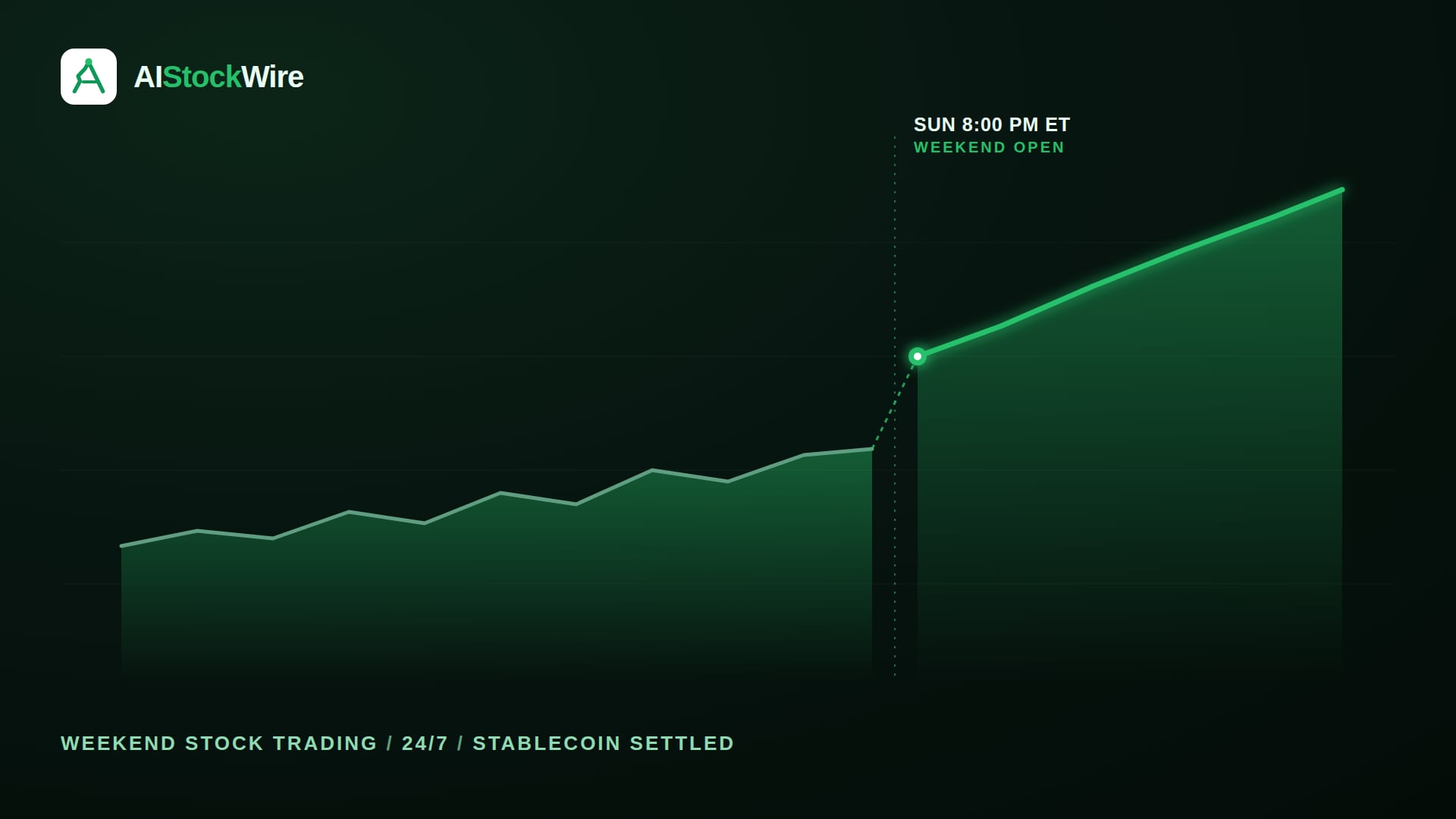
Here is the rhythm that makes the whole thing work, and it is the real point. The regular market closes Friday at 4 PM, and even the overnight 24-hour market shuts down at 8 PM Friday. From that moment until Sunday evening, the normal ways to trade a US stock are closed. A 24/7 venue like Hyperliquid is not. So if a story breaks on a Saturday, you can sit there and watch the perp climb, up and up, all through the weekend, while everyone on a normal broker is locked out and can only watch. Then comes the release valve: Blue Ocean ATS, the overnight US stock venue, reopens at 8 PM ET Sunday and trades until 4 AM, Sunday through Thursday. That Sunday 8 PM session is the very first place US stocks get a real, live price each week.
And you do not need a crypto exchange to use it. Mainstream brokers like Robinhood, Webull and Charles Schwab now plug into that same Blue Ocean session and offer 24-hour trading, 8 PM Sunday to 8 PM Friday, on the big, most-popular stocks and ETFs, with limit orders. So a regular investor can buy or sell a name like IBM (IBM) or Tesla at 8 PM on a Sunday from a normal brokerage app. Where Hyperliquid stands apart is the actual weekend: Blue Ocean and the brokers are closed from Friday evening until 8 PM Sunday, while Hyperliquid keeps trading right through Saturday and Sunday, with leverage and a wider menu of oil, indexes and pre-IPO names on top.
That 8 PM Sunday open is a big deal for the weekend traders, because those overnight prices flow into the data oracles that on-chain markets rely on. So when Blue Ocean lights up at 8 PM Sunday, the perp suddenly has a fresh, real-world reference again. If a stock ran up all weekend on a story, and the overnight session agrees and reprices it higher, the perp can jump right then, a full thirteen and a half hours before the regular 9:30 AM open. That is the “it went up even more at 8 PM” moment.
The IBM weekend, start to finish
Put it all together and you get the IBM story from the weekend of May 30 and 31. A clip of Trump praising IBM CEO Arvind Krishna as a “legend” went viral on X that Saturday. One post claimed the president was “calling” the stock at $297 and pulled in about 3.7 million views before Community Notes pointed out the obvious problem: the footage was from December 2025. It was an old interview, not breaking news.
Did not matter, at least not at first. IBM had already jumped about 13 percent that Friday to close near $298, right around the $297 the post kept waving around. Then the brokers shut at 8 PM Friday. Over Saturday and Sunday, with no normal venue open, the IBM perp on Hyperliquid kept grinding higher as the clip spread. When Blue Ocean reopened at 8 PM Sunday the overnight session confirmed the move, and by Monday’s 9:30 open IBM was around $322. It ran to almost $328 and closed up 7.6 percent at $320.42. Two more catalysts landed right behind the video, a Barclays analyst starting coverage with a $350 price target and IBM announcing a $10 billion plan for quantum computing, so the run had real substance under it too. The stock went on to an all-time high around $332 in early June.
If you were watching Hyperliquid, you saw the sentiment turn before almost anyone trading through a normal brokerage could act on it. That is the appeal in one sentence: a real-time read on what the weekend crowd thinks a stock is worth, hours or days before Wall Street weighs in.
So is it actually a good indicator?
Sometimes, and that word is doing a lot of work. There are real cases where these 24/7 markets front-ran the news. When Trump announced strikes on Iran on a Saturday back in February, one trader was already long oil on Hyperliquid and rode the move for a gain of up to 243 percent, something he could not have done waiting for futures to reopen. TD Securities figured the platform had priced in about 80 percent of one oil move before traditional exchanges even opened. We saw the same weekend-pricing dynamic play out with crude in our piece on the Iran weekend and Monday’s open, and it is the same reason Hyperliquid became the hot venue for trading pre-IPO names like SpaceX, which we covered in our rundown of the space stocks.
But the honest answer is that it is a noisy signal, not a crystal ball. Weekend liquidity is thin, so it does not take much money to shove a price around. The moves can be driven by pure hype, and the IBM case is the perfect warning: the spark was a recycled video dressed up as fresh news. The funding mechanics can distort short bursts, and a perp that overshoots on a Saturday can just as easily mean-revert by Tuesday. It is a useful early read on mood and on genuine weekend news. It is not a promise about Monday.
The bottom line: Hyperliquid and the overnight session have turned the weekend from a blackout into a live feed of market sentiment, settled in stablecoins and open to anyone. That is genuinely new and worth watching, especially when real news breaks on a Saturday. Just remember that an 8 PM Sunday pop is a crowd’s opinion, not a fact, and crowds get loud over old videos.
Nothing here is investment advice. Perpetual futures use leverage and can be liquidated, weekend and overnight markets are thin and volatile, and stablecoins and crypto venues carry their own risks. Do your own research.
Cover: AIStockWire illustration.
This is general market commentary and opinion, not investment advice. Markets can go down as well as up, and you can lose money. Always do your own research and consider speaking with a licensed financial professional before making any investment decision.