Key points
- Four things in an earnings report matter most: revenue, earnings per share (EPS), profit margins, and the company's guidance for what comes next.
- A "beat" means the company topped Wall Street's estimate, but a stock can still fall on a beat if expectations were sky-high. Micron beat by about 24% on June 24, 2026, hit a record high the very next day, then fell back within a week as the whole chip sector sold off.
- Valuation ratios like the P/E show how much you pay for those earnings. There is no single "good" number: a high P/E can be fair for a fast grower, and a low one can be a warning.
I spend a lot of my time digging through filings to see what other people own. The other place a company shows its hand is the earnings report it puts out every three months. It can look like a wall of numbers and jargon. Once you know which lines to read, though, it tells a clear story. Is this business growing, is it actually making money, and is the stock a fair price for it? Here is how to read one without an accounting degree.
Start with the top line: revenue
Revenue, also called sales or the "top line," is all the money a company brought in during the quarter. It sits at the top of the report, which is where the nickname comes from. The first thing to check is growth. Compare revenue to the same quarter a year earlier, not to last quarter. That is year-over-year growth, and it matters because many businesses are seasonal. A retailer always sells more in the holiday quarter, so comparing winter to fall would fool you.
What counts as good depends entirely on the company, and this is where a lot of beginners get tripped up by headlines. A 5 percent revenue gain sounds small, but for a mature bank or a big food maker, that might be a genuinely strong year. A fast-growing chipmaker posting the same 5 percent would be a red flag. So skip the search for a universal "good" number. Measure a company against its own recent history and against its closest competitors instead. If you only remember one habit from this whole guide, make it that one.
Then the bottom line: earnings per share
If revenue is the money coming in, earnings are what is left after the company pays its costs. Earnings per share, or EPS, is that profit divided by the number of shares. It is called the bottom line because it sits near the bottom of the statement. EPS is the single most-watched number in an earnings report.
One catch trips up beginners. Companies often report two versions, GAAP and adjusted (sometimes called non-GAAP). GAAP follows strict accounting rules. Adjusted earnings strip out costs the company calls one-time, like a big legal settlement or stock paid to employees. Adjusted numbers are not fake, but they always look rosier, because the company decides what to remove. When the gap between the two is large, it is worth asking what got left out.
The words that move stocks: beat, miss, and guidance
Before a company reports, Wall Street analysts publish estimates for its revenue and EPS. The average of those is the consensus. When the actual numbers come in higher, the company "beat." Lower, and it "missed." That comparison, not the raw number, is what usually moves the stock in the first minutes after a report.
Then there is guidance: the company's own forecast for the next quarter or year. This is the part newer investors tend to skip, and it is often the part that matters most. A company can beat on the quarter that just ended and still get crushed if management warns the next one looks softer. Why? Because the stock price was never really about last quarter. It was already betting on this quarter, and now it needs a new story about the one after that.
Margins show how healthy the business is
Two companies can both grow sales and still be in very different health. Margins tell you which is which. A margin is simply profit as a percentage of revenue. Gross margin is what is left after the direct cost of making the product. Operating margin also subtracts the cost of running the business. Net margin is what finally reaches the bottom line.
Higher is generally better. Rising margins usually mean a company has pricing power or is getting more efficient at what it does, while falling margins can be an early warning sign even in a quarter where sales still look fine. But don't grade every company against the same bar. A software company can run gross margins above 70 percent because it costs almost nothing to sell one more copy of its product. A grocery chain might run margins in the low single digits and still be a perfectly healthy business, because that is just how thin the grocery business runs everywhere. Once you've read a few reports in the same industry, you'll start to sense what's normal there without needing to look it up.
Cash is king
Reported profit is an accounting figure, and it can be shaped by choices about how to count things. Free cash flow is harder to dress up. It is the real cash a business generates after paying to run and maintain itself. A company with strong, steady free cash flow has options. It can pay a dividend, buy back shares, pay down debt, or reinvest in growth.
Two terms show up here. A dividend is a cash payment to shareholders. A buyback is when a company purchases its own stock, which nudges EPS up by spreading profit over fewer shares. Both return money to owners. Just check that the company can afford them out of its cash flow rather than by borrowing.
Cheap or expensive? Valuation in plain terms
Good numbers do not automatically make a good investment. You also have to ask what you are paying for them. The most common yardstick is the price-to-earnings ratio, or P/E. Take the share price and divide by annual earnings per share. A P/E of 20 means you are paying 20 dollars for every dollar of yearly profit.
Here is the part that confuses almost everyone starting out: there is no magic "good" P/E. A fast grower can deserve a high one, because its earnings may be far larger in a few years, while a cheap-looking P/E can actually be a trap if the business behind it is shrinking. Start simple. Just get comfortable comparing a company's P/E to its own history and to its closest competitors, the same habit as with revenue.
Once that feels natural, two upgrades are worth learning. Forward P/E swaps in analysts' expected future earnings instead of the trailing twelve months, which suits a company whose business is changing fast. The PEG ratio goes a step further and divides the P/E by the growth rate, so a P/E of 40 on a company growing earnings 40 percent a year suddenly looks a lot more reasonable than the raw number implied. And for young companies that aren't profitable yet, there is no P/E to even calculate, so investors lean on price-to-sales instead. You don't need all four on day one. P/E alone will get you most of the way there.
A quick real example
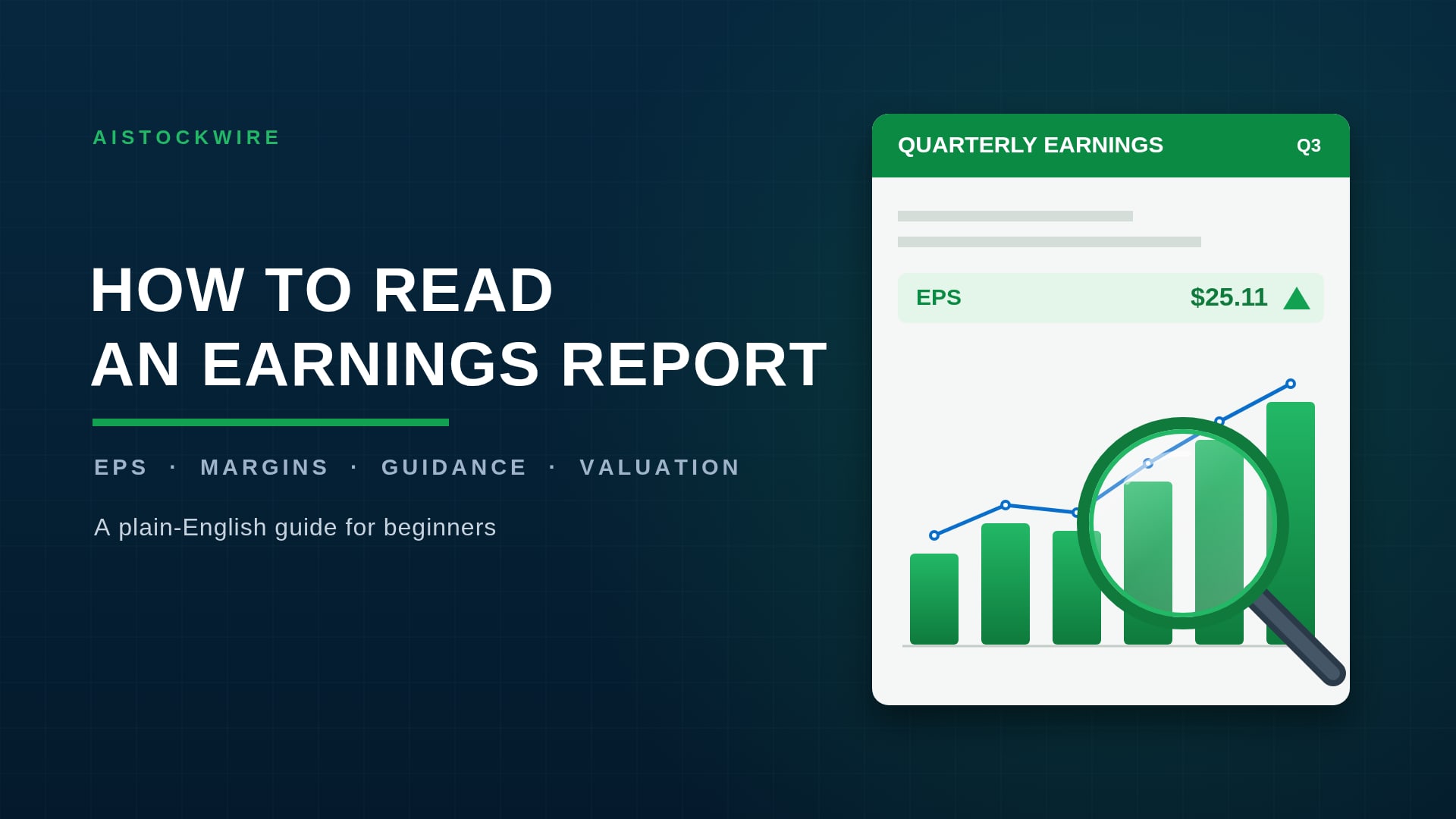
Put it together with a real report. When Micron (MU) reported on June 24, 2026, analysts expected about 20.20 dollars in earnings per share. Micron delivered 25.11. That is a beat of roughly 24 percent, a genuinely strong quarter for the memory-chip maker.
Now the twist that teaches the whole lesson. The day after the report, Micron touched a record high near 1,255 dollars. About a week later it had fallen back to around 976 as the whole chip sector sold off, on fears that AI computing was being built out faster than customers could use it. A blowout quarter did not protect the stock. It had already climbed roughly 300 percent in six months, so plenty of good news was priced in, and a shift in the mood of the entire sector mattered more than one company's results.
One more piece ties in valuation. Add up Micron's last four quarters of earnings and you get about 45 dollars per share. At a price near 976, that is a P/E of about 22. For a company whose profits were still growing quickly, that is not a wild price, which is part of why some investors kept liking it even after the drop.
Reading a single quarter is one piece of a bigger picture. If you want to see what a full write-up on one company looks like start to finish, this stock analysis report example walks through the whole thing.
Putting it together
You do not need to read all 60 pages of a filing. If you are just starting out, pick two questions and only two: is revenue growing, and did EPS beat or miss? That alone will put you ahead of most people who only read the headline. Once those feel automatic, layer in the rest. What does guidance say about next quarter? Are margins holding up or slipping? Is the stock a fair price for all of it? You don't have to do this all at once, and honestly, I still skip some of these depending on what I'm looking at.
The more reports you sit through, the faster the pattern-matching gets. You start to notice when a "beat" is really a company clearing a bar it quietly lowered a few months earlier, or when a scary-looking headline is hiding a business that's actually fine underneath. Catching that difference is genuinely the fun part for me, and it gets easier faster than people expect.
This is not investment advice. It is a guide to reading the numbers so you can make up your own mind. If you want to practice, our earnings calendar shows which companies report next.