Key points
- A neocloud is a company built almost entirely around one job: buying Nvidia GPUs and renting out the computing power, unlike Amazon, Microsoft, or Google, which sell hundreds of different cloud services.
- The business runs on debt. Neoclouds borrow against multi-year contracts to buy hardware, then race to collect revenue before the GPUs lose value.
- CoreWeave (CRWV), Nebius (NBIS), and IREN are the three public names investors watch most, and each got there a different way.
- The risk is concentration: Microsoft and Meta alone account for a huge share of the industry's contracted revenue, which is exactly what crashed CRWV and NBIS on July 1, 2026.
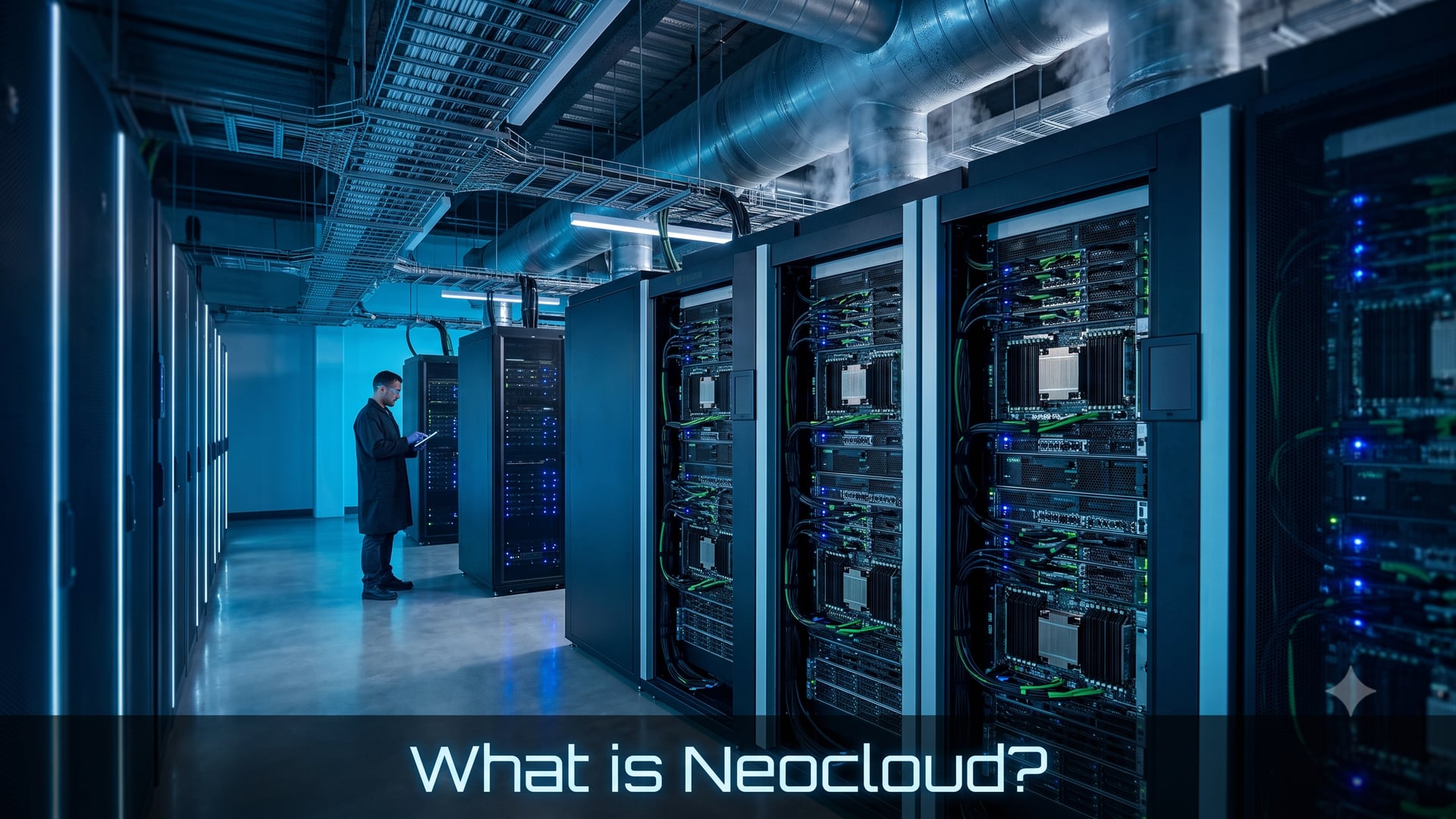
Cover image: AI-generated illustration of a data center, not an actual photo.
There is something genuinely fun about a word that shows up in half the filings I read and gets defined in exactly none of them. "Neocloud" is one of those words. It sounds like jargon because it is jargon, but the idea underneath it is simple, and it explains why hedge funds keep piling into stocks most people have never heard of. Here is what a neocloud actually is, how the business works, and why it comes with more risk than the word "cloud" makes it sound like.
Why is it even called a "neocloud"?
Break the word apart and it stops being mysterious. "Neo" is just Greek for new. A neocloud is a new cloud provider, full stop, arriving decades after Amazon Web Services, Microsoft Azure, and Google Cloud already owned the category. The term itself is barely older than this site: it started catching on in late 2024 as GPU-only providers multiplied, and nobody can point to a single person or article that coined it first. I've seen one theory that it's a nod to Neo from The Matrix, the new arrival who breaks into a system everyone thought was locked down. Cute story, impossible to verify, so file it under fun rather than fact.
What makes a neocloud different from AWS or Google Cloud
A neocloud does one thing: buy the newest Nvidia GPUs, wire them into a data center, and rent out that raw computing power. AWS, Azure, and Google Cloud do that too, but only as one line item among dozens built up over two decades, storage, databases, security, email, and everything else. Specializing lets a neocloud turn a GPU order into working capacity while a hyperscaler is still routing the request through its own systems.
How the business actually works
A neocloud buys GPU servers, mostly with borrowed money, then signs customers to multi-year contracts that lock in a fixed slice of capacity at a fixed price. Many of these are take-or-pay deals: the customer pays whether it uses the capacity or not. That contracted revenue becomes the collateral. The neocloud borrows against it, pledging the GPUs themselves too, to fund the next round of hardware, and the whole arrangement only holds up if growth stays ahead of the debt payments.
Lenders have gotten more comfortable with the model fast. CoreWeave's own borrowing costs show the shift:
| CoreWeave GPU-backed loan | Amount | Rate | Rating |
|---|---|---|---|
| 2023 (first deal) | $2.3B | About 15% | Unrated |
| March 2026 ("DDTL 4.0") | $8.5B | About 6% (SOFR + 2.25%) | Investment-grade, a first for this type of loan |
Why would a hyperscaler rent instead of building more of its own capacity? It's the same reason a company leases a car instead of buying one: the payments spread out as an operating expense instead of landing on the balance sheet all at once as years of capital spending. Speed is the other half of it. Standing up a new data center takes a company 18 to 30 months, while a neocloud, already holding the space and the hardware, can have a customer running in weeks.
The three names investors actually watch
Three public neoclouds come up constantly in AI stock coverage, and no two got there the same way:
| Company | Started out as | Headline deal | Scale |
|---|---|---|---|
| CoreWeave (CRWV) | Crypto-mining outfit turned Nvidia-aligned GPU cloud | Expanded Meta contract, April 2026 | $99.4B backlog, about 19x 2025 revenue |
| Nebius (NBIS) | Yandex's internal cloud and AI unit | Meta agreement, March 2026 | Up to $27B |
| IREN | Bitcoin miner (Iris Energy) | Microsoft GPU supply deal, November 2025 | $9.7B over five years |
What ties them together matters more than how each one started: all three are betting the balance sheet that a small list of customers keeps renewing and expanding, not shrinking. Nebius is the one worth a second look for the strangest reason: its predecessor was Russia's largest tech company, spun out into an Amsterdam-based AI infrastructure business only after Yandex's Nasdaq shares were suspended in 2022 and its parent sold the Russian operations in 2024.
The risk built into the model
A neocloud's business rests on a handful of very large customers renewing and expanding what they've already signed. Microsoft has committed roughly $60 billion combined across CoreWeave, Nebius, and other private neoclouds. Meta alone accounts for close to $35 billion of CoreWeave's backlog and up to $27 billion of Nebius's. A landlord that dependent on one or two tenants gets nervous fast if a tenant so much as hints at building its own space.
That's what happened on July 1, 2026. Bloomberg reported Meta was exploring a cloud business to resell its own excess AI computing capacity, which would mean Meta eventually renting less from the neoclouds it uses today. CoreWeave fell 13.9% that day, Nebius dropped 17% and lost about $12 billion in market value in a single session. We covered the crash as it happened, and a week later covered Meta breaking ground on a $9 billion Canadian data center, a move that reopened the exact question it had seemed to answer.
A second risk gets less attention. Some of this growth is financed in a loop: Nvidia sells the GPUs, and in some cases also invests in or helps finance the same neocloud customers buying them. That doesn't make the underlying AI demand fake, but it's part of why analysts keep asking how much of the neocloud boom reflects real end demand and how much is Nvidia recycling its own capital to keep the story going.
None of that has slowed the money pouring in, not yet anyway. Synergy Research puts 2025 neocloud revenue above $25 billion and expects it near $180 billion by 2030, a forecast worth treating as exactly that: a forecast, in an industry with a habit of moving faster or slower than anyone predicted. It's also why hedge fund 13F filings keep showing fresh stakes in this corner of the market, which is really the whole reason I went looking for a plain definition of "neocloud" in the first place.
Related coverage
See CoreWeave, Nebius, and IREN filings on our CRWV, NBIS, and IREN pages, or read about their Nasdaq-100 debut.
This is general market commentary and opinion, not investment advice. Markets can go down as well as up, and you can lose money. Always do your own research and consider speaking with a licensed financial professional before making any investment decision.