Key points
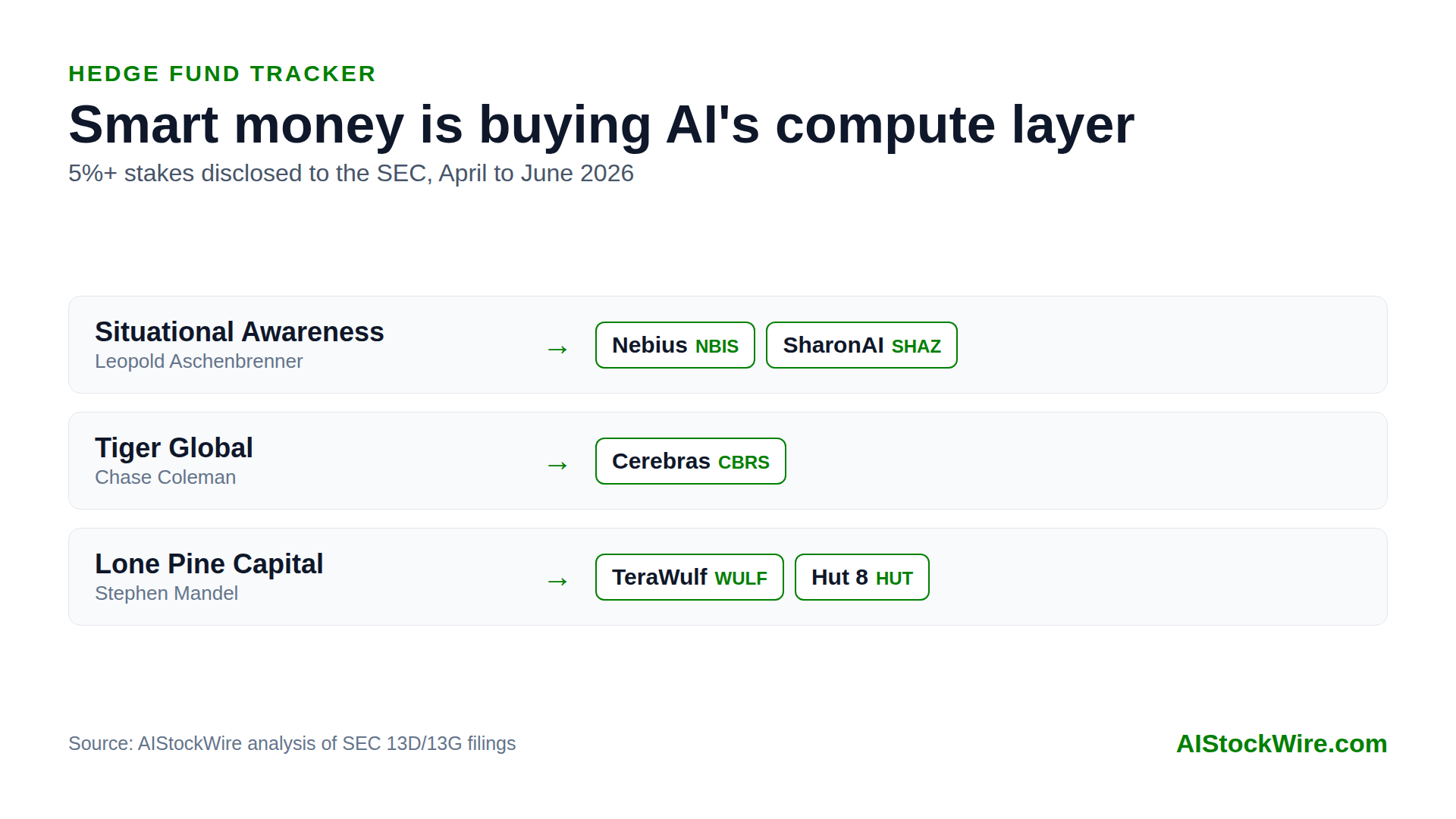
- Several closely watched funds disclosed 5%+ stakes in AI "compute" companies over the past 10 weeks, according to SEC filings.
- Leopold Aschenbrenner's Situational Awareness bought into neoclouds Nebius (NBIS) and SharonAI (SHAZ); Tiger Global took a 5%+ stake in AI chipmaker Cerebras (CBRS).
- Lone Pine added crypto miners turned AI-data-center operators TeraWulf (WULF) and Hut 8 (HUT).
- These are lagged disclosures of speculative, mostly unprofitable companies, not a green light, and Aschenbrenner is at the same time betting against the big chipmakers.
Over the past few weeks, some of the most closely watched investors on Wall Street have been quietly building positions in one specific corner of the AI trade: the companies that supply raw computing power. Not the famous chip designers, but the "neoclouds" that rent out graphics processors, a freshly public chip challenger, and crypto miners reinventing themselves as AI data centers. You can see it in their SEC filings, and it points to where the smart money thinks the next leg of the AI build-out is headed.
What the filings show
The clearest signal comes from Leopold Aschenbrenner's Situational Awareness, the roughly $13 billion fund run by the former OpenAI researcher. It disclosed a 5 percent-plus stake in Nebius (NBIS) on May 27 and a new stake in SharonAI (SHAZ) on June 29, both of them neoclouds. Tiger Global, the big technology investor, reported a 5%-plus stake in Cerebras (CBRS) on May 22, the AI chipmaker that had just gone public. And Lone Pine Capital built positions in TeraWulf (WULF) and Hut 8 (HUT), two former bitcoin miners now pivoting to AI computing.
What makes these more interesting than a normal quarterly portfolio update is the type of filing. A fund must file a Schedule 13D or 13G within days of crossing a 5 percent ownership stake in a company, so these are far more timely than the 13F reports that come out once a quarter with a 45-day delay. They are about as close to a real-time read on a big fund's conviction as the rules allow. You can see each fund's filings as they land on our hedge fund tracker.
What a "neocloud" is, and why it matters
A neocloud is a company that buys huge quantities of AI chips, mostly Nvidia's, wires them into data centers, and rents that computing power to anyone training or running AI models. Think of them as the landlords of the AI boom. As demand for AI compute has outrun supply, these middlemen have become some of the fastest-growing companies in technology. CoreWeave is the best-known example, and we mapped where they fit in our look at the neoclouds.
Nebius is one of the larger independent players. SharonAI is a newer, Australian name that recently raised $1.6 billion and signed a multiyear deal with Nvidia for up to 40,000 of its newest GB300 chips. For a fund that believes AI demand keeps climbing, owning the landlords is a way to bet on the build-out without picking which AI model wins.
The Cerebras bet
Tiger Global's target is different. Cerebras (CBRS) makes wafer-scale chips, single pieces of silicon far larger than a normal processor, designed to train and run AI models faster than Nvidia's GPUs in certain tasks. It is one of the few credible challengers to Nvidia, and its customers reportedly include OpenAI, Amazon and Meta. Cerebras went public on May 14 at $185 a share, jumped 68 percent on its first day, and was briefly valued near $95 billion. Tiger crossing the 5 percent mark so soon after the IPO is a clear vote for an Nvidia alternative.
The miners turning into data centers
Lone Pine's picks round out the theme. TeraWulf (WULF) and Hut 8 (HUT) started as bitcoin miners, which means they already own the two things an AI data center needs most: cheap power contracts and the physical sites to house servers. Both are now converting capacity to lease to AI and high-performance-computing customers. It is the same reinvention we covered with the ex-miners chasing AI, and clearly a trade Lone Pine wants exposure to.
The catch
A few cautions keep this honest. First, even 13D and 13G filings are not live trades, and they only tell you a fund crossed 5 percent, not its full position or its cost. Second, most of these companies are speculative and unprofitable. SharonAI, for instance, is guiding to heavy losses as it spends to build out. The former miners are volatile and tied to both bitcoin and AI sentiment.
Third, and most telling, the smart money is not simply long this trade. In the same period, Aschenbrenner's fund built large bearish put positions against the big chipmakers, including Nvidia (NVDA), Broadcom (AVGO) and Oracle (ORCL), which you can see on his fund page. In other words, he is betting on the companies that rent out AI computing while betting against some of the companies that sell the chips. That is a nuanced, hedged view, not a wholesale "buy AI" call, and it is worth remembering before reading too much into any single stake.
Bottom line
Three respected funds, in the space of about 10 weeks, all reached for the same shelf: the compute layer of AI, through neoclouds, a chip challenger, and miners turned data centers. It is a genuine signal about where experienced investors see durable demand. It is also a reminder that these are early, risky companies, and that following 13F and 13G filings means you are always a step behind the people making the trades. The value is in spotting the pattern, then doing your own homework, which you can start with our hedge fund tracker.
This article is for information only and is not investment advice. Always do your own research before buying any stock.