Key points
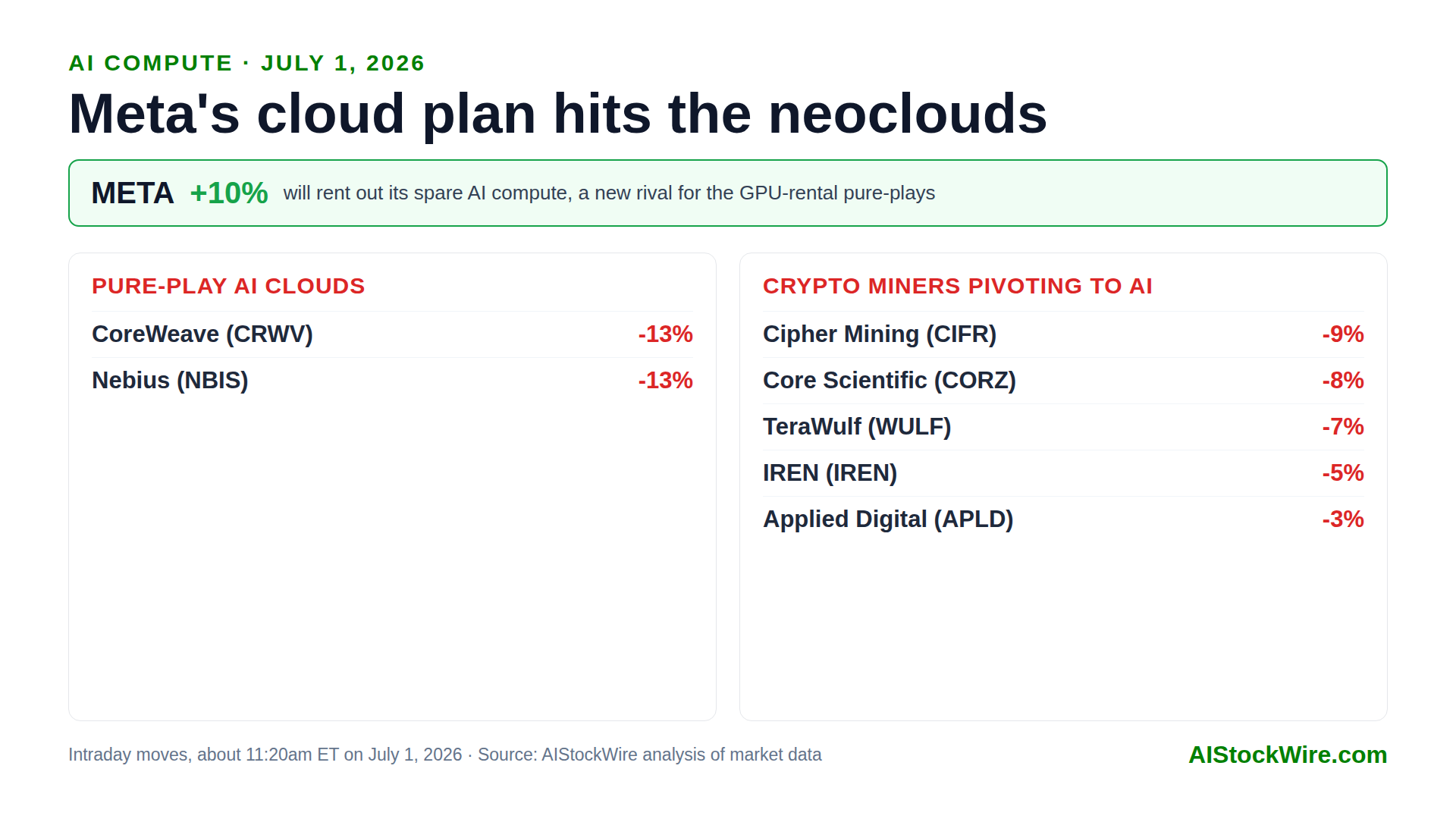
- The neoclouds sold off hard on July 1, 2026 after Meta (META) said it will rent out its spare AI computing power. CoreWeave (CRWV) and Nebius (NBIS) each fell about 13%.
- The read is simple: a company Meta's size renting out GPUs is a giant new competitor for the companies whose entire business is renting out GPUs.
- The former bitcoin miners that pivoted to AI hosting fell too: Cipher (CIFR) about 9%, Core Scientific (CORZ) about 8%, TeraWulf (WULF) about 7%.
- Same news, opposite reactions. META rose about 10% for the exact reason the neoclouds dropped.
This morning had a clean before-and-after. Meta (META) is up about 10 percent on a report that it will start renting out its spare AI computing power to outside companies. That was great news for Meta. It was rough news for the neoclouds, the smaller companies whose whole reason for existing is renting out that same kind of computing power. They are down hard while Meta celebrates.
We wrote earlier about the rotation out of chips and into software, and Meta's cloud plan was the spark. This is the other side of that story: who gets hurt when a giant muscles into their business.
What Meta actually said
Bloomberg reported that Meta is building a cloud business to sell its spare AI computing power to outside customers, the same model Amazon runs with AWS and Microsoft runs with Azure. Meta has guided to $125 billion to $145 billion of capital spending in 2026, most of it on AI data centers, which is close to double what it spent in 2025. Turning that hardware into a product it can rent out helps pay for the buildout. This is not out of nowhere: at Meta's shareholder meeting in May, Mark Zuckerberg said moving into cloud was on the table, noting that companies were approaching Meta almost every week to buy access to its AI models or spare computing power. For Meta, the market loved it. For anyone already in the business of renting GPUs, it landed very differently.
Why it hits the neoclouds
A neocloud is a company that buys huge numbers of Nvidia (NVDA) chips, builds data centers around them, and rents that computing power to AI labs and companies that do not want to build their own. CoreWeave (CRWV) and Nebius (NBIS) are the two best-known public names, and we have covered how they climbed into the Nasdaq-100.
The whole model rests on one idea: AI computing is scarce and expensive, so whoever owns the chips can rent them out at a good price. Now picture a company worth more than $1.5 trillion, with its own enormous fleet of chips and a much cheaper cost of borrowing, deciding to rent out the parts it is not using. That is more supply hitting the market and a deep-pocketed new competitor at the same time. Traders did the math fast, and it was not kind to the pure-plays.
The scoreboard
Here is where the group stood when we pulled these prices, at about 11:20am ET. Notice how much harder these names fell than the chips themselves. Nvidia was down only about 2 percent, so this was not just the semiconductor selloff spilling over. It was a reaction aimed at this group specifically.
| Company | Ticker | Move | Price |
|---|---|---|---|
| CoreWeave | CRWV | about -13% | $86.80 |
| Nebius | NBIS | about -13% | $240 |
| Cipher Mining | CIFR | about -9% | $22.40 |
| Core Scientific | CORZ | about -8% | $23.60 |
| TeraWulf | WULF | about -7% | $22.95 |
| IREN | IREN | about -5% | $43.30 |
| Applied Digital | APLD | about -3% | $36.25 |
Five of these names, IREN, Cipher, Core Scientific, TeraWulf and Applied Digital, came out of the bitcoin-mining and crypto-hosting world and are building AI computing businesses on the side. Only CoreWeave and Nebius are true pure-play neoclouds, but the whole group trades together now, so they fell together.
The other side of the trade
Before writing the neoclouds off, it is worth hearing the pushback. These companies are largely sold out. CoreWeave and its peers have signed multi-year contracts with names like Microsoft and OpenAI, and demand for AI computing still runs well ahead of supply. Meta renting out spare capacity is not the same as Meta building dedicated data centers to compete head-on, and its first customers may not overlap much with who the neoclouds serve. On that view, a 13 percent drop in a day looks more like a sentiment shock than a change in the actual business. Fear-driven selloffs in high-priced AI names can reverse just as fast as they arrive.
The hedge-fund angle
This is also a theme some sharp investors are playing carefully. Leopold Aschenbrenner's Situational Awareness fund is bullish on AI computing capacity, holding names like SharonAI (SHAZ) and HIVE Digital, but it pairs those bets with large put positions against chip stocks. That barbell says something useful here: you can believe AI compute demand is real and still think individual names are priced for perfection. You can follow those filings on our hedge fund tracker.
Why it matters
The neocloud trade just picked up a risk it did not have to think about a week ago: competition from the hyperscalers themselves. If Amazon, Microsoft and now Meta are all renting out compute, the pure-plays have to prove they can win on price, speed or specialization against companies that print cash. That does not make them bad businesses. It makes the story more complicated, and today the market priced in the complication all at once.
Bottom line
One announcement, two reactions. Meta jumped because renting out spare compute turns its giant AI bill into a revenue line. The neoclouds fell because that same move drops a huge new rival into their lane. Watch whether this was a one-day fear trade or the start of a real re-rating, because the answer decides whether today was a dip or a warning.
This article is for information only and is not investment advice. Prices are intraday and approximate, captured at about 11:20am ET on July 1, 2026, and will change. Always do your own research before buying any stock.