Key points
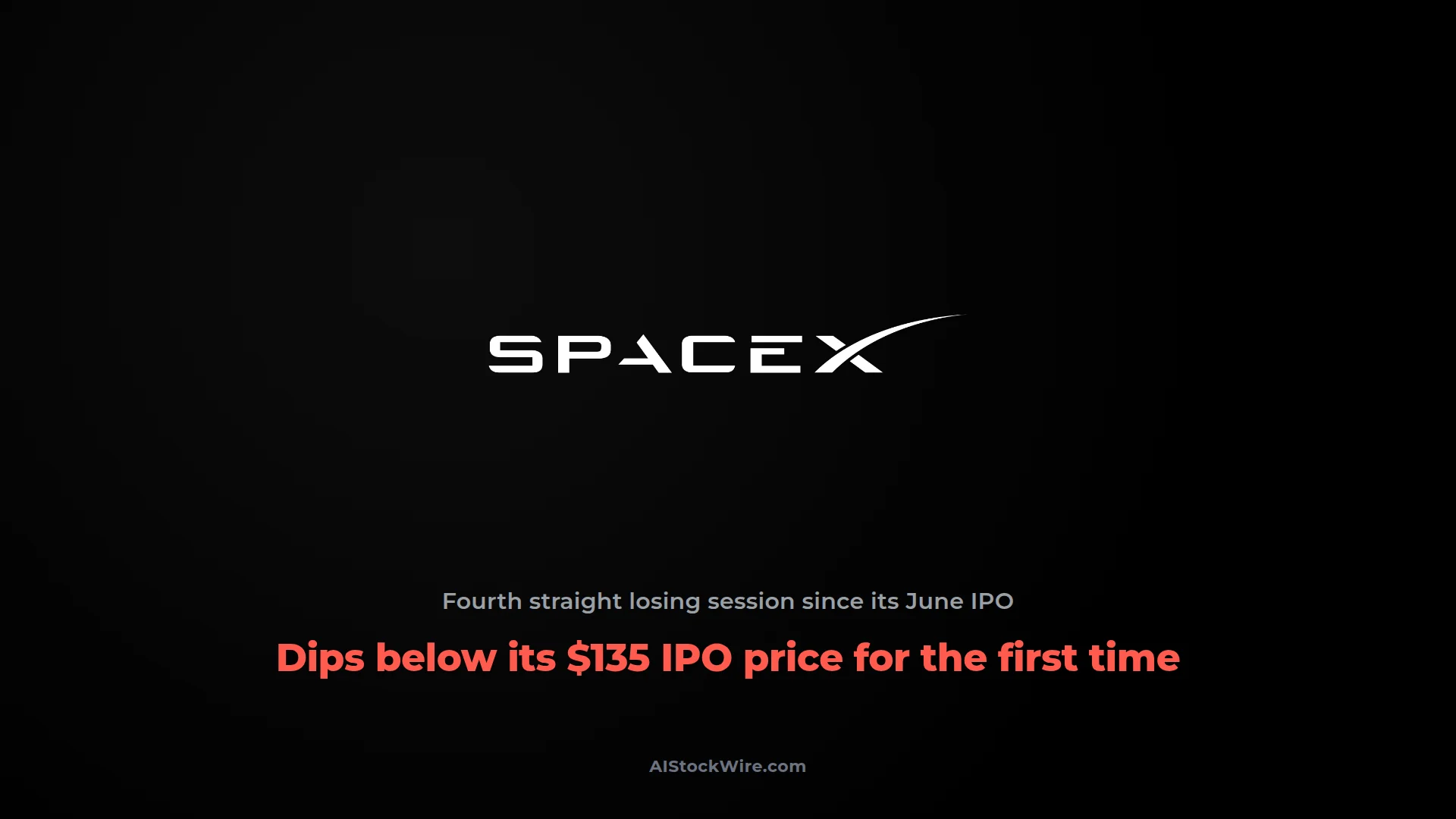
- SpaceX (SPCX) fell as low as around $132 Wednesday, briefly trading below its $135 IPO price for the first time, before closing at $135.27, just 27 cents above the IPO price.
- The $1.77 trillion IPO valuation works out to about 95 times 2025 revenue, or 59 times the high end of 2026 revenue estimates.
- SpaceX posted a GAAP net loss of $4.94 billion in 2025, so there is no real price-to-earnings ratio behind the valuation at all.
- Morningstar pegged fair value at $780 billion before the IPO even priced, less than half the IPO target.
- The S&P 500, Nasdaq and Dow all closed higher Wednesday, while memory chip stocks reversed hard after Tuesday's spike.
SpaceX (SPCX) briefly traded below its $135 IPO price on Wednesday for the first time since the rocket company went public last month, before closing at $135.27, just 27 cents above it. The broader market had a calm, green day: Apple hit a fresh record high, and memory chip stocks gave back some of Tuesday's spike. But the SpaceX move is the one worth sitting with, because on the numbers, a full close below IPO price looks like a matter of time, not a maybe.
The math never worked
SpaceX priced its IPO at a $1.77 trillion valuation on June 12 and surged on debut day, touching a market cap near $2.1 trillion, within striking distance of Amazon. That's against 2025 revenue of $18.7 billion, up 43% from $13.1 billion the year before. It prices the IPO at about 95 times revenue, or 59 times the high end of Wall Street's roughly $30 billion 2026 estimate. At the $2.1 trillion debut-day peak, those multiples run to about 112 times and 70 times. And that is all against revenue, not earnings, because there are none: SpaceX posted a GAAP net loss of $4.94 billion in 2025, an EPS of negative $1.69, even with a positive $6.6 billion in adjusted EBITDA. A normal price-to-earnings ratio does not apply to a company with no earnings to divide by. Real revenue multiples in the 60-to-110 range, on a business that lost money on paper, is the whole story behind Wednesday's close.
Morningstar made the same argument before the IPO even priced, valuing SpaceX at $780 billion, less than half the IPO target and less than 40 cents on the dollar of Wednesday's debut-day peak.
SpaceX's own IPO prospectus makes the bull case, and it skips near-term financials entirely. Confining humanity to one planet, the filing argues, "constitutes a single point of failure and carries existential risk with a probability of one that must be solved." The company frames its whole mission around that idea, writing plainly: "We do not want humans to have the same fate as dinosaurs." That is the actual case for a $2 trillion valuation on $18.7 billion of revenue: not a multiple, a bet on civilization-scale insurance. Investors can decide for themselves whether that is worth 95 to 112 times sales. Wednesday's session, a brief dip below the IPO price before a narrow recovery, suggests at least some of them are starting to doubt it.
Wednesday's session (SPCX fell as much as 3% intraday to around $132, dipping below the $135 IPO price for the first time, before closing at $135.27) is that valuation gap starting to show up in the stock, a month after the fact. Only about 4% of the company's shares actually trade publicly, which is a big part of why it took this long, and why the stock can swing enough in a single session to threaten the IPO price and still close back above it.
The rest of the tape: chips give back the spike, Big Tech absorbs the money
Away from SpaceX, Wednesday was a calm day at the index level. The S&P 500 rose 0.38% to 7,572.40, the Nasdaq climbed 0.62% to 26,269.23, and the Dow added 0.29% to 52,658.64. Apple closed at a fresh all-time high, up about 4%. Amazon (AMZN) and Alphabet (GOOGL) each rose roughly 3%, and Microsoft (MSFT) was higher by nearly 3%. Nvidia (NVDA) sat out the rally, closing little changed, the same divide we flagged at midday: this rotation is landing on the software and platform names, not the AI-hardware side of the Mag 7. We broke down the mechanics of that split in today's earlier piece on the rotation.
The losers were almost all memory and chip-adjacent names giving back Tuesday's spike, and they gave back a lot. SK Hynix's Nasdaq stock (SKHY) fell about 9% to roughly $176.46, a day after jumping 27%. SanDisk (SNDK) fell about 8%, Western Digital (WDC) fell about 9%, and Micron (MU) fell about 8%. Lam Research (LRCX) and AMD each fell about 3% too. You can see the full board on our movers page.
The mechanics of that reversal are simple: SK Hynix's brand-new, thinly available ADR ran up 27% on Tuesday, and thin, newly listed stocks that move that fast tend to give some of it back once the initial rush of demand is satisfied. We already flagged Micron, SanDisk and SK Hynix's ADR as having their worst day in weeks earlier this afternoon, and the closing numbers confirm that held into the bell.
What to watch tomorrow
TSMC reports second-quarter earnings before the bell on Thursday, and it is genuinely positioned to swing the chip story either way. A confident beat with strong AI-demand guidance would give the whole complex, including the names that fell today, a real reason to turn back higher. A cautious print could deepen the rotation out of chips instead. We laid out the full setup, including where TSMC scores on our Stock Scorer, in this afternoon's earnings preview.
All prices and percentages here are as of Wednesday's regular session close, July 15, 2026, and do not include any after-hours trading. Markets keep moving, and this wrap will not be updated after publication. Nothing here is investment advice.