NVDA211.44 -0.17%AAPL325.95 +3.52%GOOGL370.47 +3.05%MSFT395.21 +2.67%AMZN254.53 +2.84%TSM421.10 +0.17%AVGO394.86 +1.48%SPCX135.33 -0.55%META679.84 +2.84%TSLA394.56 -0.41%SKHY174.74 -9.89%MU907.75 -7.67%AMD529.13 -3.47%ASML1,804.79 +1.64%INTC102.98 -4.44%AMAT579.09 -2.79%CSCO111.73 -4.58%LRCX334.21 -3.44%ORCL133.14 +4.06%PLTR133.96 +0.18%ARM276.52 -1.65%KLAC223.41 -3.02%PANW355.60 +0.77%GEV1,060.60 -0.51%DELL412.37 -9.87%SNDK1,638.36 -6.80%ANET171.87 -5.86%CRWD206.82 -1.86%IBM211.92 -2.37%QCOM178.05 -0.03%STX825.44 -6.02%MRVL205.74 -7.51%WDC515.66 -8.46%ETN412.00 -0.85%APP453.32 +0.97%UBER72.55 +0.65%ISRG388.67 +2.42%CRM167.60 +0.02%LMT514.11 -0.17%VRT305.14 +0.51%NOW104.99 +0.13%TT477.09 -1.34%HOOD115.46 +1.77%CDNS372.68 -1.09%EQIX1,015.40 -0.80%NET273.31 -3.00%SNOW272.20 -1.36%DDOG264.84 -2.18%CEG258.21 +0.69%ADBE224.00 +1.46%ACN136.97 +1.79%SNPS424.55 -0.32%INTU279.57 -1.01%NXPI279.70 -1.47%MPWR1,348.14 -2.05%DLR174.93 +1.05%HPE47.85 -3.45%NOK11.21 -4.23%ALAB349.80 -3.31%CIEN421.44 -5.70%LITE753.34 -7.54%COHR298.38 -3.99%CARR68.44 -1.89%VST159.78 +0.85%TER341.87 -3.22%ROK463.56 -1.32%NBIS201.79 +3.97%RKLB76.75 -2.61%CRDO226.64 -4.04%CRWV77.40 -3.18%CBRS185.62 -8.92%CCJ90.88 -0.75%CLS336.16 -2.57%WDAY142.48 +1.91%GFS61.21 -3.44%ERIC10.02 -1.23%GEHC63.49 +2.96%TSEM251.28 -1.65%ASTS66.67 -3.13%SYM42.69 -2.22%FSLR224.87 +1.95%SOFI17.84 -3.85%TLN399.97 +0.76%LSCC131.48 -1.81%FN489.72 +1.44%SMCI27.06 -2.13%NXT109.86 +4.97%AMKR67.66 -3.62%IONQ37.42 -4.76%IREN38.70 +0.27%LDOS107.90 +1.26%FIG23.51 -1.47%MOD231.10 +0.67%ZBRA256.28 -1.47%DRS43.81 -1.26%CGNX63.44 -2.45%GSAT80.51 +0.45%WULF19.55 +0.72%VSAT70.22 +0.54%KTOS49.78 -1.16%AAOI110.80 -11.68%PL24.91 -2.54%CIFR19.94 +0.33%MBLY9.62 -4.71%OKLO45.52 -1.56%AVAV141.96 -1.05%QBTS18.21 -3.91%KRMN49.12 +7.18%BB10.68 -3.04%IRDM48.68 -0.37%RGTI15.13 -6.11%ONDS7.02 -4.69%FRMI6.26 -7.20%PENG72.63 -6.65%CLSK14.17 +5.32%FLY20.83 -3.34%NVTS13.29 +1.49%UPST31.70 -0.06%SMR8.37 -2.73%FLNC15.41 -1.28%SOUN6.50 -2.78%AEHR87.94 +22.11%KEEL4.37 -2.67%OUST38.42 -8.46%SHAZ70.00 -1.77%LUNR14.86 -0.34%RDW9.39 -3.64%ALKT17.66 +3.52%TE6.66 -2.70%QUBT8.05 -3.31%ABSI9.75 -4.69%FCEL20.19 -5.44%EOSE4.40 +2.62%VOYG26.19 -12.06%BBAI3.14 +1.13%POET8.40 -4.65%AI9.19 +0.44%HLIT12.97 -5.12%RCAT8.29 -5.69%AEVA18.54 -6.46%PRCT19.03 -1.48%CSIQ15.81 +4.08%AOSL35.53 +2.07%ASST12.60 +1.53%SBGI14.40 +4.24%NNE17.84 -1.68%BKSY24.45 -4.75%UMAC18.53 -0.80%INDI4.07 -2.40%HIVE3.21 +0.79%BOT31.51 -14.17%HYLN3.95 -3.55%ASPI4.55 -3.19%SPIR13.71 -5.44%SERV5.76 -1.03%ELMT14.78 +1.16%EH5.51 +1.10%RR1.70 +1.50%DGXX4.08 -0.12%SPCE2.67 +2.14%OSS13.31 -1.92%GRRR11.81 -29.58%ARQQ18.28 -2.40%GLOO3.37 -0.30%PDYN5.27 -1.40%EU1.23 -2.00%AIRO6.76 -1.59%VLN1.94 -3.95%PERF1.93 +0.00%III4.01 +1.91%SLNH1.14 +1.34%DPRO4.70 -1.05%KULR2.90 -0.95%MBOT1.88 +0.27%TRT10.86 +5.85%LTRN3.05 -0.65%KITT0.82 -6.11%NVDA211.44 -0.17%AAPL325.95 +3.52%GOOGL370.47 +3.05%MSFT395.21 +2.67%AMZN254.53 +2.84%TSM421.10 +0.17%AVGO394.86 +1.48%SPCX135.33 -0.55%META679.84 +2.84%TSLA394.56 -0.41%SKHY174.74 -9.89%MU907.75 -7.67%AMD529.13 -3.47%ASML1,804.79 +1.64%INTC102.98 -4.44%AMAT579.09 -2.79%CSCO111.73 -4.58%LRCX334.21 -3.44%ORCL133.14 +4.06%PLTR133.96 +0.18%ARM276.52 -1.65%KLAC223.41 -3.02%PANW355.60 +0.77%GEV1,060.60 -0.51%DELL412.37 -9.87%SNDK1,638.36 -6.80%ANET171.87 -5.86%CRWD206.82 -1.86%IBM211.92 -2.37%QCOM178.05 -0.03%STX825.44 -6.02%MRVL205.74 -7.51%WDC515.66 -8.46%ETN412.00 -0.85%APP453.32 +0.97%UBER72.55 +0.65%ISRG388.67 +2.42%CRM167.60 +0.02%LMT514.11 -0.17%VRT305.14 +0.51%NOW104.99 +0.13%TT477.09 -1.34%HOOD115.46 +1.77%CDNS372.68 -1.09%EQIX1,015.40 -0.80%NET273.31 -3.00%SNOW272.20 -1.36%DDOG264.84 -2.18%CEG258.21 +0.69%ADBE224.00 +1.46%ACN136.97 +1.79%SNPS424.55 -0.32%INTU279.57 -1.01%NXPI279.70 -1.47%MPWR1,348.14 -2.05%DLR174.93 +1.05%HPE47.85 -3.45%NOK11.21 -4.23%ALAB349.80 -3.31%CIEN421.44 -5.70%LITE753.34 -7.54%COHR298.38 -3.99%CARR68.44 -1.89%VST159.78 +0.85%TER341.87 -3.22%ROK463.56 -1.32%NBIS201.79 +3.97%RKLB76.75 -2.61%CRDO226.64 -4.04%CRWV77.40 -3.18%CBRS185.62 -8.92%CCJ90.88 -0.75%CLS336.16 -2.57%WDAY142.48 +1.91%GFS61.21 -3.44%ERIC10.02 -1.23%GEHC63.49 +2.96%TSEM251.28 -1.65%ASTS66.67 -3.13%SYM42.69 -2.22%FSLR224.87 +1.95%SOFI17.84 -3.85%TLN399.97 +0.76%LSCC131.48 -1.81%FN489.72 +1.44%SMCI27.06 -2.13%NXT109.86 +4.97%AMKR67.66 -3.62%IONQ37.42 -4.76%IREN38.70 +0.27%LDOS107.90 +1.26%FIG23.51 -1.47%MOD231.10 +0.67%ZBRA256.28 -1.47%DRS43.81 -1.26%CGNX63.44 -2.45%GSAT80.51 +0.45%WULF19.55 +0.72%VSAT70.22 +0.54%KTOS49.78 -1.16%AAOI110.80 -11.68%PL24.91 -2.54%CIFR19.94 +0.33%MBLY9.62 -4.71%OKLO45.52 -1.56%AVAV141.96 -1.05%QBTS18.21 -3.91%KRMN49.12 +7.18%BB10.68 -3.04%IRDM48.68 -0.37%RGTI15.13 -6.11%ONDS7.02 -4.69%FRMI6.26 -7.20%PENG72.63 -6.65%CLSK14.17 +5.32%FLY20.83 -3.34%NVTS13.29 +1.49%UPST31.70 -0.06%SMR8.37 -2.73%FLNC15.41 -1.28%SOUN6.50 -2.78%AEHR87.94 +22.11%KEEL4.37 -2.67%OUST38.42 -8.46%SHAZ70.00 -1.77%LUNR14.86 -0.34%RDW9.39 -3.64%ALKT17.66 +3.52%TE6.66 -2.70%QUBT8.05 -3.31%ABSI9.75 -4.69%FCEL20.19 -5.44%EOSE4.40 +2.62%VOYG26.19 -12.06%BBAI3.14 +1.13%POET8.40 -4.65%AI9.19 +0.44%HLIT12.97 -5.12%RCAT8.29 -5.69%AEVA18.54 -6.46%PRCT19.03 -1.48%CSIQ15.81 +4.08%AOSL35.53 +2.07%ASST12.60 +1.53%SBGI14.40 +4.24%NNE17.84 -1.68%BKSY24.45 -4.75%UMAC18.53 -0.80%INDI4.07 -2.40%HIVE3.21 +0.79%BOT31.51 -14.17%HYLN3.95 -3.55%ASPI4.55 -3.19%SPIR13.71 -5.44%SERV5.76 -1.03%ELMT14.78 +1.16%EH5.51 +1.10%RR1.70 +1.50%DGXX4.08 -0.12%SPCE2.67 +2.14%OSS13.31 -1.92%GRRR11.81 -29.58%ARQQ18.28 -2.40%GLOO3.37 -0.30%PDYN5.27 -1.40%EU1.23 -2.00%AIRO6.76 -1.59%VLN1.94 -3.95%PERF1.93 +0.00%III4.01 +1.91%SLNH1.14 +1.34%DPRO4.70 -1.05%KULR2.90 -0.95%MBOT1.88 +0.27%TRT10.86 +5.85%LTRN3.05 -0.65%KITT0.82 -6.11%

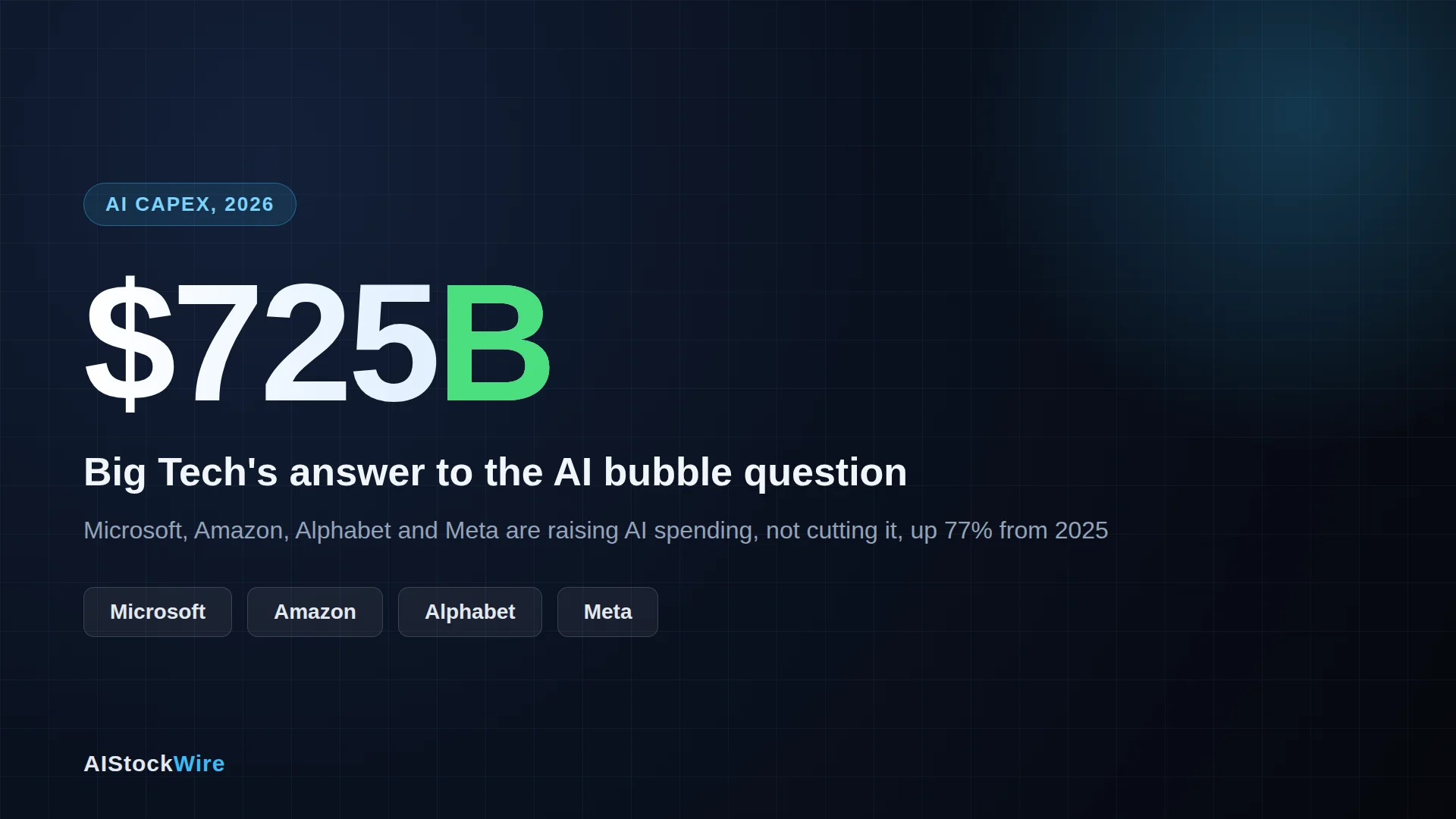
Big tech is about to spend $725 billion on AI data centers. That's not what a bubble looks like.

Big tech is about to spend $725 billion on AI data centers. That's not what a bubble looks like.

Key points

  • Microsoft, Amazon, Alphabet and Meta are on track to spend $725 billion combined on AI capex in 2026, up 77% from last year.
  • Demand keeps outrunning supply. Google Cloud's backlog nearly doubled to $460 billion in one quarter.
  • Capex now eats roughly 90% of these companies' cash flow, and Meta already sold $25 billion in bonds to cover the gap.

Every few weeks another headline asks the same question: is the AI stock rally a bubble about to pop? It's a fair question, one we've asked before when chip stocks cratered for a week and then ripped right back (we covered that dip here). But the honest way to answer it isn't to guess at sentiment. It's to look at what the four companies actually paying for this buildout are doing with their checkbooks. Right now, they're writing bigger checks, not smaller ones.

The number: $725 billion

Microsoft (MSFT), Amazon (AMZN), Alphabet (GOOGL) and Meta (META), the four hyperscalers building the actual data centers this whole trade depends on, are guiding to roughly $725 billion in combined capital spending for 2026. That's up about 77 percent from around $410 billion in 2025, and the overwhelming majority of it is going to AI: land, power contracts, custom chips and the buildings themselves.

Broken out: Amazon is spending around $200 billion, Alphabet $175 billion to $185 billion, and Microsoft is tracking toward $190 billion. Meta guided $115 billion to $135 billion, then raised that range toward $125 billion to $145 billion mid-year on higher memory chip prices and rising construction costs. None of the four cut their number this year. Every revision has gone up.

Layer on the chip side and the number gets bigger still. Nvidia (NVDA) has told investors it expects global data center capital spending to reach $3 trillion to $4 trillion a year by 2030, and that AI hyperscalers alone could spend more than $1 trillion in a single year as soon as next year. Take Nvidia's own forecast with the obvious grain of salt since it sells the chips, but the demand side of that forecast is showing up in real numbers too.

Why the spending keeps climbing

The case that this is all overheated has to explain one thing: why cloud demand keeps outrunning what these companies can build. In the most recent quarter, Google Cloud grew revenue 63 percent year over year, Microsoft's Azure grew 40 percent, and Amazon Web Services grew 28 percent, and all three describe themselves as compute constrained, meaning they could sell more capacity than they currently have. Google Cloud's backlog, contracted future revenue that hasn't been billed yet, nearly doubled in a single quarter, from $240 billion to $460 billion. That's customers signing contracts for compute that doesn't exist yet, not a company padding a growth story.

That demand is the entire justification for the number above. A hyperscaler spending $200 billion on data centers it can't fill would be a bubble. A hyperscaler spending $200 billion because its cloud backlog just doubled is a company trying to keep up.

The risks are real, just not the ones people argue about

The bubble debate usually centers on two things: state pushback on data centers, and the circular financing deals tying Nvidia, OpenAI and Oracle together. Both are real, and neither is actually the thing likely to slow this down.

On the regulatory side, more than 300 data center bills have been filed across over 30 states in 2026, and New York became the first state to actually freeze new hyperscale projects, a one-year moratorium we covered here that hit TeraWulf (WULF) the hardest of any stock in the group. Other states are pushing special electricity rate classes so data centers, not regular ratepayers, cover the cost of new grid capacity. That raises the cost and the timeline of building in certain states. It doesn't touch how much money hyperscalers are willing to spend, it just changes where they spend it.

The circular financing story is the more interesting risk, and Meta's own year shows the tension. The same company that said it had spare cloud capacity to rent out broke ground on a $9 billion data center in Alberta a week later, then raised its 2026 capex guidance and sold $25 billion in bonds the same day, not the behavior of a company second-guessing demand. Wall Street now counts more than $800 billion tied up in deals that loop money between a handful of chipmakers, cloud providers and the AI companies buying their gear, Nvidia's roughly $100 billion stake in OpenAI the biggest single piece. OpenAI itself is on pace to lose about $14 billion in 2026 while promising $100 billion in revenue by 2029. Janus Henderson (JHG) calls the arrangement a "virtuous circle," suppliers, builders and customers lining up around real demand, though critics see the same numbers as manufactured demand instead. Either way, it's a smaller slice than the $725 billion the big four are spending directly on land, steel and power they control themselves.

The risk we'd actually flag is the cash flow math. The big four now put close to 90 percent of operating cash flow into capex, up from about two-thirds a year ago. Meta's $25 billion bond sale this spring is the clearest sign of the shift: real debt, not just cash on hand. Morgan Stanley and JPMorgan both put the industry's total borrowing need as high as $1.5 trillion over the next few years. For most of this buildout the big four paid cash. Now they're borrowing, and debt is far less forgiving than a cash pile if cloud growth ever slows.

Where we land

What actually keeps this rally alive is simple: the companies paying for it keep raising their numbers instead of cutting them. Cloud growth and contract backlogs are climbing right alongside the spending, the real tell that it's chasing actual revenue. Two things would flip that read: cloud growth rolling over, or a hyperscaler cutting guidance instead of raising it. So would debt markets suddenly turning cold on AI-linked bonds. None of that has shown up yet. Microsoft, Alphabet, Amazon and Meta all report over the coming weeks, and that's the number to watch: a fifth straight raise, or the first cut.

None of this is a buy or sell signal on these four stocks. Watch where the actual money is going instead of the headlines.

Frequently asked questions

Is the AI stock rally a bubble in 2026?

The rally doesn't look like a bubble by the spending data alone. Microsoft, Amazon, Alphabet and Meta are raising their AI capital spending guidance in 2026, not cutting it, and cloud backlogs like Google Cloud's $460 billion in contracted revenue point to real demand behind the buildout. The bigger risk is that capex now exceeds these companies' free cash flow, pushing them into debt markets for the first time in this cycle.

How much are Microsoft, Amazon, Alphabet and Meta spending on AI in 2026?

The four companies are guiding to roughly $725 billion combined in 2026 capital expenditure, up about 77% from around $410 billion in 2025. Amazon is spending around $200 billion, Alphabet $175 billion to $185 billion, Microsoft close to $190 billion, and Meta $125 billion to $145 billion after raising its original guidance.

What is the biggest real risk to the AI data center buildout?

It's the cash flow math. The big four are now putting close to 90% of their operating cash flow into capex, up from about two-thirds a year ago, and Meta already sold $25 billion in bonds to help cover its 2026 spending. If cloud growth ever slows, that debt load is a lot less forgiving than spending straight out of cash reserves.

Are the circular financing deals between Nvidia, OpenAI and Oracle a warning sign?

They're real, but they're a small slice of the total buildout. Wall Street counts more than $800 billion in deals where a chipmaker or cloud provider invests in an AI company that then spends that money on the investor's own chips or cloud capacity, most visibly Nvidia's roughly $100 billion commitment to OpenAI. That's a real incentive problem, but it's dwarfed by the $725 billion the big four are spending directly on their own data centers.

David Han
David Han

David Han runs AIStockWire and trades the market himself. He's a swing trader and chart reader who writes about AI and tech stocks, shares the positions he holds, and is honest about the wins and the losses. He's not a financial advisor, and nothing he writes is investment advice.