Key points
- Rep. Dan Crenshaw (R-TX) disclosed on July 16, 2026 that he sold Google, Amazon, Apple, Meta stock and a leveraged financial-sector ETF (FAS) all on June 1, then bought a leveraged oil fund (USOU) the same day.
- Since June 1: Google is down about 7.2% and Amazon is down about 4.9%, good timing on those two. Apple is up about 8.9% and Meta stock is up about 4.6%, a miss on those two.
- FAS, the leveraged financial ETF he sold, is up more than 31% since. There's no reliable public price history available for USOU, the fund he bought instead, so there's no way to check how that swap has actually gone.
- A separate trade in the same filing: he bought Meta put options on April 28, then sold them a week later on May 5 with the price up from $11.80 to $22.00 a contract, right after Meta stock had its roughest single day of the year.
Dan Crenshaw, the Republican congressman representing Texas's 2nd district, filed a periodic transaction report on July 16 that covers eight trades. Six of them happened on a single day, June 1, and read like a full portfolio swap: Google, Amazon, Apple, Meta stock and a leveraged financial-sector fund all went out, and a leveraged oil fund came in. The other two trades, a Meta options position opened in late April and closed in early May, are a separate story buried in the same filing.
What the June 1 filing shows
This is one we caught through our own Congress trade tracker, part of the 100 sitting members of Congress we watch for fresh disclosures as they land. Here's everything Crenshaw reported for June 1, all in amounts between $1,001 and $15,000:
| Action | Asset | Type |
|---|---|---|
| Sold | Google (GOOG) | Stock |
| Sold | Amazon (AMZN) | Stock |
| Sold | Apple (AAPL) | Stock |
| Sold | Meta (META) | Stock |
| Sold | Direxion Daily Financial Bull 3X (FAS) | Leveraged ETF |
| Bought | United States 3x Oil Fund (USOU) | Leveraged ETF |
The STOCK Act only requires a dollar range, not an exact number, so that's as precise as any of this gets. Four of the biggest names in his portfolio left on the same day, and a leveraged bet on oil took their place.
How the four stocks have moved since
Prices below compare the June 1 closing price to where each stock is trading as of midday July 17, 2026.
| Stock | Price June 1 | Price now | Change |
|---|---|---|---|
| Google (GOOG) | $372.58 | $345.61 | -7.2% |
| Amazon (AMZN) | $261.26 | $248.36 | -4.9% |
| Apple (AAPL) | $306.31 | $333.70 | +8.9% |
| Meta (META) | $600.47 | $628.03 | +4.6% |
So it's a split result. Selling Google and Amazon looks like good timing so far, both are lower than where he got out. Apple and Meta stock ran the other way, both up since he sold. Nothing here is close to a clean sweep either direction.
A leveraged fund for a leveraged fund
The fifth sale is where this stops looking like an ordinary trim and starts looking like a bet. FAS is not a normal financial-sector ETF, it's built to move three times the daily change of a basket of big U.S. banks and insurers, in either direction. Crenshaw sold it on June 1 at $130.76. It's trading at $171.52 now, up more than 31%, which is what a 3x fund does when the sector underneath it has a good run.
What he bought instead, USOU, works the same way but for oil, a fund built to move three times the daily change in crude prices. That's a genuine swap, one leveraged, direction-agnostic bet traded for another, not a shift into something safer. The problem for anyone trying to grade this move: standard market-data sources don't carry a usable price history for USOU, it's thinly traded enough that it isn't consistently covered. So while the FAS side of this trade clearly cost him upside, there's no way to independently check whether the oil side has made any of it back.
The other trade in the filing: a Meta options bet that landed well
The same report also discloses a Meta options position that has nothing to do with the June 1 activity. On April 28, Crenshaw bought Meta put options, a type of contract that pays off if the stock falls, at a price of $11.80 each, in a batch described on the filing as 10 contracts. On May 5, a week later, he sold them at $22.00 each, according to the same filing, just under double what he paid.
The timing lines up with an actual move in the stock. Meta closed at $671.34 on April 28, the day he bought the puts. Two days later, on April 30, the stock fell about 8.6% in a single session, its worst day of the year, and it kept drifting lower into early May, closing at $604.96 on May 5, the day he sold. A put option gains value when the stock underneath it drops, so a position opened right before an 8.6% single-day decline and closed a week into the aftermath is about as well-timed as this kind of trade gets.
A late-arriving filing
The STOCK Act gives members of Congress up to 45 days to disclose a trade. The June 1 batch was filed right at that line, 45 days later, on July 16. The two Meta options trades were not: the April 28 purchase was disclosed 79 days after the fact, and the May 5 sale 72 days after. Late PTR filings aren't unusual on Capitol Hill and typically draw only a small administrative fine, but these two are meaningfully past the window the law sets.
What this filing doesn't tell you
A periodic transaction report shows what was bought or sold, in a dollar range, weeks after the fact. It doesn't say why. It isn't evidence Crenshaw had any advance knowledge about any of these six positions, and members of Congress are barred from trading on material non-public information the same as anyone else. There's no way to know from this filing alone whether June 1 reflects one coordinated decision or six unrelated ones that happened to land on the same day.
Sources
- House periodic transaction report, Filing #20035024, signed July 16, 2026
- Our Congress trade tracker, updated as new disclosures land
- Related reading: Should you actually copy stocks bought by hedge funds, Congress, or insiders?
- Related reading: How to track stock trades by Congress and the president
- Price data via Robinhood market data
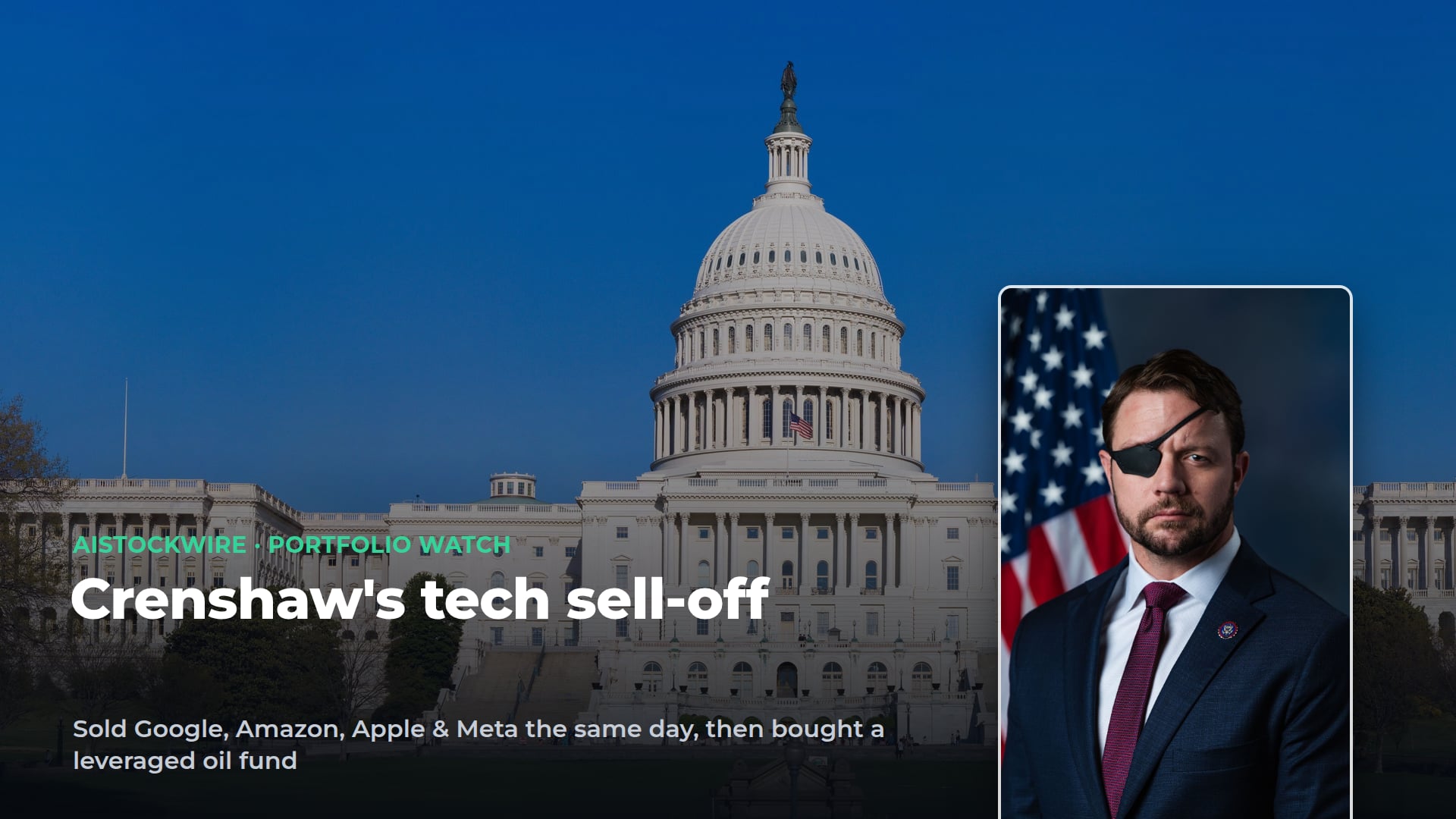
- Cover photo: U.S. Capitol, west front, public domain, via Wikimedia Commons, composited with Crenshaw's official congressional portrait (House Creative Services, public domain)
This reflects a public STOCK Act disclosure and price data, not investment advice. Jennifer Song does not hold positions in the securities discussed. Prices are as of midday July 17, 2026 and will move. Always do your own research and consider speaking with a licensed financial professional before making any investment decision.