My position: I don't own INTC right now. I'm watching it and I might buy. Nothing below is investment advice. Just my own read on the stock.
Key points
- The US government owns about 10% of Intel, a real floor under the stock that almost no other chip name has.
- Intel hired Seok-Hee Lee, the former CEO of SK Hynix, to run advanced packaging at Intel Foundry. He's not building DRAM there. He's building the piece that glues memory to logic.
- SK Hynix has reportedly been testing Intel's packaging tech for HBM integration, which puts Intel inside the tightest bottleneck in AI hardware right now, without Intel needing to become a memory company itself.
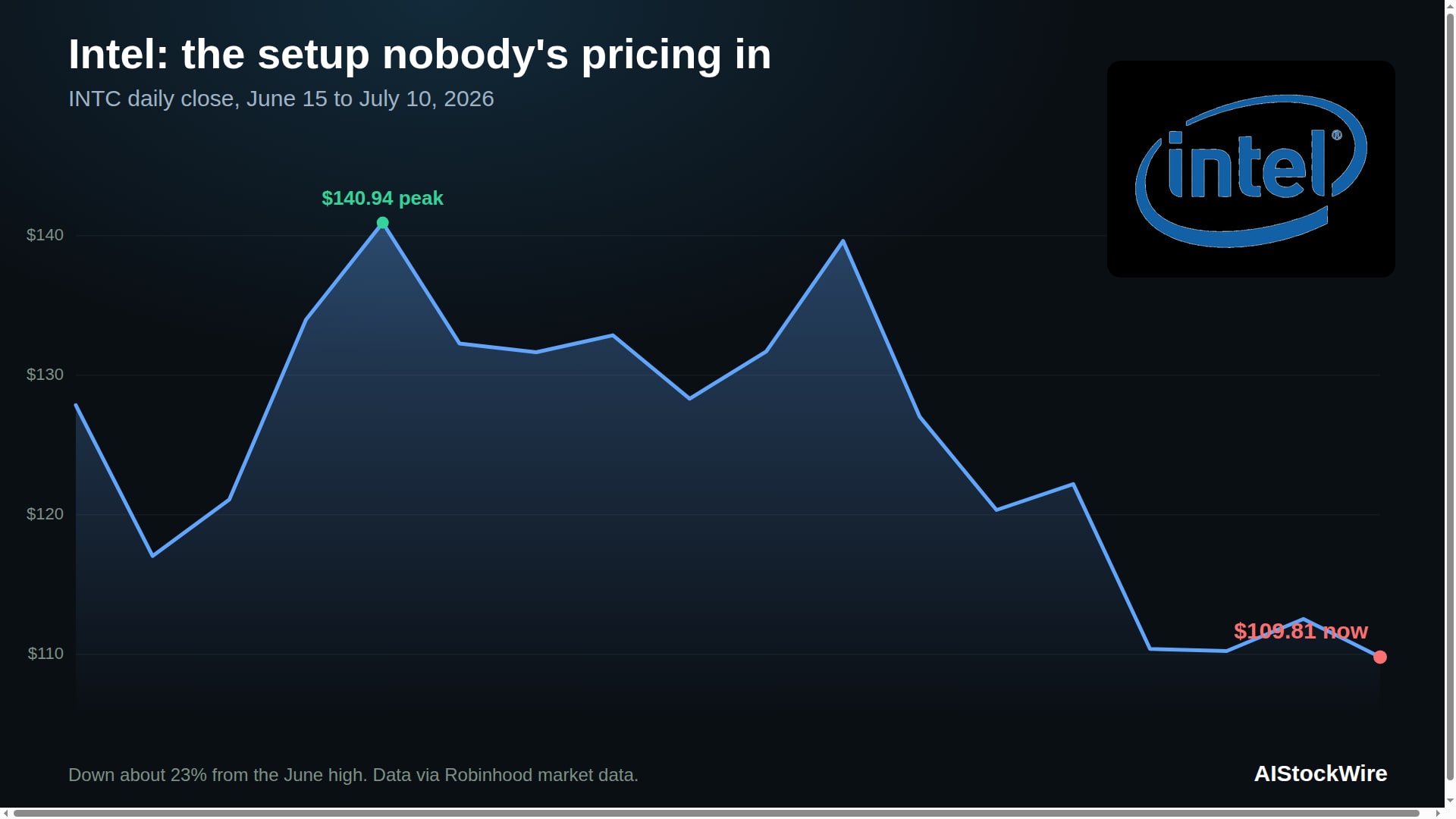
- INTC is down about 23% from its June high. Earnings land July 23, and that's the real catalyst, not the Lee hire by itself.
I don't own Intel yet. I've been circling it for a week. Here's why.
Our HBM memory stocks page sorts the names into makers, packaging, equipment and interface silicon.
Start with the boring part. The US government bought roughly 433 million shares of Intel at $20.47 each. That's about $8.9 billion, some of it CHIPS Act money. Say whatever you want about that politically. For a trader it's simple: Intel has a floor under it that basically no other chip stock has. The government doesn't want its own stock to tank.
Now, the part that actually got my attention. Intel hired Seok-Hee Lee, the former CEO of SK Hynix. That's one of maybe two companies on the planet that actually know how to make HBM at scale, the fast memory that sits next to every AI chip and feeds it data. Lee ran their whole DRAM division before he became COO, then CEO. This is not a random hire.
Here's where it gets interesting, though. Intel didn't put him in charge of building DRAM chips. They put him in charge of advanced packaging at Intel Foundry, reporting straight to the CEO. Packaging sounds boring, but it's not. It's the step where you glue the memory die to the logic die so the whole thing works as one chip. And there are already reports that SK Hynix itself has been testing Intel's packaging tech for HBM. Read that twice. The company Lee used to run might already be looking at Intel as a partner.
So the real trade isn't "Intel makes memory now." They don't, not yet anyway. The real trade is Intel becoming the packaging partner every HBM maker needs, right as HBM is the single tightest bottleneck in the entire AI buildout. There's a longer shot DRAM comeback too, a SoftBank partnership called Z-Angle Memory. That one's not close. Prototype in 2027, real production more like 2030. That's the lottery ticket, not the reason to buy this week.
The reason to pay attention this month is Intel's Q2 earnings on July 23rd. Management talks 18A yields and how much outside foundry revenue is showing up. That's the real catalyst. The Lee hire is the story underneath it, not the trigger by itself.
The stock sits down about 23% from its June high of $142.35, trading around $109.81 right now. Nothing about that drop is Lee related. It's sector-wide chip valuation fear plus doubts about whether 18A actually hits profitable yield this year or slips to 2027.
One more thing worth knowing. Nancy Pelosi disclosed a big Intel buy back in May, one of her largest positions by her own reported range. She paid somewhere between $113 and $127 a share that day. INTC trades under $110 right now. So if you're looking at this stock today, you're getting in cheaper than one of the most closely watched traders in Congress did. That doesn't make it a good trade by itself. It's just a real price anchor worth knowing.
My honest read: this isn't a today thing. It's a name to watch into earnings, with a real story building underneath it that most people aren't connecting yet. Government backstop on one side, a legit memory guy building out the packaging side on the other. If 18A commentary on the 23rd doesn't stink, this thing can move fast.
Sources
- Yahoo Finance, Intel's next chapter: government backing, foundry ambitions, and AI partnerships
- TradingKey, Intel stock prediction: HSBC says $200, BofA says bubble
- Related coverage: What is a chip foundry?
- Price data via Robinhood market data
This is general market commentary and opinion, not investment advice. Prices reflect closing levels as of Friday, July 10, 2026, and will move. Markets can go down as well as up, and you can lose money. Always do your own research and consider speaking with a licensed financial professional before making any investment decision.