Key points
- TSMC (TSM) makes roughly 70% of the world's made-to-order chips, and an even bigger share of the most advanced ones.
- Most big chipmakers are fabless: Nvidia (NVDA), AMD (AMD) and Apple (AAPL) design chips, but TSMC actually builds them.
- The real AI bottleneck is TSMC's CoWoS packaging, and nearly all leading-edge output is made in Taiwan, a major concentration risk.
You hear the names constantly: Nvidia (NVDA) makes the GPUs that power AI, Apple (AAPL) designs the chips in your iPhone, AMD (AMD) builds the processors in data centers. Here is the part that surprises most people. Almost none of those companies actually make their own chips. One company, on an island off the coast of China, physically manufactures the bulk of them: Taiwan Semiconductor Manufacturing Company, better known as TSMC (TSM). Understand what a foundry is and why TSMC dominates it, and you understand the single chokepoint the entire AI hardware boom runs through.
What a foundry actually is
A semiconductor foundry is a factory that makes chips designed by other companies. That is the whole idea. Chipmaking splits into two very different jobs: designing the chip, which means drawing the blueprint for billions of microscopic transistors, and fabricating it, which means actually etching that design onto a disc of silicon. A foundry does the second job, as a contract manufacturer, for whoever shows up with a design and an order.
The factory itself is called a "fab," short for fabrication plant. A modern leading-edge fab is one of the most complex and expensive things humans build, costing $20 billion or more and filled with machines, like the lithography systems from ASML (ASML), that print features just a few nanometers wide. That price tag is the key to the whole story.
Fabless, foundry, IDM: the three kinds of chip company
Once you know a cutting-edge fab costs $20 billion, the industry's structure makes sense. There are three models:
- Fabless: companies that design chips but own no factories. They hand their designs to a foundry. Nvidia (NVDA), AMD (AMD), Qualcomm (QCOM), Broadcom (AVGO), and Apple (AAPL) are all fabless. They pour their money into design and software and let someone else do the manufacturing.
- Foundry: companies that own the factories and make other people's designs, but sell no chips of their own. TSMC (TSM) is the giant. GlobalFoundries (GFS) and China's SMIC are smaller players.
- IDM, or integrated device manufacturer: companies that both design and make their own chips. Intel (INTC) is the classic example. Samsung does both, designing its own chips and also running a foundry that makes chips for others.
The fabless-plus-foundry split is the arrangement that now rules the cutting edge, and it is why a company like Nvidia can be worth trillions of dollars without owning a single factory.
Why the foundry model took over
It comes back to that $20 billion fab. Almost no chip designer sells enough of any one chip to justify building, and then constantly upgrading, its own leading-edge factory. A foundry solves this by pooling demand. It builds one enormously expensive fab and spreads the cost across dozens or hundreds of customers. Nvidia, Apple, and AMD can all use the same TSMC fab, so none of them has to pay for one alone. The designers get access to the best manufacturing on earth without the capital bill, and the foundry gets the scale to keep investing in the next factory. It is one of the great win-win structures in modern business, and it quietly concentrated an enormous amount of power in very few hands.
Why TSMC is so dominant
TSMC makes roughly 70 percent of all made-to-order chips, and an even larger share of the most advanced ones. Its customer list is basically the who's-who of technology: Apple, Nvidia, and AMD are its three biggest, followed by the likes of Broadcom, Qualcomm, Amazon, Google, Tesla, and even Intel for some products. In 2025 it took in more than $120 billion in revenue, up about 36 percent in a year, riding the AI wave.
Earnings watch
TSMC reports every quarter, and as the company at the heart of the AI supply chain, each release is one of the most-watched readouts in tech. See its next date on our earnings calendar.
Why is it so hard to catch? Three reasons. First, manufacturing at the cutting edge is brutally difficult, and TSMC's "yield," the share of chips on a wafer that come out working, is consistently better than anyone else's. Samsung's foundry, the number-two player with under 10 percent of the market, has repeatedly stumbled on yields at its most advanced nodes. Second, TSMC is a pure foundry: it never competes with its own customers by selling chips, so Apple and Nvidia trust it with their crown-jewel designs in a way they might not trust Intel or Samsung. Third, decades of doing nothing but this have built an ecosystem of tools, talent, and supplier relationships that money alone cannot quickly replicate.
The node race, and the real AI bottleneck
You will see foundries talk about "nodes" like 3nm and 2nm. Loosely, a smaller number means smaller transistors, which means more of them on a chip and better speed and power efficiency. TSMC's newest node, called N2 or 2nm, entered volume production in late 2025 and offers a solid step up from 3nm. Leading this race is much of why TSMC commands premium prices. If you want the fastest AI chip that can be built, there is essentially one place to build it.
But here is the twist that matters most for AI right now. The bottleneck has not really been making the chip itself. It has been advanced packaging, specifically a TSMC technology called CoWoS that stitches a GPU together with its stacks of high-bandwidth memory (HBM) into one tightly integrated package. CoWoS capacity has been the single biggest limit on how many AI accelerators the world can produce, and TSMC has been racing to expand it, roughly doubling capacity year over year and still falling short of demand. If you have wondered why AI chips are so scarce, the answer is as much about packaging as about the chips. We map the full chain in the AI stock map, and the memory side in the memory giants piece.
Why investors should care: one island, one chokepoint
The flip side of TSMC's dominance is concentration risk, and it is the thing that keeps strategists up at night. The overwhelming majority of the world's most advanced chips are made on a single island, Taiwan, which sits in one of the most geopolitically tense corners of the planet and on an earthquake fault line. Any serious disruption there would ripple through every company that depends on those chips, which is to say almost the entire technology industry. TSMC is building fabs in Arizona and Japan to spread the risk, a roughly $165 billion commitment in Arizona alone, but those plants run years behind Taiwan and will not change the basic picture soon. Meanwhile Intel and Samsung are spending heavily to build credible foundry alternatives, because the world badly wants a second source.
That is the real lesson of the foundry. Whoever controls the narrowest part of a supply chain holds the pricing power, and in chips, that part has a name and an address. For investors, the foundry is not a boring back-office detail. It is the chokepoint the entire AI trade flows through.
This article is for general education, not investment advice. Market shares and figures are approximate and current as of 2026. Do your own research before making any investment decision.
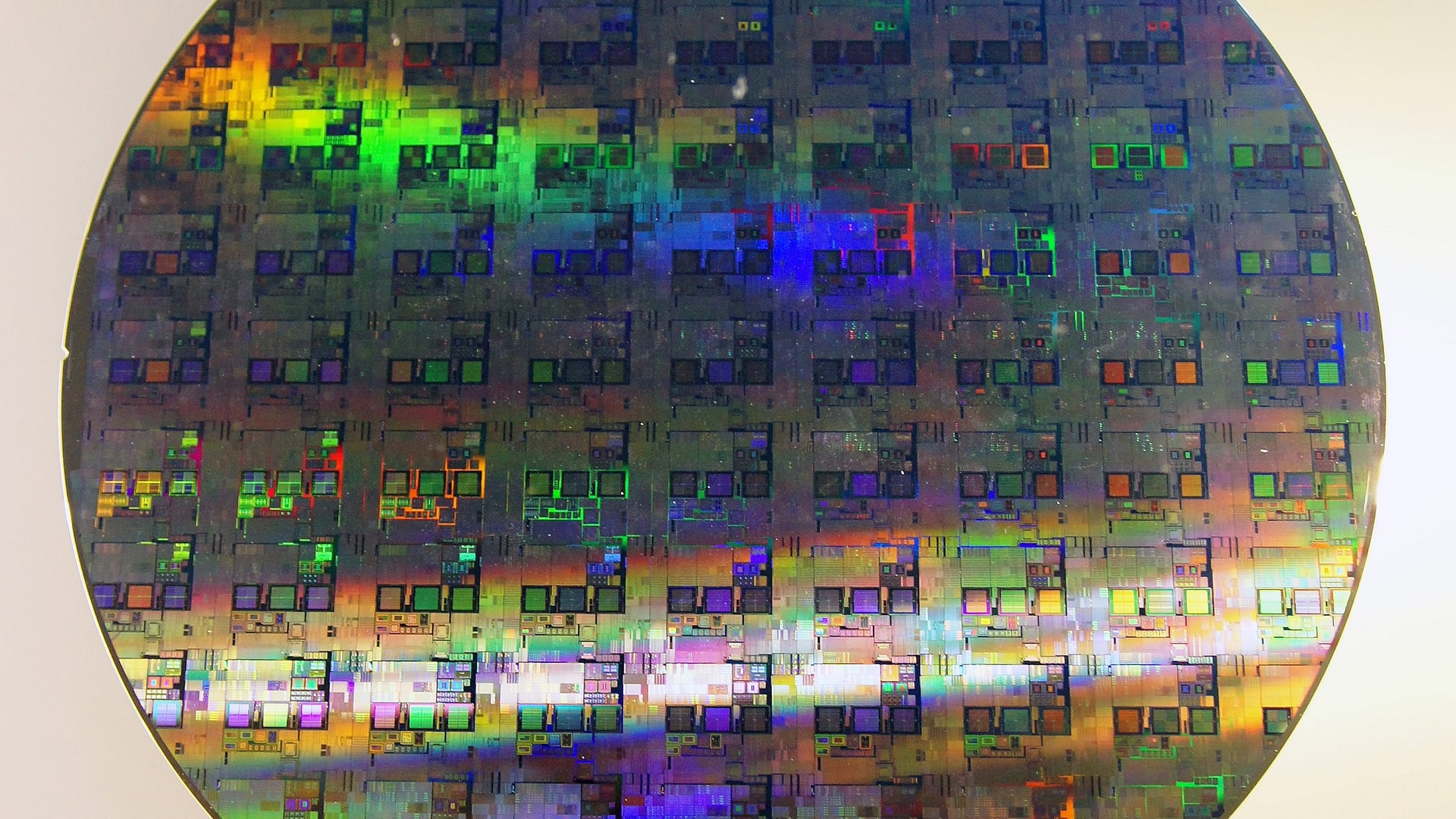
Cover photo: 12-inch silicon wafer by Peellden / Wikimedia Commons, CC BY-SA 3.0, cropped.