Key points
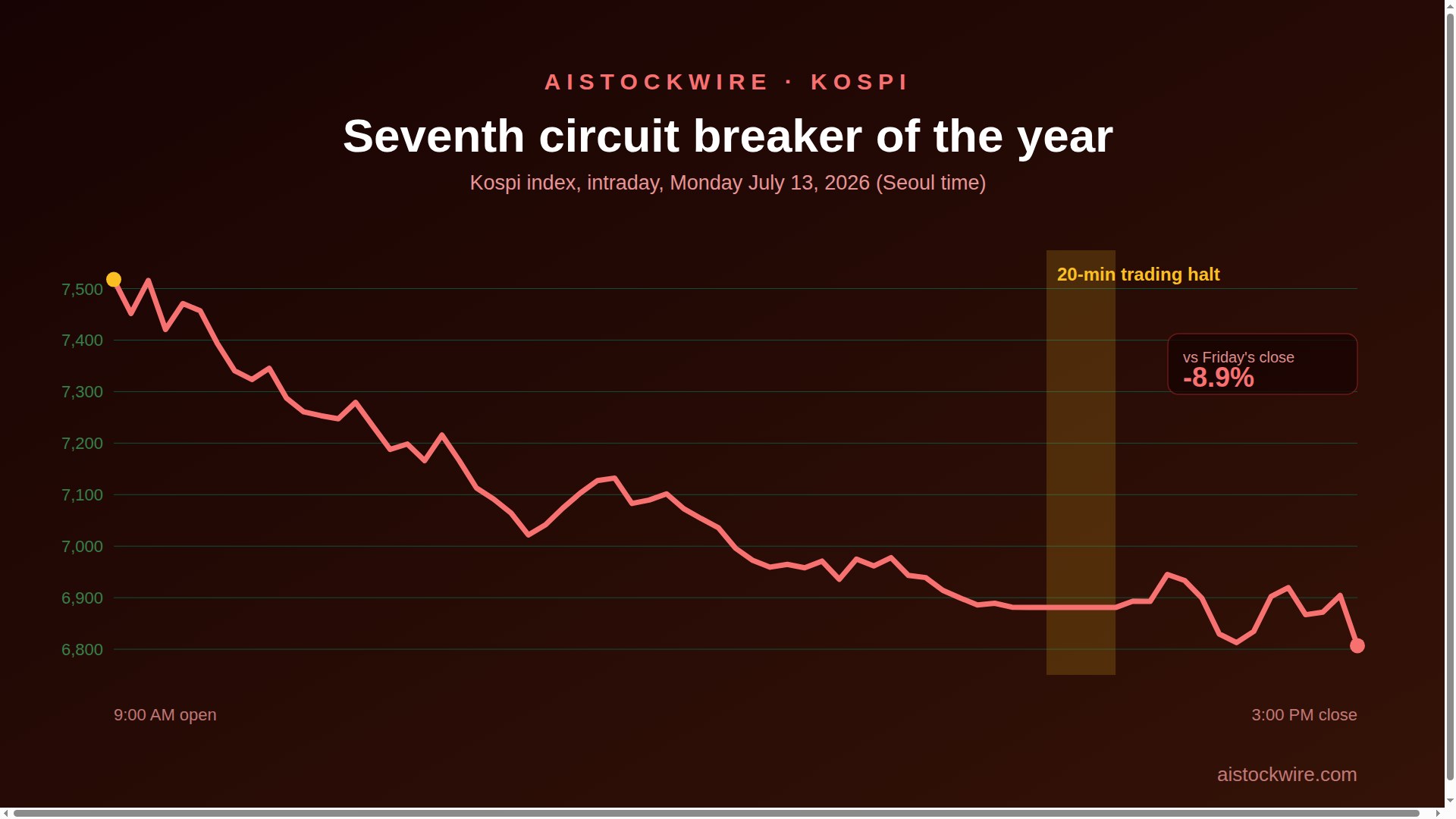
- The Kospi closed down 8.95% at 6,806.93 Monday, triggering a 20-minute trading halt when the index hit -8.08% intraday. It's South Korea's seventh circuit breaker of 2026, more than half of every circuit breaker the Kospi has ever had since the mechanism started.
- SK Hynix fell 15.4% in Seoul, worse than Samsung's 10.7% drop. Local reporting ties the extra selling specifically to profit-taking after SK Hynix's US listing three days ago, on top of a downbeat earnings forecast.
- SK Hynix's new US-listed shares (SKHY) fell about 7.3% in New York the same day, roughly half of Seoul's drop but the same direction, exactly the arbitrage relationship that links an ADR to its home-market stock.
- US stocks opened mixed, not uniformly lower. The Nasdaq and chip stocks took the brunt of it (Micron down over 6%, AMD down more than 4%) while the Dow actually traded slightly positive.
South Korea's Kospi closed down 8.95% Monday, its worst single session in weeks, and stopped trading entirely for 20 minutes when the index cracked below 7,000 and breached an 8% intraday loss. It's the seventh time the exchange has halted trading this year. Behind it: a fresh escalation between the US and Iran that spread strikes to four countries over the weekend, sent oil surging, and hit South Korea's two biggest companies on the same day SK Hynix's brand-new US shares got their first real stress test.
Prices, the exchange code and our full file on the company are on the SK Hynix page.
What happened with Iran over the weekend
The ceasefire that briefly held earlier this month is done. The US carried out a second and third night of strikes on Iranian targets, and Iran's Islamic Revolutionary Guard Corps retaliated by hitting US military facilities in Bahrain and striking at Oman, Jordan and Kuwait. The IRGC declared the Strait of Hormuz closed over what it called American interference, though the US and Iran gave conflicting accounts of whether shipping traffic is actually still moving through it. President Trump said the US would become the strait's "guardian" and vowed to hit Iran "very hard." Brent crude jumped more than 4% to around $79 a barrel on the news, and oil-tracking funds moved the same way: the United States Oil Fund (USO) is up about 3.2% and the Brent-tracking BNO is up roughly 3.5% as of midday.
The Kospi's seventh circuit breaker of the year
The Korea Exchange activated a Level 1 circuit breaker at 1:28 p.m. local time, when the Kospi hit 6,871.20, down 8.08% from Friday's close of 7,475.94. Trading in every Kospi-listed stock froze for 20 minutes and resumed around 1:48 p.m. The index kept falling into the close, finishing at 6,806.93, down 8.95% on the day. Foreign and institutional investors sold more than 2.8 trillion won in shares. This is the seventh circuit breaker South Korea's stock market has seen in 2026 alone, out of only 13 the Kospi has ever recorded since the mechanism was introduced. More than half of the exchange's entire circuit-breaker history has happened this year.
Local reporting points to two things layered on top of the Iran shock: profit-taking following SK Hynix's ADR listing last week, and a downbeat earnings forecast report that hit sentiment going into the weekend. The stronger dollar and weaker won that came with the oil spike added another layer of risk-aversion on top of both.
Why SK Hynix fell harder than Samsung, again
Samsung closed down 10.7% in Seoul. SK Hynix closed down 15.4%, worse than Samsung by a wide margin, the same lopsided pattern this site wrote about after SK Hynix briefly passed Samsung in market value back in June, just in the opposite direction. The specific culprit named in Korean coverage is profit-taking tied directly to the new US listing: SK Hynix's ADR priced at $149 and started trading Friday, and some of the money that piled into the Seoul-listed shares ahead of that debut looks to be cashing out now that US access exists.
The new ADR didn't escape the damage either. SKHY closed at $168.01 Friday and is trading around $156 as of midday Monday, down about 7.3%. That's a noticeably smaller drop than the Seoul stock's 15.4%, roughly half as steep, which tracks with the two markets not being open at the same time, arbitrage needing time to fully close a gap like this, and the won's move against the dollar adding its own noise. The direction still matches, and that's the actual point. Each SKHY share represents one-tenth of a Korean common share, and that fixed ratio is why a crash in Seoul shows up in New York the same trading day instead of staying contained to one market.
How US markets are actually reacting
Not every part of the US market is red. The S&P 500 is down a modest 0.3%, the Russell 2000 is down about 0.2%, and the Dow is actually fractionally positive, helped by energy names benefiting from the oil spike. The damage is concentrated in tech and chips specifically: the Nasdaq-100 is down about 1.6%, Micron (MU) is off more than 6%, AMD is down over 4%, and Nvidia (NVDA) is down a more modest 1.3%. That's the same pattern this site has flagged before during memory-sector selloffs: chip and memory names take the concentrated hit while the broader market absorbs a much smaller one.
Why did the Kospi crash on July 13, 2026?
A combination of an escalating US-Iran conflict that sent oil prices up and the won down, profit-taking in SK Hynix following its new US ADR listing, and a downbeat earnings forecast report. The Kospi fell 8.95% and triggered a 20-minute trading halt after breaching an 8% intraday loss.
What is a Kospi circuit breaker?
A circuit breaker is an automatic 20-minute trading halt across every stock listed on the Kospi, triggered when the index falls a set percentage intraday. Monday's halt was the seventh triggered on the Kospi in 2026, out of only 13 the exchange has ever recorded.
Did SK Hynix's US shares (SKHY) fall along with the Seoul-listed stock?
Yes, though by a smaller margin. SK Hynix fell 15.4% in Seoul while its three-day-old US ADR, SKHY, fell about 7.3% over the same stretch, roughly half as much. The two aren't required to move in exact lockstep since the markets trade at different hours, but the fixed ten-to-one conversion ratio between an SKHY share and a Korean common share is what keeps them moving in the same direction even when the size of the move differs.
Is the Strait of Hormuz actually closed to shipping?
That's disputed. Iran's Revolutionary Guard Corps declared it closed, but the US and Iran have given conflicting accounts of whether shipping traffic is still moving through it. Oil prices moved as if the market is taking the disruption risk seriously regardless of the technical status.
Sources
- CNBC: US and Iran exchange strikes as Strait of Hormuz standoff escalates
- Al Jazeera: New Iran strikes on Gulf as US attacks escalate
- Korea JoongAng Daily: Kospi trading halted as circuit breaker hits after sell-side sidecar
- Seoul Economic Daily: Seventh circuit breaker of the year hits Kospi
- Our earlier coverage: SK Hynix passed Samsung for one day and SK Hynix's $149 ADR pricing
- Price data via Robinhood market data
Prices are as of midday July 13, 2026 and will move. This is not investment advice. Always do your own research and consider speaking with a licensed financial professional before making any investment decision.