Key points
- Eight bitcoin miners, IREN, TeraWulf (WULF), Hut 8 (HUT), Cipher (CIFR), Core Scientific (CORZ), Applied Digital (APLD), HIVE Digital (HIVE) and CleanSpark (CLSK), are all pitching the same pivot: the cheap power and big buildings built for mining bitcoin also work for AI data centers.
- They are not equally far along. IREN, TeraWulf and Core Scientific now earn more from AI than from mining. Hut 8, Cipher and Applied Digital have signed tens of billions in AI leases that mostly have not started billing yet. CleanSpark, the last to sign, now has Meta as a tenant but will not see rent until late 2027.
- A signed contract is not the same thing as revenue. Several of these stocks have announced AI deals worth $10 billion or more while still reporting quarterly revenue that is mostly, or entirely, bitcoin mining.
- A signed lease does not protect against local politics. New York paused new data center permits for up to a year in July 2026, which touches TeraWulf's Lake Mariner campus, and Texas froze new grid connections in August pending an audit that Bernstein said leaves Cipher, CleanSpark and Core Scientific the most exposed.
Bitcoin jumped again today, and a stock screener sorted by "bitcoin miners" would show a wall of green. But treating these eight stocks as one basket is exactly the mistake that costs people money. Half of this group barely needs bitcoin's price anymore. The other half still lives and dies by it. Here is how to tell which is which.
Why a bitcoin miner would even want to do this
A bitcoin mine is, physically, a warehouse full of specialized computers plugged into cheap electricity, usually with heavy-duty cooling. An AI data center is, physically, the same thing: racks of specialized computers (GPUs instead of mining rigs) plugged into cheap electricity with heavy-duty cooling. The buildings, the power contracts and the cooling infrastructure a miner already owns are close to exactly what an AI company needs to rent. That overlap is the entire trade. A miner that owns 300 megawatts of cheap power in Texas does not have to build an AI business from nothing, it has to convert one.
The two that are already there: IREN and TeraWulf
IREN, formerly Iris Energy, has gone the furthest. It signed a five-year, roughly $9.7 billion deal to rent Nvidia (NVDA) GB300 computing capacity to Microsoft (MSFT), backed by about $5.8 billion in GPU purchases from Dell (DELL), and added a separate $3.4 billion AI cloud contract with Nvidia itself. In July it added $2.8 billion of new AI cloud contracts, and its fiscal 2026 results on August 27 marked the crossover: AI Cloud revenue of $70.5 million beat bitcoin mining revenue of $66.7 million in the June quarter, the first time that has happened, alongside a new multi-year contract with an unnamed frontier AI lab. The company was worth roughly $14 billion in July, enough that it signed the richest jersey patch deal in North American pro sports, over $50 million a year to put its name on Golden State Warriors jerseys, and JPMorgan double-upgraded the stock to overweight with a $65 target on September 14.
TeraWulf (WULF) made the other headline deal in this group: a 20-year lease with Anthropic worth roughly $19 billion for about 401 megawatts of critical IT capacity, announced in July 2026 and backed by a $3.5 billion debt raise to fund the buildout at its Kentucky site. Initial delivery is expected in the second half of 2027 and full delivery in early 2028. The existing business already tipped: second-quarter revenue of $44.8 million included $31.9 million of HPC lease revenue, about 71% of the total, from 81 megawatts running at Lake Mariner, which rose to 102 megawatts in July and unlocked $600 million of Google credit support behind Fluidstack's lease. Both IREN and TeraWulf have shown the same pattern when the news hits: the stock spikes hard, gives most of it back within a day or two, then tends to move with the rest of the AI infrastructure group rather than on its own.
The huge-backlog, not-yet-billing group: Hut 8, Cipher, Applied Digital
Hut 8 (HUT) has the single largest contracted backlog in the group. By its second-quarter report on August 4 it counted about $26.6 billion of base-term contract value across 949 megawatts of AI data center capacity, all leased or backstopped by investment-grade counterparties, and it had closed $7.5 billion of non-recourse project financing in a single quarter. The biggest piece is Beacon Point in Texas, where 15-year leases on all 704 megawatts are worth $19.6 billion over their base terms and up to $50.2 billion with renewals. Hut 8 never named that tenant; the Financial Times reported it is Nvidia, and the Wall Street Journal reported on August 31 that Anthropic's $35 billion cloud deal with Lambda runs on the campus. But Hut 8's actual revenue today is still overwhelmingly bitcoin mining: $72.5 million of the quarter's $74.9 million came from its Compute segment, which is mostly bitcoin mining run through its majority-owned subsidiary American Bitcoin Corp, a company it formed with Eric Trump and Donald Trump Jr.'s data center business. The company targets its first data hall deliveries in the second and third quarters of 2027.
Cipher (CIFR) has locked in hyperscaler names most of this group would want: a roughly $3.8 billion, 10-year hosting deal with Fluidstack (with Google backstopping more than $1.7 billion of it) and a $5.5 billion, 15-year lease with Amazon Web Services, part of about $11.4 billion in total contracted revenue. Cipher is actively winding down its bitcoin mining site by site to make room, but every dollar of its $24.8 million of second-quarter revenue was still bitcoin mining. The first AWS rent started in August at its Black Pearl campus, two months ahead of schedule, so the September quarter is the first with hosting revenue in it.
Applied Digital (APLD) works a little differently. It does not mine bitcoin itself, it hosts other miners' equipment and now leases data center capacity to AI companies instead. It has three leases with CoreWeave (CRWV) worth about $11 billion combined at its Polaris Forge 1 campus, and by its fiscal fourth-quarter report on July 27 it had added three more leases with the same investment-grade hyperscaler worth roughly $20 billion, taking contracted critical IT load to 1.4 gigawatts and base-term lease revenue to about $36 billion. The GPU cloud unit is gone: it was combined with Ekso Bionics into ChronoScale (CHRN), of which Applied Digital keeps about 96%. Like Hut 8 and Cipher, most of that contracted value has not turned into rent yet. Of the $258.7 million the company reported for the May quarter, $208.2 million was tenant fit-out services and $50.6 million was data center rent and recoveries, with the new campuses not expected to start operating until 2027. Babcock & Wilcox (BW) holds a $2.4 billion contract to build the power plants for them.
Already crossed over: Core Scientific
Core Scientific (CORZ) is a useful middle case. Its hosting revenue from CoreWeave passed its bitcoin mining revenue in the first quarter of 2026, $77.5 million against $30.1 million, and the second quarter widened the gap: colocation revenue of $136.7 million was 83% of the $164.2 million total, while self-mining fell to $21.5 million. That relationship survived a rocky patch: CoreWeave tried to acquire Core Scientific outright in 2025, shareholders voted the deal down, and the companies now operate as separate businesses under a continuing hosting contract instead. An exclusivity clause tying Core Scientific to CoreWeave on its newer campuses expired in early 2026, and the company says other hyperscalers have already come calling. Its Texas sites cleared a hurdle on September 10, when an 8-K showed Denton's 371 megawatts sit outside ERCOT's frozen Batch Zero process and Pecos and Hunt were conditionally approved.
Real but still small: HIVE Digital
HIVE Digital (HIVE) is a hydro-powered miner running on cheap power in Sweden, Canada and Paraguay that grew mining revenue 158% to $297.8 million in its most recent fiscal year. Its AI arm, called BUZZ HPC, is an official Nvidia cloud partner and signed a $220 million sovereign-AI GPU deal, but it generated only $19.5 million that year, about 6% of the company's total revenue. The June quarter, reported August 15, was more of the same in a bigger frame: $79.1 million of revenue, of which $72.1 million was mining and $7.1 million was HPC, with contracted GPU cloud run-rate revenue of about $110 million. Management is targeting a $200 million AI run-rate by March 2027. The pivot is real and growing fast, it is just still small next to the mining business that pays HIVE's bills today.
Last to sign, and now Meta's landlord: CleanSpark
CleanSpark (CLSK) was the holdout when this piece first ran, still earning nearly all of its revenue from bitcoin mining and routinely left out when the group rallied on AI news. That changed on July 14, when it signed a roughly $6.6 billion, 20-year lease for a 175-megawatt campus in Sandersville, Georgia, with a tenant it described only as an investment-grade technology company, and put its entire 885-megawatt Texas portfolio under exclusivity to the same tenant. On September 17 an investor presentation named the tenant as a Meta (META) subsidiary, with Meta guaranteeing the rent, and a CleanSpark unit went out to borrow $2.227 billion in secured notes to build it. The revenue picture has not changed yet: first rent is projected for November 2027, so until then CleanSpark is still a bitcoin miner with a large lease attached.
The one thing to check before assuming any of these is "an AI stock"
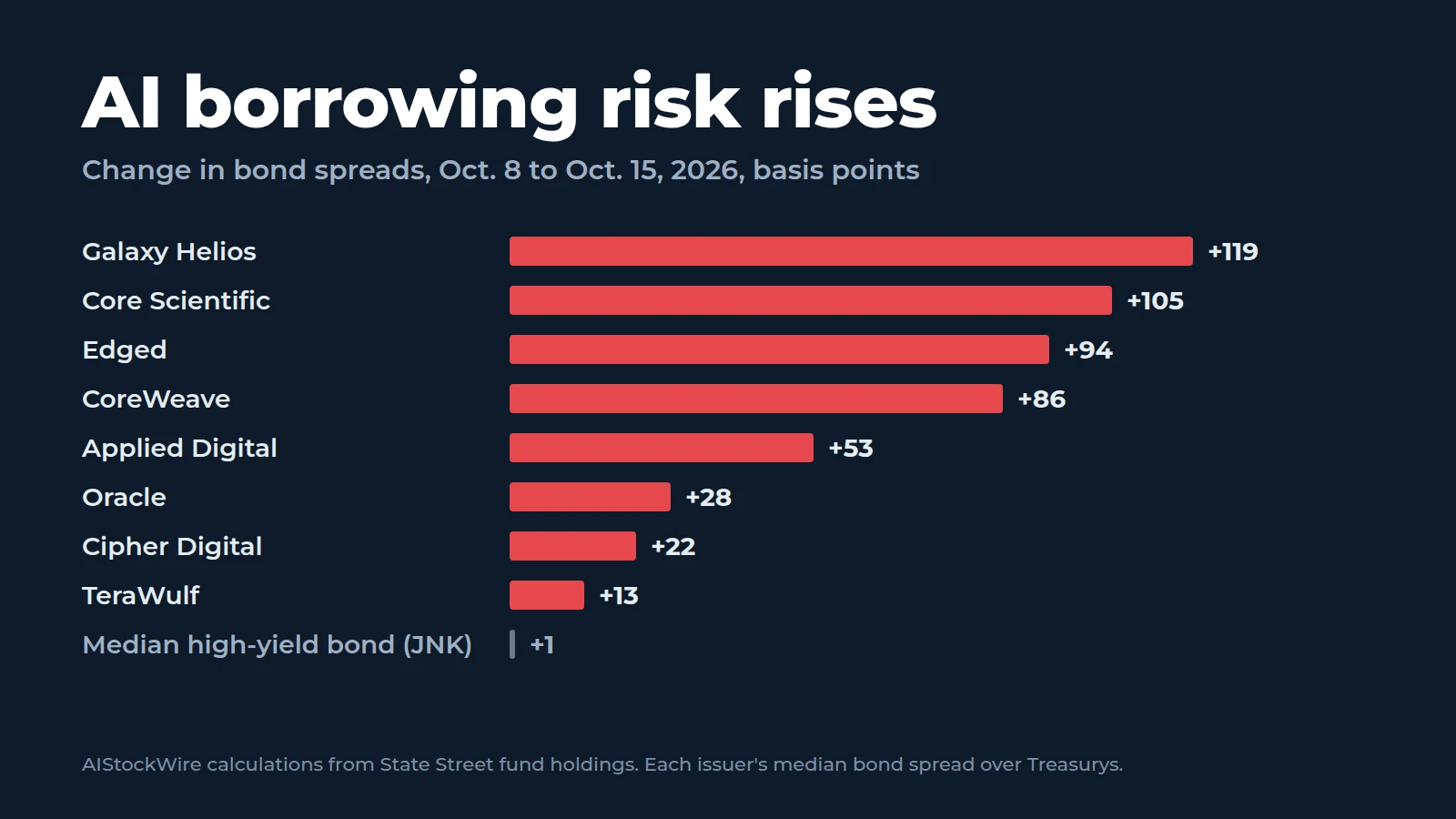
The gap between a signed contract and actual revenue is the whole story in this sector right now. Hut 8's backlog is enormous and its AI revenue is not expected until 2027. Cipher and Applied Digital are in a similar spot. Before treating any headline dollar figure as current earnings, check the same two numbers: how much of last quarter's actual revenue came from AI hosting versus bitcoin mining, and when management says the rest of the backlog is scheduled to start billing. A $10 billion lease is real, but it is not the same thing as $10 billion showing up on an income statement.
What to watch
Bitcoin's own price still matters here, since the miners furthest from an AI pivot, CleanSpark and to a lesser extent HIVE, remain sensitive to it. But for IREN, TeraWulf, Cipher, Hut 8 and Applied Digital, the bigger swing factor going forward is whether their AI contracts actually convert into recurring revenue on schedule, not what bitcoin does on any given day.
There is also a regulatory risk here that a signed lease does not protect against. TeraWulf's Lake Mariner campus sits in New York, and in July 2026 the state paused new data center permits for up to a year, a policy that applies directly to that site. The stock fell harder than the rest of this group the day it happened. Texas followed on August 3, when Governor Abbott ordered an audit of every data center in ERCOT's interconnection queue and froze new approvals until it is done; Bernstein named Cipher, CleanSpark and Core Scientific as the most exposed. The same thing could happen anywhere a state or city decides a project's power or water use has become a problem. A contract with a hyperscaler is only as good as the government's willingness to let the building keep running.
Sources
- Company investor relations releases and SEC filings for IREN, TeraWulf, Hut 8, Cipher, Core Scientific, Applied Digital, HIVE Digital and CleanSpark, 2025-2026, including each company's June-quarter 2026 results, linked above
- Our earlier coverage, IREN bought the Warriors' jersey patch
- Our earlier coverage, TeraWulf's $19 billion Anthropic lease
- Our earlier coverage, HIVE Digital's AI pivot
- Our earlier coverage, why this whole group trades together
This is general market commentary and opinion, not investment advice. Contract values, revenue splits and market caps change as companies report new results; figures here reflect the most recent public disclosures as of September 20, 2026, when this piece was last updated. Always do your own research and consider speaking with a licensed financial professional before making any investment decision.
Related coverage
- TeraWulf is borrowing $3.5 billion for its Anthropic data center
- TeraWulf (WULF) spiked 18%, then gave most of it back
- Bitcoin is sliding, and the AI data center miners are sliding with it
- Data-center and bitcoin-miner stocks sold off at the open
- Anthropic's $15 billion Australia data center plan
- New York just froze new data centers for a year, and TeraWulf became the day's biggest loser because of it