Key points
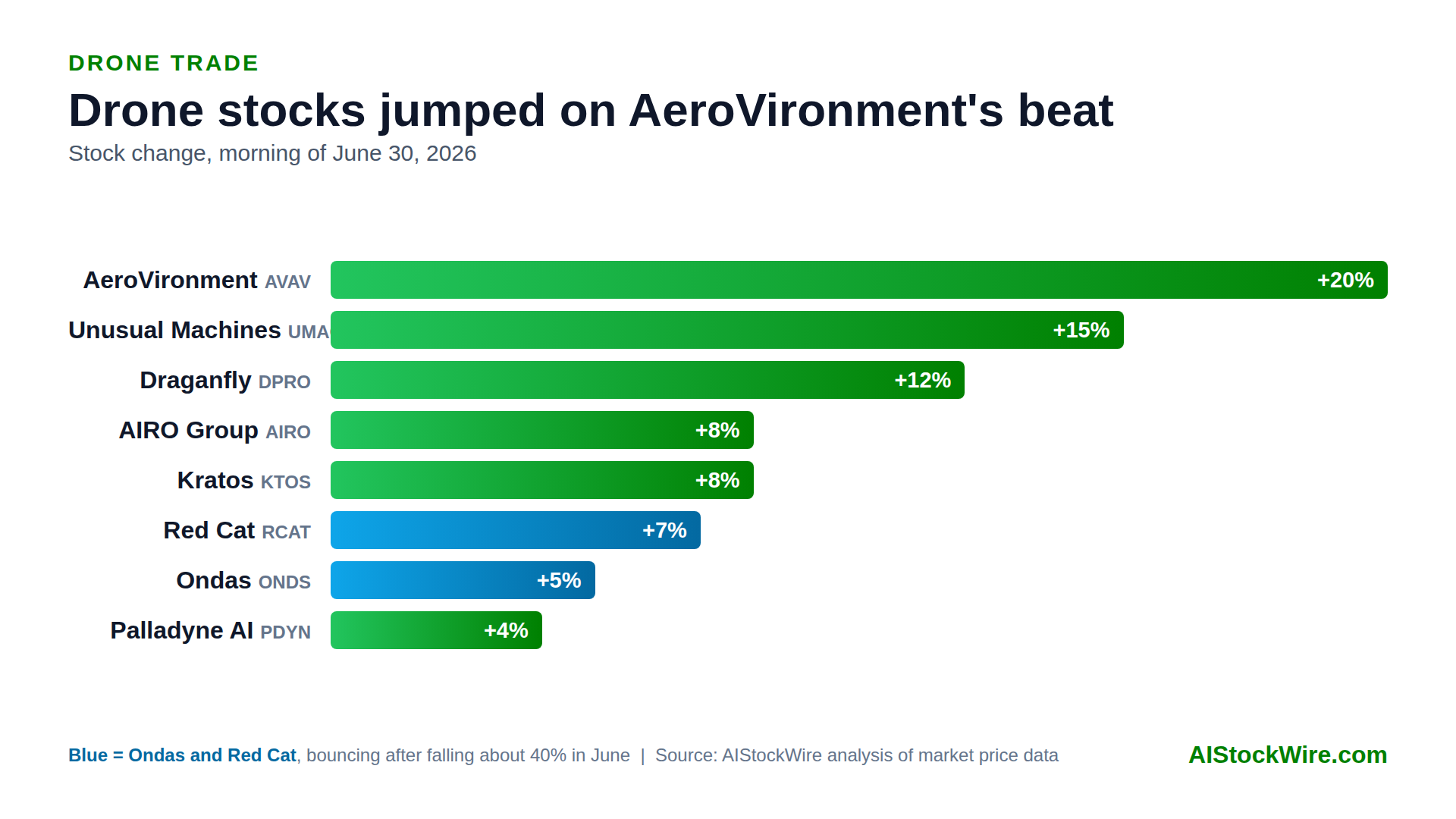
- Drone stocks jumped at the June 30, 2026 open after AeroVironment's (AVAV) earnings beat, with AeroVironment up about 20%.
- The small caps joined in: Unusual Machines (UMAC) jumped about 15%, the biggest small-cap mover, with Red Cat (RCAT) up about 7% and Ondas (ONDS) about 5%.
- The bounce follows a brutal June, when Ondas and Red Cat each fell roughly 40% from their early-June highs.
- It also lands amid a widening drone trade war: the US has sidelined China's DJI, and in late June China restricted exports to Red Cat (RCAT) and other US military suppliers.
The drone trade came back to life on Tuesday. A day after AeroVironment (AVAV) reported a strong quarter, the whole group of drone and defense-technology stocks jumped at the open, and the smaller names that had been left for dead in June, led by Ondas (ONDS) and Red Cat (RCAT), finally caught a bid. The move also comes as Washington and Beijing trade blows over who gets to build and sell drones, a fight that is slowly redrawing the map of the industry.
The morning move
As of about 10:35 a.m. Eastern on June 30, 2026, AeroVironment led the group, up about 20 percent to around $167. The gains spread well beyond it, and the biggest small-cap move belonged to Unusual Machines (UMAC), up about 15 percent. Draganfly (DPRO) rose about 12 percent, AIRO Group (AIRO) and Kratos (KTOS) each about 8 percent, Red Cat (RCAT) about 7 percent, Ondas (ONDS) about 5 percent, and Palladyne AI (PDYN) about 4 percent. On a quiet summer morning, that is a sharp, broad move for one corner of the market.
What set it off
The spark was AeroVironment. After Monday's close it reported fiscal fourth-quarter earnings of $1.84 a share, ahead of the roughly $1.48 Wall Street expected, on revenue of about $641.6 million, up about 133 percent from a year earlier with help from its BlueHalo acquisition. The company also guided next year's revenue above $2.1 billion, comfortably ahead of the roughly $2 billion it just did. A beat paired with stronger guidance is the combination the market rewards most, and the stock had already popped after hours before adding to the move on Tuesday. We covered the report when it landed, in AeroVironment jumps after hours on a Q4 beat and raise.
When the biggest, most-watched name in a small group posts numbers like that, traders tend to buy the whole basket, betting the read-through is good for everyone selling drones and defense gear. That is exactly what happened to the small caps, the same ones that had rallied with AeroVironment ahead of the report and then sold off for weeks.
A rough month, then a bounce
For most of June, the small-cap drone names were a painful place to be. Ondas (ONDS) fell from about $13.50 in early June to a low near $7.68 on June 24, a drop of more than 40 percent. Red Cat (RCAT) slid from about $15 at the start of the month to a low near $8.90 on June 25, also about 40 percent. There was no single disaster behind it, just a high-flying group giving back a big run as traders took profits and rotated elsewhere.
This week the tide turned. Red Cat bottomed on June 25 and has climbed back toward $11, and Ondas has now risen for three sessions in a row off its low. For investors who held through the drop, AeroVironment's quarter is the first piece of good news in a while, a reminder that demand for drones and counter-drone systems is still growing even when the stocks are not.
Why Ondas keeps the audience's attention
Of the small caps, Ondas (ONDS) is the one readers ask about most, and it has spent 2026 trying to earn that attention. The company has reinvented itself from a small drone-software firm into a broader defense-technology platform. It reported record first-quarter revenue of $50.1 million and raised full-year guidance to at least $390 million. And it used a roughly $1 billion cash pile to buy six defense-technology companies this year, pushing into counter-drone systems and high-altitude surveillance.
That is a lot of change in a short time, and it cuts both ways. The growth and the order book are real, but Ondas has also sold large amounts of new stock to pay for it, which dilutes existing shareholders, a tension we dug into in our earlier look at its Lockheed Martin deal and the dilution that came with it. Tuesday's bounce gives the bulls something to point to, though the stock is still well below where it traded a month ago.
Washington and Beijing are reshaping the drone business
Behind the day-to-day swings, government policy is quietly becoming the biggest force in this group. On the US side, the most popular consumer drone maker, China's DJI, has been pushed to the sidelines: it now sits on the Federal Communications Commission's Covered List, which blocks new models from being approved for import, and a provision of the recent defense budget restricts foreign-made drone parts. Drones already in the country keep flying, but the door to new Chinese hardware is closing. The stated goal is to give US makers like AeroVironment, Red Cat and Ondas room to grow. You can read the current state of the DJI ban here.
Beijing is pushing back. In late June 2026, China placed export restrictions on 10 American military-related companies, including Red Cat (RCAT) and its Teal Drones unit, in retaliation for a US move barring some Chinese tech firms from defense contracts. The restrictions bar Chinese suppliers from shipping dual-use components to those firms. As industry trade press noted, the move highlights a real weakness: even American military drones still rely on some Chinese parts, from motors to batteries, so cutting off that supply is a genuine near-term headache.
The longer-term takeaway is the one the bulls like. The harder it becomes to use Chinese drones and Chinese parts, the more the US has to build its own drone supply chain, and the companies in that chain are exactly the names that jumped on Tuesday. Unusual Machines (UMAC) is the clearest example, and not by accident the biggest small-cap gainer of the morning. Out of a factory in Orlando, it makes US-made, NDAA-compliant drone parts: the motors, cameras and flight controllers that go inside other companies' drones. The US Army's 101st Airborne Division has already ordered 3,500 of its motors, and the Army has signaled plans to buy roughly 20,000 more components in 2026. When the government tells drone makers to stop using Chinese parts, a domestic parts supplier like Unusual Machines is the company they have to call.
Red Cat is another. It won the US Army's Short-Range Reconnaissance program over Skydio, a marquee contract to supply small reconnaissance drones built by its Teal unit. That win is a big part of why investors care about the stock at all, and it is also why China singling out Red Cat this month was not a surprise.
Keep it in perspective
A few cautions are worth remembering. AeroVironment is a real, profitable defense contractor, but the small-cap drone names are far more speculative. They are thinly traded, can move 10 to 20 percent in a single session in either direction, and several, including Ondas, have sold large amounts of new stock that dilutes existing shareholders. The China parts restrictions are a fresh risk for Red Cat in particular, and critics have questioned how much of some US drones is truly American-made. A one-day bounce on someone else's earnings is sentiment, not a fundamental all-clear, and the group can give it back just as fast as it rose, as June showed.
Bottom line
AeroVironment's quarter did what a strong report from the group leader often does: it lifted everything around it and reminded investors why they liked drone stocks in the first place. For Unusual Machines (UMAC), Ondas (ONDS) and Red Cat (RCAT), beaten down or overlooked for most of June, that is a welcome change, and the wider push to build drones outside of China gives the group a story that goes well beyond one earnings report. Whether this is the start of a real recovery or just a bounce will depend on what these companies deliver next, and on how the drone trade war plays out, not on one good morning.
This article is for information only and is not investment advice. Always do your own research before buying any stock.