Key points
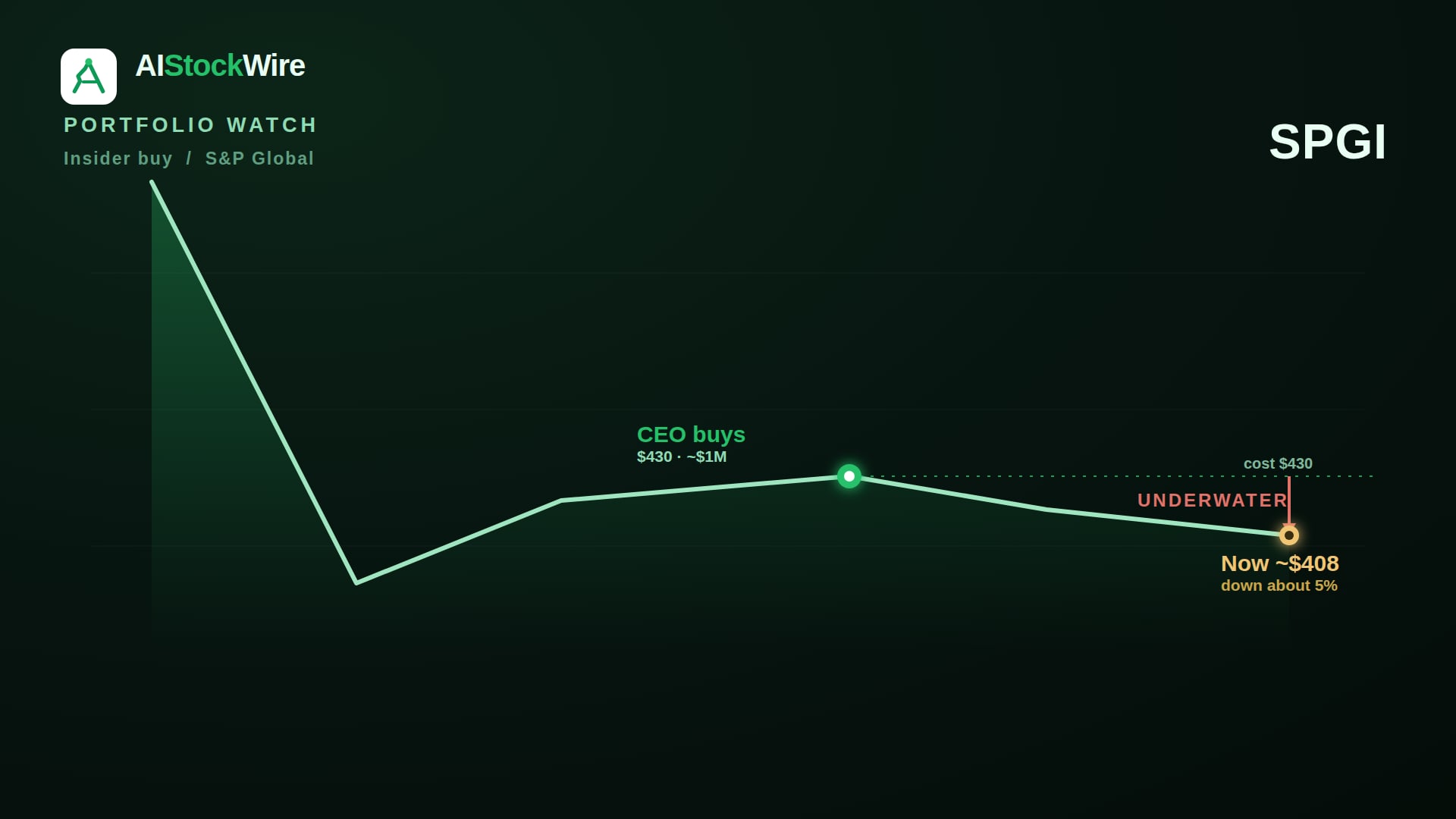
- S&P Global (SPGI) CEO Martina Cheung bought 2,322 shares at a weighted-average $429.93 on April 29, 2026, an open-market purchase worth about $1 million.
- At Friday’s close near $408, the buy is already down about 5%, a paper loss of roughly $50,000.
- A CEO buying on the open market is usually read as a confidence signal, but this one landed the day after a strong quarter and the stock has slipped since.
- SPGI pays a $0.97 quarterly dividend ($3.88 a year, about a 0.95% yield) and just raised it for the 53rd straight year.
Reading through insider filings is a habit of mine, and S&P Global (SPGI) turned up one worth a closer look. The company’s own chief executive just bought a chunk of her company’s stock with her own money, and a couple of months later she is already in the red on it.
What Martina Cheung actually bought
The disclosure comes from a Form 4, the filing a corporate insider has to submit to the SEC whenever they buy or sell their own company’s shares. On April 29, 2026, CEO Martina Cheung bought 2,322 shares of S&P Global (SPGI) at a weighted-average price of $429.93 (the individual trades ranged from $429.92 to $430.25). That is roughly $1 million.
The detail that makes it interesting is the transaction code: “P,” which means an open-market purchase. In plain terms, she paid cash for these shares, the same way any investor would, rather than receiving them as part of her pay. After the buy, she directly held 27,518 shares, on top of 14,630 restricted stock units, which are shares she earns over time as compensation. The cash purchase is the part that gets noticed.
It is already underwater
Here is the catch. SPGI closed near $408 on Friday, June 26. So those 2,322 shares are now worth about $948,000, which means the purchase is down roughly 5%, a paper loss of around $50,000, in under two months.
It is fair to say she bought before a further slide, though “bought high” needs context. Over the past year SPGI has traded between $381.61 and $579.05, so her $430 entry was actually in the middle of the range, not the top. She was buying well below last summer’s high, into what looked like a recovery after a sharp February drop. The recovery just did not hold. Timing-wise, she stepped in the day after S&P Global reported a strong first quarter on April 28 (earnings of $4.97 a share against a $4.82 estimate), so this was a vote of confidence right after good news.
What an insider buy does and does not tell you
Executives sell their own stock for all kinds of reasons, taxes, a new house, simple diversification, so a sale rarely means much. A purchase is different, because there is really only one reason to buy: you think the stock is cheap. That is why a CEO open-market buy, especially a seven-figure one, tends to draw attention.
But it is a single data point, not a guarantee, and this one proves the point. Even the person who runs the company, with the best possible view of its prospects, is underwater two months later. An insider buy can tell you what an executive thought a fair price was. It cannot tell you what the stock will do next.
Why SPGI has been falling
For context, S&P Global is one of the great toll booths in finance. It runs the world’s largest credit-rating agency, it owns and licenses the S&P 500 and Dow indices, and it sells financial data and analytics. It collects a small fee on an enormous amount of market activity.
Even so, the stock has fallen about 30% from its August 2025 high near $579. The damage was mostly done in February 2026, when a soft fourth-quarter report and cautious 2026 guidance, with slower growth in its Market Intelligence data business, sent the shares tumbling. Layered on top is a worry hanging over the whole sector: that AI could chip away at financial-data and research businesses, the same fear that hammered software stocks, which we covered in the SaaS selloff. A first-quarter beat in April helped steady the stock, and that is roughly when Cheung stepped in.
Does S&P Global pay a dividend?
Yes, and the dividend is quietly one of the best stories here. SPGI pays $0.97 per share every quarter, or $3.88 a year, which works out to a yield of about 0.95% at the current price. The yield itself is modest. The track record is not: the company just raised its payout for the 53rd consecutive year, which makes it a Dividend Aristocrat, and it has paid a dividend every single year since 1937. The next payment is scheduled for September 10, 2026, with an ex-dividend date of August 26.
The bottom line: a CEO putting about $1 million of her own money into the stock at $430 tells you she saw value there. The market has disagreed for two months. For anyone watching insider activity, it is a data point to file away, not a verdict, and S&P Global reports its next quarter around July 30. We track these moves the same way we did with Nancy Pelosi’s latest disclosure and Michael Burry’s portfolio.
Nothing here is investment advice. Insider buys and sells are disclosures, not recommendations, and a single transaction does not predict a stock’s direction. Do your own research.
Cover: AIStockWire illustration.
This is general market commentary and opinion, not investment advice. Markets can go down as well as up, and you can lose money. Always do your own research and consider speaking with a licensed financial professional before making any investment decision.