Key points
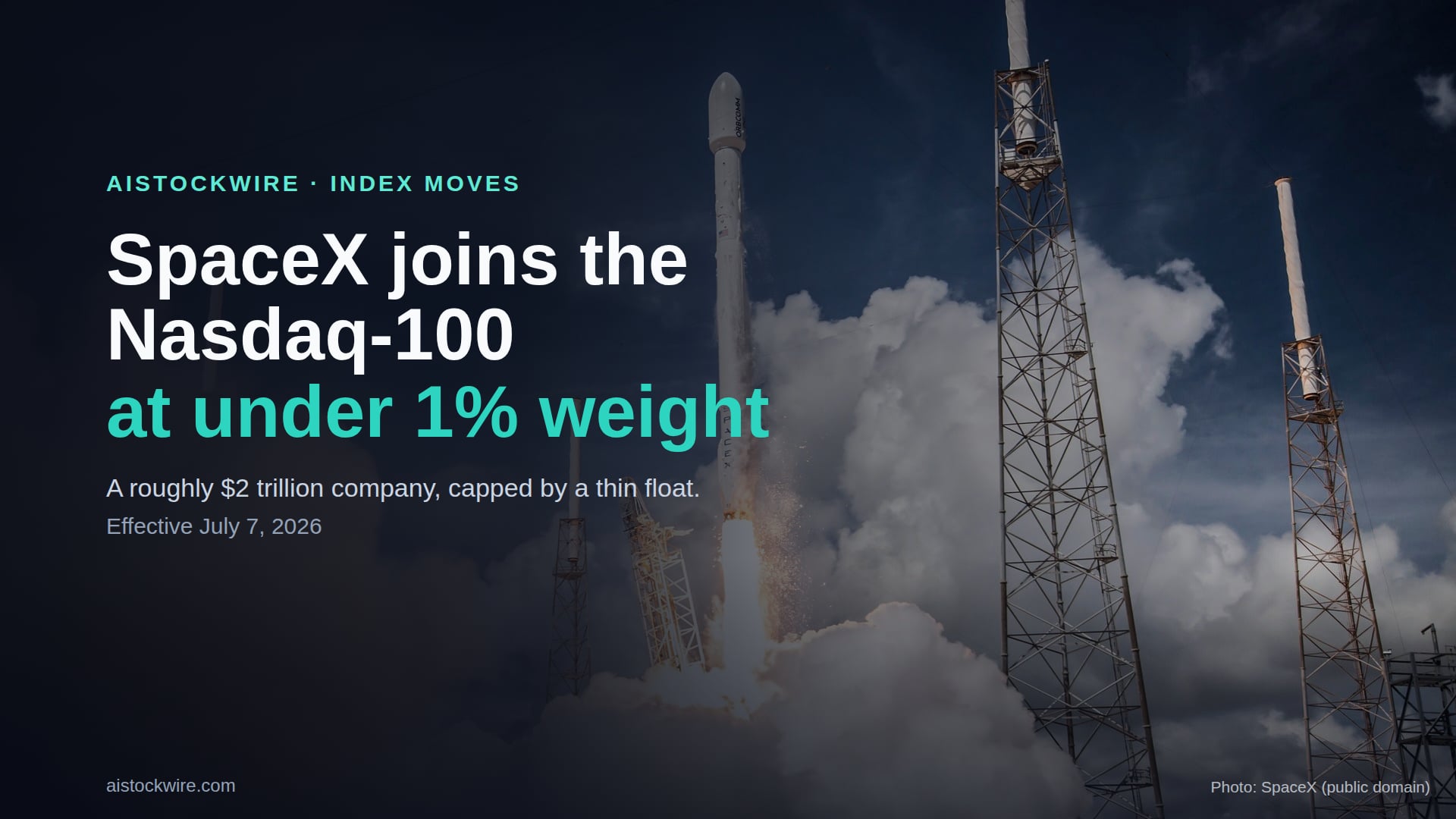
- SpaceX (SPCX) joins the Nasdaq-100 before the open on July 7, less than a month after the largest IPO in history.
- It qualifies under Nasdaq's new fast-entry rule (top-40 market cap, just 15 trading days), one of the quickest additions the index has ever made.
- A roughly $2 trillion company, it enters at under 1% weight, because only about 4% of its shares float and a new rule caps low-float names at 3x their float.
- Inclusion forces an estimated $4.3 billion of passive buying, a real near-term tailwind but small next to SpaceX's size.
SpaceX went public on June 12 in the largest IPO the market has ever seen. Barely two weeks later, after Friday's close, Nasdaq said it qualifies for the Nasdaq-100, and the stock joins the index before trading opens on July 7. For most companies, getting into the Nasdaq-100 means waiting months. SpaceX is doing it in 15 trading days. That alone is unusual enough to be worth a look, but the more interesting part is the size it comes in at.
Why it is happening this fast
Nasdaq quietly changed its rulebook this spring. As of May 1, any newly listed company that ranks in the top 40 of the market by size can be fast-tracked into the Nasdaq-100 after just 15 trading days, instead of sitting out until the next annual reshuffle. The point was to stop a situation where a giant company goes public and the index that is supposed to hold the 100 biggest names on the Nasdaq has to pretend it does not exist for the better part of a year. SpaceX, worth about $2 trillion, clears that top-40 bar without breaking a sweat. So it becomes one of the quickest entries the index has ever waved through.
A $2 trillion company at under 1 percent
Here is the head-scratcher. SpaceX is worth around $2 trillion, which on paper would make it one of the ten biggest stocks in the whole index. Yet it is set to come in at a weight of less than 1 percent. The reason is its float. Only about 4 percent of SpaceX's shares actually trade in public hands. Elon Musk and other insiders hold the rest, and the IPO floated just a thin slice of the company.
Nasdaq's other new rule deals with exactly this. For any company whose public float is below a third of its shares, the index no longer counts the full market cap. It counts the lesser of the full value or three times the float. With roughly 4 percent of SpaceX trading, three times that float works out to only about $255 billion of countable value, not $2 trillion. So the index treats the biggest new listing in history as if it were a $255 billion company, which lands it under 1 percent. The thin float that makes SpaceX such a wild ride is the same thing that shrinks its footprint in the index.
Is it a good fit?
By the index's own rules, yes, easily. The Nasdaq-100 is simply the 100 largest non-financial companies listed on the Nasdaq, and a $2 trillion business that trades on the Nasdaq belongs there by definition. The sector is less of a stretch than it sounds, too. This index already added a wave of AI and space names in June, including Rocket Lab, so a satellite-and-rockets company is not the odd one out it would have been a few years ago. The only awkward piece is the float, and the new rule is built precisely to handle that. So SpaceX fits on size and fits the index's growing tilt toward AI and space. It is a clean fit, just an unusually small one.
How the other recent additions stack up
For scale, look at the class that joined a week earlier, in the June 22 quarterly rebalance. The index brought in CoreWeave (CRWV), worth about $52 billion, Nebius (NBIS) at about $56 billion, Astera Labs (ALAB) near $63 billion, plus Rocket Lab (RKLB) and Teradyne (TER), kicking out older names like Charter, Zscaler and Cognizant. Those five came in at small weights, a fraction of a percent each, which is normal for $50-to-$60-billion companies in an index where Nvidia, Apple and Micron sit at the top. Now hold that next to SpaceX. By market value, SpaceX is something like 35 times the size of CoreWeave, but because of the float cap it enters at a weight only a few times larger, not 35 times larger. Without that cap, a $2 trillion name would have walked in near the top of the index. With it, SpaceX slots in down near the companies a thirtieth of its size.
Bullish, or not?
In the short run, inclusion is a mild positive. Every fund that tracks the Nasdaq-100, the giant Invesco QQQ among them, has to buy SpaceX to match the index, and analysts put that forced buying at roughly $4.3 billion around the July 6 close. Guaranteed demand on a known date is the kind of thing that can give a stock a bump. There is also a prestige effect: joining the Nasdaq-100 puts SpaceX in front of every passive investor in the country and stamps it as a permanent fixture rather than a fresh IPO.
Temper it, though. That $4.3 billion is small against a $2 trillion company, and the weight is tiny, so SpaceX will not move QQQ and QQQ will not do much for SpaceX after the one-time buy. The thin float that caps its weight also makes the stock lurch. In its first two weeks it ran from a $135 IPO price to a high above $225, then back to the $147 area, and it sits around $153 now. Wall Street's average price target is about $188, but the spread of estimates runs from $62 to $310, which tells you the pros cannot agree on what a company like this is worth. And more float is coming eventually, as lockups expire and insiders sell, which is a steady headwind over time even if index inclusion is a tailwind this week.
None of this is investment advice. But the honest read is that SpaceX joining the Nasdaq-100 is a milestone and a small, mechanical positive, not a green light. The number that matters most here is not the $2 trillion valuation or the $4.3 billion of buying. It is that under-1-percent weight, which quietly tells you the market is still only letting a sliver of SpaceX trade.
This is general market commentary and opinion, not investment advice. Markets can go down as well as up, and you can lose money. Always do your own research and consider speaking with a licensed financial professional before making any investment decision.