My position: I own AAOI and INTC, and both turn up in here as Cramer calls. I am not a financial advisor, and nothing here is investment advice. This column is my personal opinion.
Key points
- 13 of Jim Cramer's last 15 tech calls beat the Nasdaq 100. Coherent (COHR) is up 52.2%.
- His 40 tech buy calls were down 16.9% on average on July 29. They're down 2.7% now.
- The 20 he told you to avoid gained more than the ones he liked, up 7.2%.
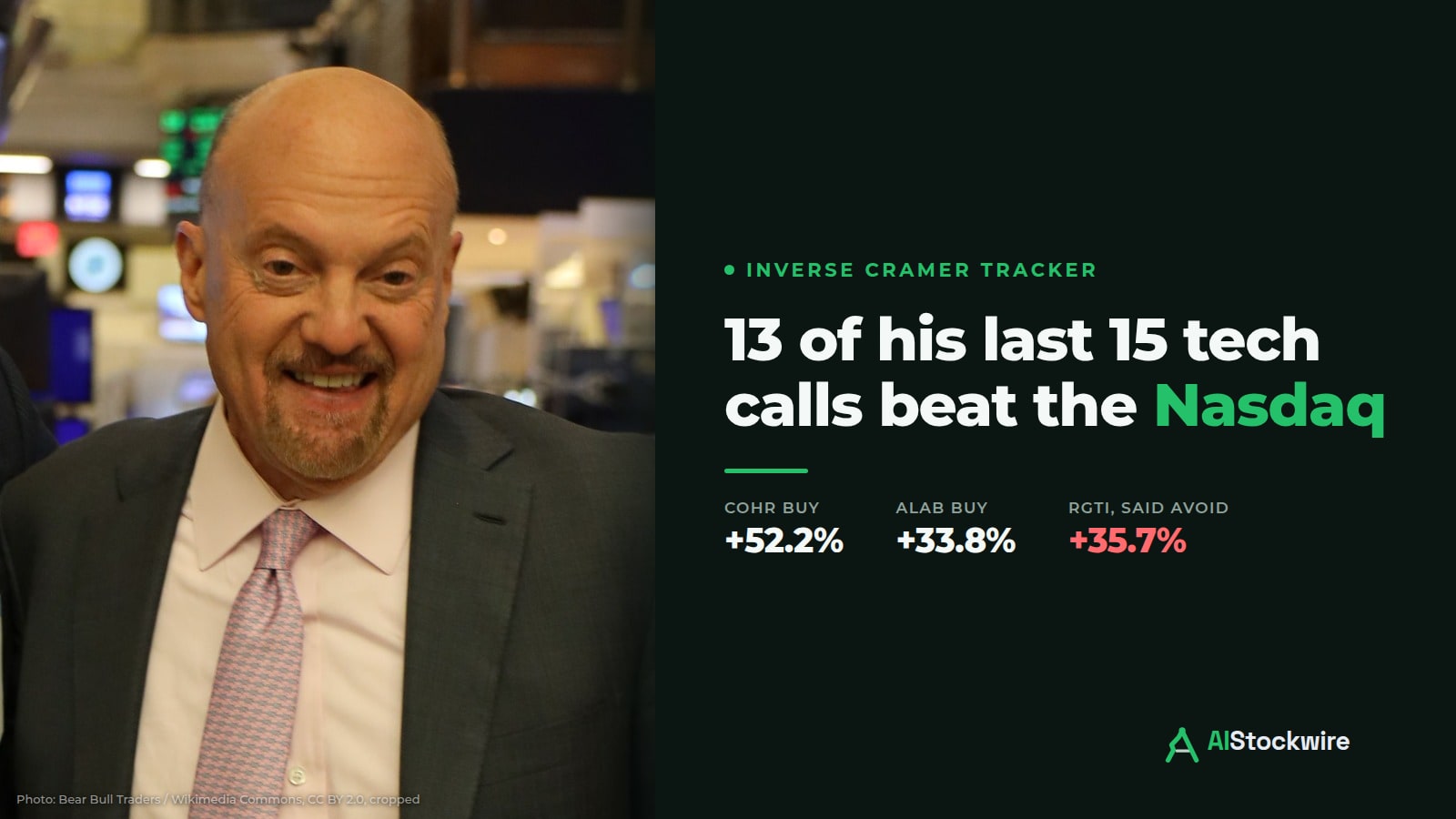
13 of Jim Cramer's last 15 technology calls are ahead of the Nasdaq 100, by an average of 8.5 percentage points.
We run the Inverse Cramer tracker. It exists to log how wrong he is. But these days, it's showing how right he is.
One thing to keep straight before the numbers start. Everything in the first half of this piece is his score, the stock's own move since he spoke. What fading him paid is the mirror of that, and we get to those numbers at the end.
A week ago we wrote that he had gone 6 for 8 on his tech calls and said we'd find out fast whether the run was real. We found out. It was real, and he's 7 for 8 on that batch now. Here it is repriced to Friday's close.
| His call, July 27 to 31 | Stock since | vs Nasdaq |
|---|---|---|
| Coherent (COHR), buy | +52.2% | +46.4 pts |
| Astera Labs (ALAB), buy | +33.8% | +24.5 pts |
| Bending Spoons (BSP), buy | +28.0% | +22.2 pts |
| Nvidia (NVDA), buy | +14.0% | +8.0 pts |
| Intel (INTC), buy | +12.7% | +7.6 pts |
| Arista Networks (ANET), buy | +11.2% | +4.1 pts |
| Microsoft (MSFT), buy | +10.8% | +5.1 pts |
| Rigetti (RGTI), avoid | +35.7% | -26.4 pts |
Before anybody gets carried away with 13 of 15, six of those calls came on August 6 and have had exactly one session to work. Throw them out. He's still 7 of 9 on the rest.
Bending Spoons (BSP) is the name most people won't know. It's a Milan software company that buys up consumer apps and runs them for profit instead of building its own, and it only started trading this summer. He called it "a really good software company" on July 30 at $34.74 and it closed Friday at $44.45.
Intel (INTC) is the one that changed the whole board. It closed at $81.88 on July 29 after the $11 billion loss it reported on July 23. It closed Friday at $101.65, up 24.1% in seven sessions.
He posted about it at 3:55 in the morning on July 31, with the stock at $90.20: "One week ago some of the most hideous selling I have ever witnessed was about to be visited upon Intel. It had just reported the best quarter of the earnings season."
We counted that one as a miss last week, since Intel opened at $96.72 that morning and sank all day from there. Even at that opening print, it's up 5.1% now. He's been bullish on Intel eight separate times at an average entry of $111.80, and against Friday's close that book has gone from 18.6% underwater a week ago to 9.1% underwater.
The one he told you to avoid went up more
July 29 was the bottom for almost everything in tech. The Nasdaq 100 rose 9.3% between that close and Friday's. Semiconductors did better than that, with the VanEck Semiconductor ETF (SMH) up 15.6% over the same seven sessions.
On that same July 29 lightning round, he did two things. He said of Astera Labs (ALAB): "Nothing changed. It is just a matter of sentiment. Buy, buy, buy." And he said of Rigetti (RGTI): "That's one I don't really care for."
Astera Labs closed at $249.74 that night, and it's $334.17 now, up 33.8%. Rigetti closed at $13.22, and it's $17.94, up 35.7%. Same night, same bottom, and the stock he didn't care for beat the stock he loved.
That isn't a fluke either. Take the 40 tech buy calls that were sitting on the tracker on July 29. They were down 16.9% on average that day, with 6 of the 40 in the green. On Friday, they were down 2.7%, with 16 in the green. Now take the 20 avoid calls that were on the board the same day. They were down 8.2%, which is exactly what he wanted. On Friday they were up 7.2%.
Put plainly, the stocks on his buy list rose 18% on average over those seven sessions. The ones on his avoid list rose 20%.
One headline did a lot of that work in both directions. On Tuesday, Reuters reported that the FCC is drafting a rule to ban imports of new optical transceiver models and then exempt many non-Chinese suppliers, and the entire photonics group gapped up. Coherent (COHR) is the biggest gain on his entire buy list because of it. Applied Optoelectronics (AAOI) is up 35.3% since he waved people off it on July 16 with "Not now. We need to wait until the speculative wave has passed." Same rule, same industry, opposite sides of his ledger.
So is fading him dead?
In tech, on the buy side, yes, and I'd rather say that plainly than pretend the tracker still says what it said in July.
These next numbers are the mirror of the ones above. They're what betting against him paid, not what his picks did.
We've logged 208 calls since June 3. Bet against every one and you're up 0.9%, which is 1.4 points better than doing the identical trade on the Nasdaq 100 over the identical days. 104 of the 208 paid off in reverse, which is a coin flip.
The 74 tech calls return 1.7%, or 2.3 points against the index. But split them by direction and the whole thing lives in one half. Fading his 52 tech buys now returns -0.1%. Against the index that's 1.5 points, which is close to nothing for two months of work. Fading the 22 stocks he told you to avoid returns 6.0%, and 4.2 points against the index.
The entire tech edge is in his negative calls. When he warns you a stock is too speculative, that's the one worth betting against. When he tells you to buy something, you'd have been better off just going with him.
I'd hold that loosely, though. Every call in this book was logged inside one violent two-month window, a chip selloff followed by a melt-up, and a fade number measured in the selloff and re-measured in the rally is mostly telling you which way the market went. The Nasdaq comparison sitting next to every figure on the tracker exists for exactly that reason.
Coherent and Lumentum (LITE) both report the week of August 10, and Coherent is now his biggest tech winner by a distance, so that one decides a lot of this. Rigetti reported on August 6 and gained 8.5% the session after. He's still wrong on that one.
Cover photo: Bear Bull Traders / Wikimedia Commons, CC BY 2.0, cropped.
This is general market commentary and opinion, not investment advice. Markets can go down as well as up, and you can lose money. Always do your own research and consider speaking with a licensed financial professional before making any investment decision.