Key points
- ASML, Vertiv (VRT) and Arm (ARM) led the June 30, 2026 open, each up about 4%, while Meta (META) and Alphabet (GOOGL) slipped.
- The rally traces back to Micron's (MU) record June 24 quarter, where earnings hit $25.11 a share versus about $20.20 expected.
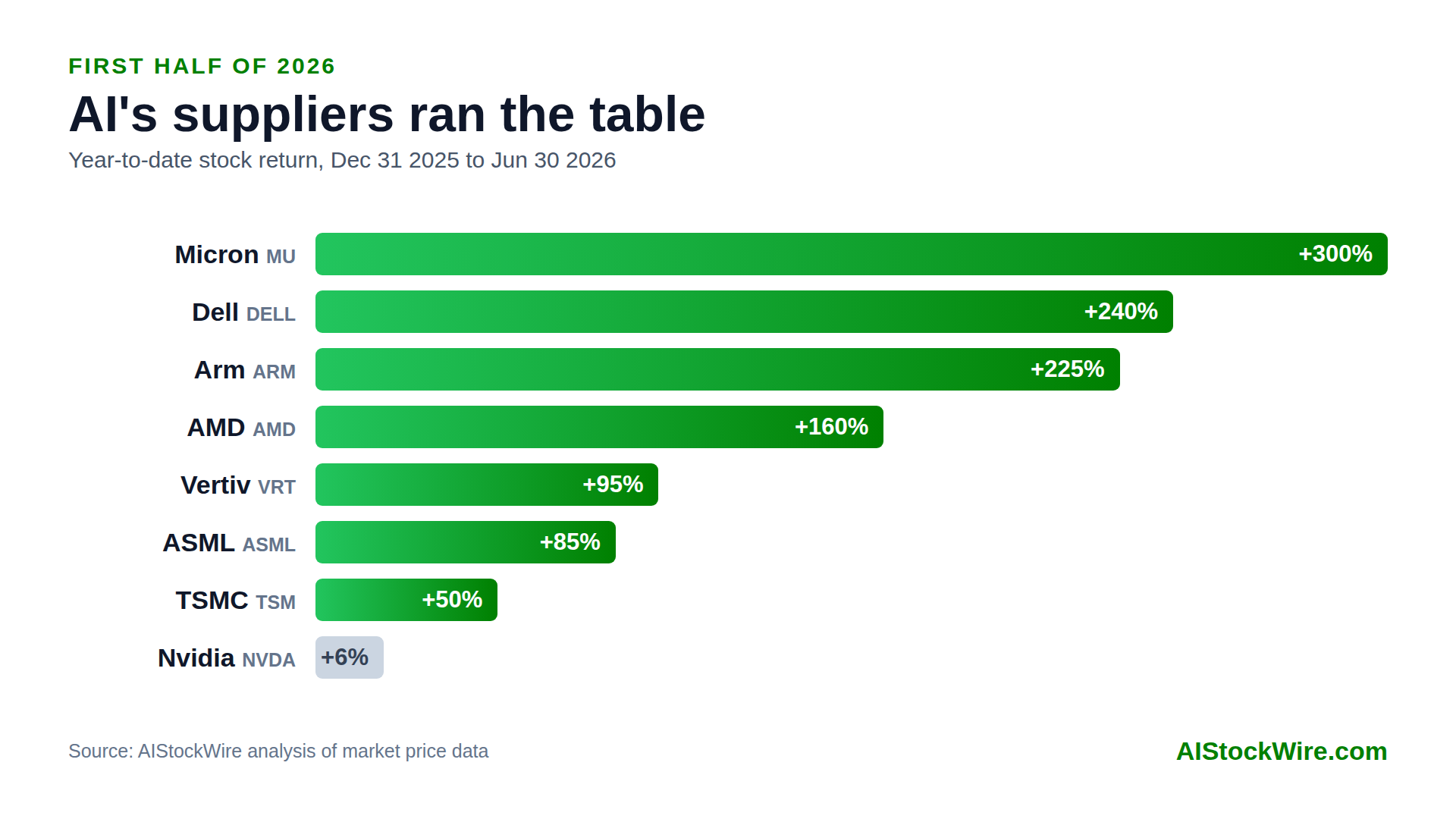
- The first half of 2026 belonged to the suppliers: Micron is up about 300% year to date, Dell (DELL) about 240% and Arm about 225%, while Nvidia (NVDA) gained just 6%.
On the last trading day of the first half of 2026, the AI trade has a clear pecking order, and the household names are not on top. The money at Tuesday's open went to the companies that supply the AI build-out: the firms that make the chip-making machines, the memory, the servers, and the power and cooling gear that fills a data center.
What is leading at the open
As of about 10:00 a.m. Eastern on June 30, 2026, the leaders were the suppliers, not the platforms. ASML, the Dutch company that builds the machines used to print the world's most advanced chips, was up about 4 percent. Vertiv (VRT), which sells the power and cooling systems that keep data centers running, rose about 4 percent. Arm (ARM), whose chip designs sit inside many AI processors, gained about 4 percent as well.
The rest of the supply chain followed. Advanced Micro Devices (AMD) and Dell (DELL) each added about 3 percent, and Super Micro (SMCI), a server maker, rose about 3 percent. Taiwan Semiconductor (TSM), the contract factory that actually makes the chips, was up about 2 percent, and Nvidia (NVDA) itself rose a more modest 1 to 2 percent.
The big platform names went the other way. Meta (META) was down about 1 percent, with Alphabet (GOOGL) and Amazon (AMZN) each off less than 1 percent. In other words, the companies that buy AI hardware lagged, and the companies that sell it led. You can see how all these pieces fit together in our map of every layer of the AI trade.
Why the suppliers are winning
The spark is Micron (MU). On June 24 the memory maker reported its best quarter ever, with earnings of $25.11 a share, well ahead of the roughly $20.20 Wall Street expected. Demand for high-bandwidth memory, the specialized chips that feed AI accelerators, is running ahead of what the industry can make, and that shortage shows up as higher prices and fatter profits across the whole chain.
When one supplier posts numbers like that, investors reprice the rest, because they all sell into the same boom. That is why a strong Micron quarter can lift ASML, which sells the equipment, and Vertiv, which sells the power and cooling, even on a day when Micron stock itself is quiet.
The first half belonged to the picks and shovels
Step back from one morning and the pattern is even clearer. Measured from the end of 2025, the biggest winners of the first half of 2026 are not the famous AI names but the ones that supply them.
Micron is up about 300 percent year to date. Dell has gained roughly 240 percent and Arm about 225 percent. AMD is up about 160 percent, Vertiv about 95 percent, ASML about 85 percent, and Taiwan Semiconductor about 50 percent. Nvidia, the stock most people picture first when they hear the word AI, is up only about 6 percent over the same stretch.
The reason is spending. Big Tech is on track to pour a record amount into AI infrastructure in 2026, with industry estimates running near $650 billion for the largest buyers. Every dollar of that budget reaches the suppliers first, which is why their sales, and their stocks, have moved faster than the platforms writing the checks. It helps to know how a chip actually gets made, because each step in that process is a company selling into the boom.
What to watch next
The next real test for this group is ASML's second-quarter report, due before the market opens on July 15. ASML sells the most advanced chip-making machines in the world, so its order numbers are an early read on whether the build-out is still speeding up or starting to cool. You can track upcoming reports on our earnings calendar.
Bottom line
The June 30 open is a snapshot of the trade that has defined all of 2026: the surest way to play the AI boom has been to own the companies that supply it, not only the ones whose names make the headlines. That can change quickly, and a year-to-date gain near 300 percent leaves little room for disappointment, so the gap between the suppliers and the platforms is worth watching closely from here.
This article is for information only and is not investment advice. Always do your own research before buying any stock.