Key points
- Amazon filed with the FCC on July 24 for 5,105 satellites that connect straight to phones, launching from 2028.
- The spectrum belongs to Globalstar (GSAT), an $11.6 billion deal that doesn't close until 2027.
- GSAT sits near $79 against a $90 headline price. The stock half is a fixed 0.3210 Amazon shares, with no downside protection.
- AST SpaceMobile (ASTS) and Rocket Lab (RKLB) both closed higher Monday instead of selling off.
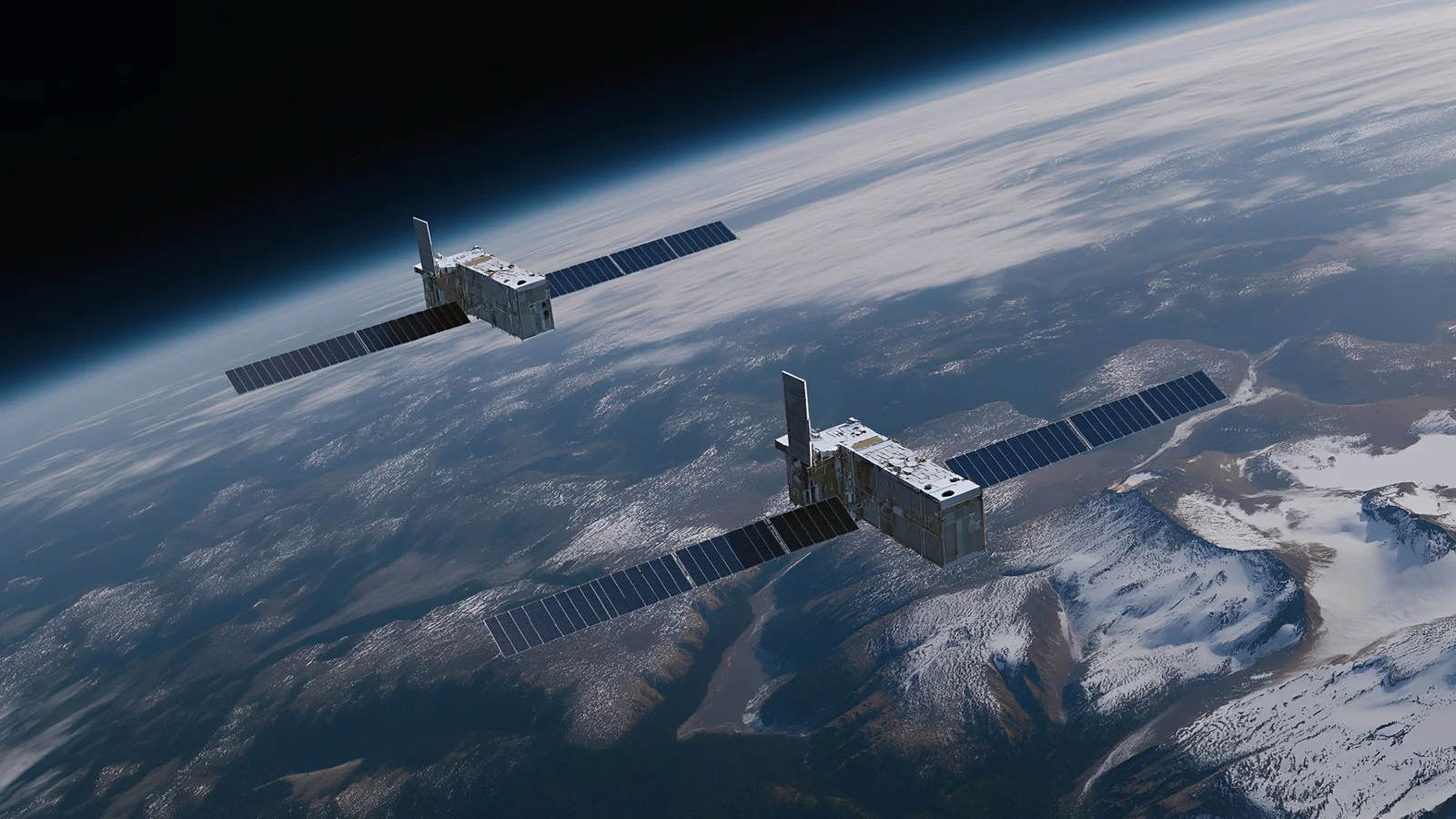
Amazon (AMZN) asked the FCC late Friday for permission to launch 5,105 satellites that connect straight to ordinary phones, without a dish or any special hardware. Deployment starts in 2028.
The spectrum those satellites would run on isn't Amazon's. It belongs to Globalstar (GSAT), the company Amazon agreed to buy in April for about $11.6 billion, and that deal hasn't closed. Nobody expects it to before 2027.
Apple (AAPL) is what makes this more than a paperwork story. Globalstar's network is what runs Emergency SOS on the iPhone, and Amazon has said Amazon Leo will take those features over.
What Amazon actually asked for
| Item | Detail |
|---|---|
| Satellites | 5,105 operational |
| Altitudes | 510 to 580 km, across five shells |
| Inclinations | 56 to 84 degrees |
| Links to phones | 1.6 GHz and 2.4 GHz |
| Links to ground stations | Ka-band and V-band |
| Satellite life | 6 to 8 years |
| First launch | 2028 |
Amazon describes the service as voice, messaging and data, plus emergency calling, aimed at places cell towers don't reach. The filing also covers fleet tracking and machine-to-machine connections. That's the part with the better margins.
This is a separate constellation from Amazon Leo, the broadband network that used to be called Project Kuiper. Amazon says the two will operate in concert, routing traffic across both, along with the older Globalstar satellites it's acquiring.
The deal behind the spectrum isn't finished
Amazon signed the merger agreement on April 13 and announced it the next morning. The headline price is $90.00 a share.
There won't be a shareholder vote. Thermo Funding and related entities hold 57.6 percent of Globalstar, and they signed a written consent within a day of the deal being struck. Per the 8-K, no further approval of Globalstar stockholders is required or will be sought. Amazon shareholders never got one either.
What's left is regulatory. The clearances still outstanding:
- Antitrust, under Hart-Scott-Rodino
- Foreign investment review
- Satellite and telecommunications law, which is the FCC's piece
- An effective registration statement covering the Amazon shares being issued
- Certain HIBLEO-4 satellite milestones at Globalstar
If those clearances do not come through, Amazon owes Globalstar $592.1 million. A reverse break fee that size is what a buyer pays to say it knows the regulatory path is hard and it's taking the risk anyway. Globalstar's own break fee, payable in a much narrower set of circumstances, runs $419.8 million.
Why Globalstar trades $11 under the deal price
Globalstar closed Friday at $78.93 against a $90.00 headline. An $11 gap on an announced deal normally means the market doubts it closes. Here it mostly doesn't mean that.
The payout has two halves and holders elect between them. Cash is $90.00 a share, stock is 0.3210 Amazon shares, and what matters is what happens to that ratio.
Below a $280.38 twenty-day average price on Amazon, the ratio stays locked at 0.3210. It does not climb to make up the shortfall. The ratio only moves if Amazon trades above $280.38, and then it moves down, so the stock leg is worth $90 and never a dollar more.
Amazon closed Friday at $232.11. That's about 17 percent under the $280.38 reference. So 0.3210 Amazon shares is worth $74.51 right now, not $90.
Elect stock in this deal and you aren't collecting $90. You're taking a position in Amazon.
Then there's the cash cap, which limits cash payment to 40 percent of Globalstar shares. Ask for more than that in aggregate and everyone who asked gets scaled back proportionally, with the remainder arriving as Amazon stock.
Run the worst case, where every holder elects cash and everybody gets pro-rated:
| Component | Value per GSAT share |
|---|---|
| 40% paid in cash at $90.00 | $36.00 |
| 60% paid in stock, 0.3210 AMZN at $232.11 | $44.71 |
| Blended value | $80.71 |
| Friday close | $78.93 |
| Discount to blended value | 2.2% |
A 2.2 percent discount on a deal closing next year isn't skepticism. That's an ordinary spread for time and paperwork.
The other end of the range is better. Thermo owns 57.6 percent of the company, and the transaction is built to qualify as a tax-free reorganization, which gives a stake that size a real reason to take stock instead of triggering a tax bill. If Thermo elects stock, that whole 40 percent cash allowance falls to public holders, who are only 42.4 percent of the shares. Nearly all of them would get cash at $90. Call it $89 a share.
Nobody knows which end of that $81 to $89 range this lands on until election forms go out, three business days before closing. Globalstar at $78.93 is priced a little below the bottom of it.
One caveat on that bottom: the stock half carries whatever Amazon does between now and closing, unhedged. If Amazon keeps sliding, $80.71 slides with it.
The last adjustment is small enough to set aside. Globalstar owes Apple up to $110 million if it misses certain operational milestones, and that comes out of the merger price. Across 128.6 million shares, the maximum hit is under 90 cents.
The registration statement is running late
The merger agreement gave both companies 45 business days from April 13 to file a Form S-4 with the SEC. That window ran out in mid-June, and as of Monday nothing has been filed.
Both sides can extend that deadline by agreement, and they do not have to announce it, so a late filing is not evidence of a problem on its own. What it does mean is that the document spelling out the election mechanics, the fairness opinion and the background of the deal is still not public.
The outside date is April 13, 2027. If the clearances or the HIBLEO-4 milestones are still hanging by then, it pushes to October 13, 2027. One more extension sits behind that, out to April 13, 2028.
Those HIBLEO-4 satellites are their own thread. MDA Space subcontracted Rocket Lab (RKLB) to build 17 spacecraft buses for them, a $143 million job that ran years past its original schedule. They finally launched on a SpaceX Falcon 9 on May 17. Getting to orbit is not the same as satisfying the milestones written into the merger agreement, and Globalstar hasn't said it has.
The pure plays went up, not down
Update, July 27 after the close: this section first ran with late-morning prices. It now carries the closing figures.
A 5,105-satellite filing aimed at the same customers should have been bad news for the companies already chasing this market. Monday didn't deliver that.
Both AST SpaceMobile (ASTS) and Rocket Lab (RKLB) opened higher, with ASTS up more than 3 percent inside the first hour.
| Stock | Friday close | Monday close | Change |
|---|---|---|---|
| AST SpaceMobile (ASTS) | $56.20 | $58.29 | +3.7% |
| Rocket Lab (RKLB) | $63.91 | $66.94 | +4.7% |
| Amazon (AMZN) | $232.11 | $231.39 | -0.3% |
| Globalstar (GSAT) | $78.93 | $79.03 | +0.1% |
Both held their gains into the close. Neither stock broke on a filing this size from a buyer with Amazon's balance sheet.
April did the same thing. AST SpaceMobile (ASTS) fell when the Globalstar deal was announced and recovered the next day. We covered the whole sector in June, when every space stock got repriced after the SpaceX IPO, and the reaction has been consistent since. A giant walking into this market reads to investors as proof the market is real.
It helps that AST is doing something technically different. Its satellites unfold very large antennas and use spectrum licensed to its carrier partners to reach unmodified phones. Amazon and Globalstar own their spectrum outright, in bands handsets already support. The engineering problem is not the same one. AST has also been funding itself the expensive way, which we wrote about when its third billion-dollar note sale since October knocked the stock down 13 percent.
Three big satellite deals in four months
Amazon and Globalstar was April. Rocket Lab agreed to buy Iridium (IRDM) for about $8 billion, at $54 a share, on June 29, which we wrote up when the whole sector rallied that day. SpaceX has been pushing into the carrier business, which we looked at when analysts started floating a T-Mobile takeover.
Each one pairs a company that owns spectrum or subscribers with one that owns launch or satellites. Amazon is the only buyer of the three that filed a constellation application before its deal closed.
The next real checkpoint is the S-4. Until Amazon files it, the election terms that decide what a Globalstar share is actually worth sit in an exhibit to a merger agreement rather than in a document written for shareholders.
Sources
- SpaceNews, Amazon files application for direct-to-device satellite constellation, July 2026
- Amazon, How Amazon Leo plans to connect mobile devices from space
- SEC, Globalstar Form 8-K, Agreement and Plan of Merger, April 14, 2026
- SEC, Globalstar Form 8-K, 2026 annual meeting results, May 14, 2026
- Rocket Lab, Rocket Lab selected by MDA to design and build spacecraft for Globalstar
- Rocket Lab, Rocket Lab to acquire Iridium, June 29, 2026
- Globalstar, Globalstar announces upcoming HIBLEO-4 satellite replenishment launch with SpaceX, May 12, 2026
- Benzinga, AST SpaceMobile shares climb as investors digest Amazon's Globalstar deal, April 2026
Reaction-table prices are July 27, 2026 closes. The merger arithmetic uses the July 24 closes named in the text. Merger terms are taken from the Agreement and Plan of Merger as filed. Blended-value figures are arithmetic from those stated terms, not a forecast of what any holder will receive. Nothing here is investment advice.