Key points
- Anthropic's IPO filing warns the government fight could reach commercial customers
- Government contracts are under 1% of its revenue
- One Pentagon designation was struck down, and another was upheld
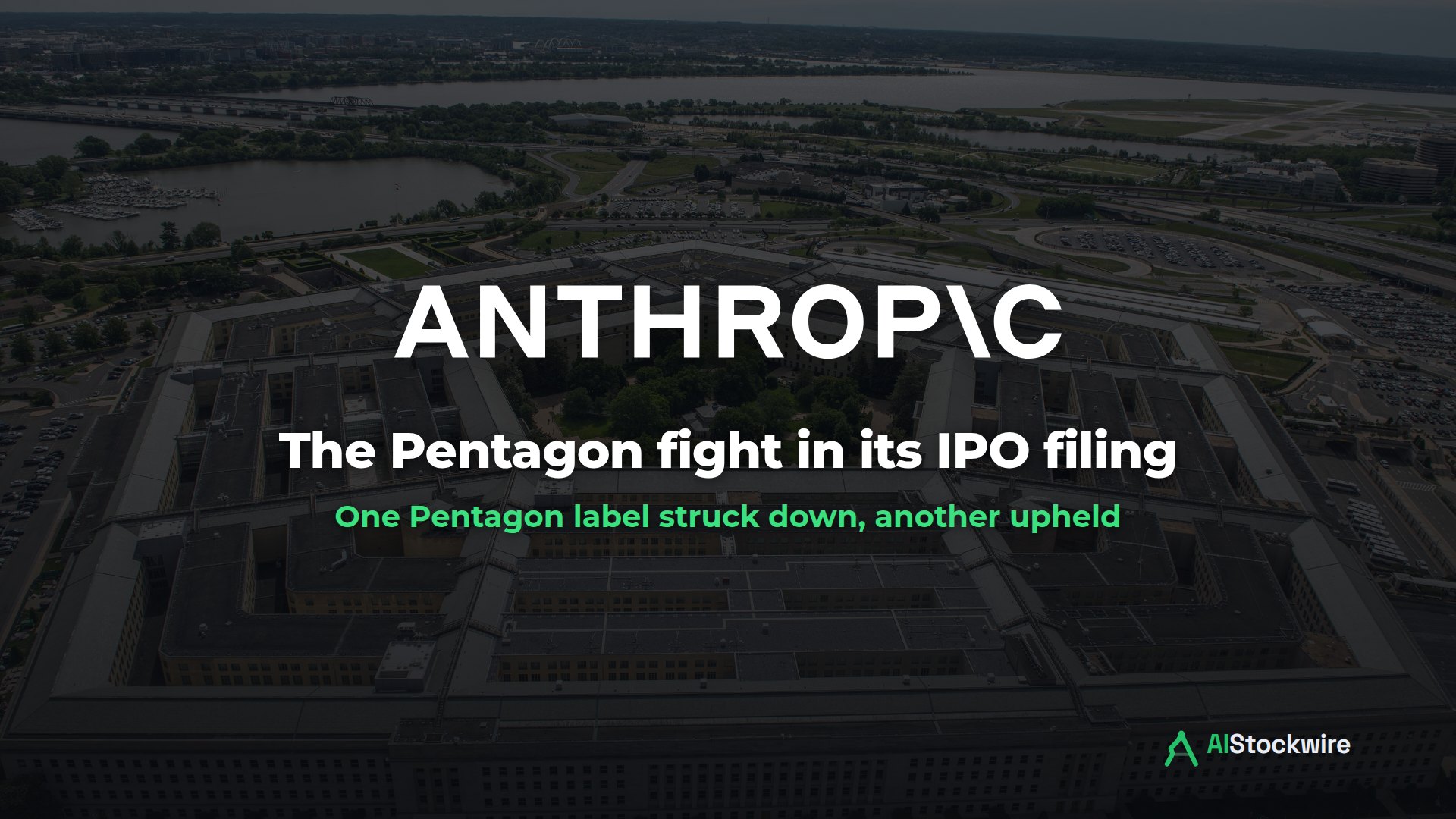
Government contracts account for less than 1% of Anthropic's annual revenue, but the company warns that its dispute with Washington could hurt its much larger commercial business. Its IPO prospectus says the US government's stance toward Anthropic could damage relationships with customers and partners, Reuters reported on Oct. 2.
The prospectus points to the Pentagon's move to label Anthropic a supply chain risk, a fight that is still in court. "The company may experience material revenue losses or business disruptions attributable to these events," Anthropic said in the filing.
The filing lists three actions by the government
In February, President Donald Trump ordered federal agencies to stop using Anthropic's models, and the Department of Defense designated the company a supply chain risk to national security, according to the prospectus. In June, the Commerce Department imposed worldwide export restrictions on Anthropic's Fable 5 and Mythos 5 models, and Anthropic disabled them for all customers to comply.
Commerce later lifted those restrictions, and Anthropic brought the models back. The company still warned that similar actions could happen again. They could cause "significant reputational harm, including adverse media coverage, public scrutiny, and negative perceptions among existing and prospective customers, partners, employees, and investors," regardless of how they turn out, the filing said.
Anthropic's warning appears to go beyond the policy risks government suppliers typically disclose, Reuters noted. The company says Washington's stance could also damage its relationships with commercial customers and partners.
Chief Financial Officer Krishna Rao estimated the potential losses in a court declaration filed in June. Even if customers interpreted the government's actions as applying only to Pentagon work, "hundreds of millions of 2026 revenue is at risk," he said. Defense contractors and other businesses dependent on the Pentagon were most likely to interpret the restrictions more broadly. Rao estimated that Anthropic could lose 50% to 100% of its revenue from those customers.
Across the business, Rao estimated potential revenue losses in 2026 of multiple billions of dollars, after accounting for how likely customers were to adopt the broadest interpretation. That estimate preceded the San Francisco court's August ruling.
The Pentagon used two different laws
The Pentagon didn't rely on a single designation. It labeled Anthropic a supply chain risk under two separate statutes, and the courts have treated them differently.
In San Francisco, US District Judge Rita Lin set aside the designation made under one of them, a defense procurement law, on Aug. 27. That law covers the risk that an "adversary" might sabotage a system. Lin wrote that the government's actions "were based on a desire to make a public example out of Anthropic for its 'arrogance' in criticizing the government, not based on any articulable basis to believe that Anthropic would actually sabotage its model," ABC News reported.
On Sept. 25, the US Court of Appeals for the D.C. Circuit upheld the other designation, made under the Federal Acquisition Supply Chain Security Act of 2018, by a 2-1 vote. The Pentagon had excluded Anthropic's Claude after the company refused to relax contract terms that bar its use for lethal autonomous warfare or domestic surveillance.
Judge Gregory Katsas, writing for the majority, said the Pentagon had "ample support" for its decision. He noted that Claude's built-in restrictions had stopped it from doing tasks government users asked for, and that a dispute over whether the contract allowed Claude's use in an overseas military operation left the department unsure it would work as needed. The court also rejected Anthropic's free-speech and due-process claims.
The appeals court distinguished the two laws. The defense procurement statute requires bad motive on the supplier's part, the majority said, while the broader 2018 law does not. It accepted the San Francisco court's conclusion that Anthropic had acted without such bad motive. Judge Karen LeCraft Henderson dissented. She wrote that the law doesn't cover "a contractor's honest and upfront enforcement of restrictions on a covered article's use disfavored by the government."
Anthropic is considering further review
Defense Secretary Pete Hegseth posted on X after the ruling, "Confirmed: @AnthropicAI = Supply Chain Risk," ABC News reported. Anthropic said it disagreed with the decision. "Another federal court has already held the government's parallel designation unlawful. We remain confident in our position and are considering all options, including further review," a spokesperson said.
The fight comes as Anthropic prepares to go public and faces other scrutiny in Washington. The Federal Trade Commission opened an industrywide probe of AI companies, including Anthropic, last month.