Key points
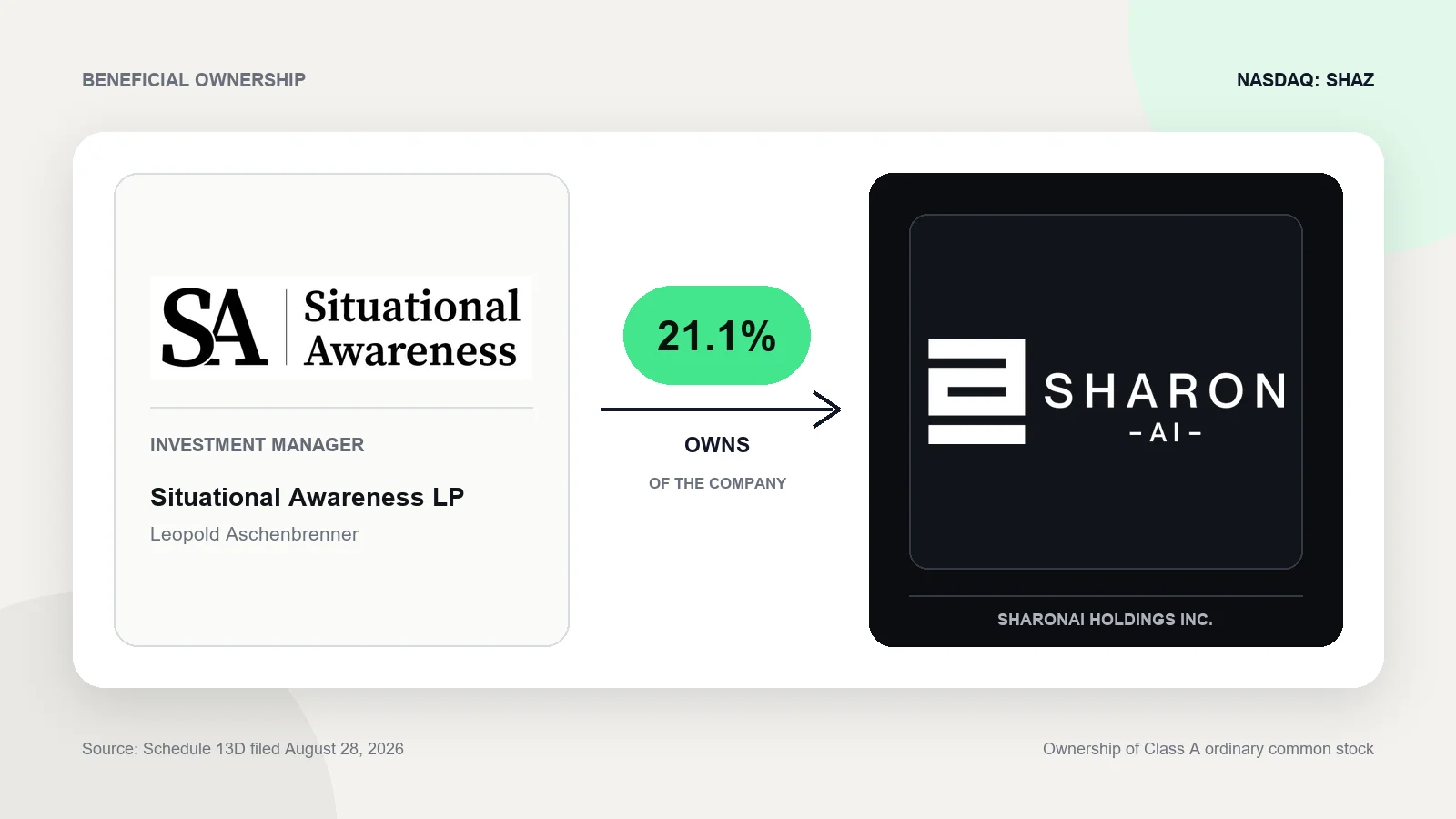
- Situational Awareness LP filed a Schedule 13D on August 28 reporting 8,070,950 shares of SharonAI Holdings (SHAZ), or 21.1% of the Class A stock, at a total cost of $523,882,863.
- The same share count was reported at 19.9% in an August 14 filing, under a 19.99% ownership limitation tied to the fund's warrants. The new filing counts everything and gives August 27 as the date the position crossed 20%.
- SHAZ fell 11.5% to $52.41 on August 28. At that price the position is worth about $423 million, about $101 million less than the fund paid.
Situational Awareness LP, the AI fund Leopold Aschenbrenner runs, told the SEC it owns 21.1% of SharonAI Holdings (SHAZ), an Australian AI cloud company that trades on Nasdaq. One month ago this was the fund at the center of the biggest forced-selling story of the summer. It's still sitting on a fifth of an AI data center company, and now it has to report that position on the form reserved for owners big enough to matter.
The Schedule 13D lays the position out as 8,070,950 Class A shares in total. That's 5,396,127 common shares plus prefunded warrants covering another 2,674,823, a warrant that's already paid for and converts to stock for a token price. The percentage is measured against the 35,667,164 shares outstanding SharonAI disclosed in a July 31 registration statement. Item 3 puts the money spent at $523,882,863.18, which works out to about $64.90 per share. Six reporting persons share the position, including Aschenbrenner himself and Carl Shulman, all with shared voting and shared dispositive power.
The purpose section, the part everyone checks first in a 13D, reads passive. The group says it bought "for investment purposes based on their belief that the Stock, when purchased, was undervalued and represented an attractive investment opportunity," and that it acquired nothing with the purpose of changing control of the company. So why file a 13D, the form associated with investors who might seek changes, instead of staying on the short-form 13G it had been using?
The same shares were 19.9% two weeks ago
The filing answers that question in its own words. It says the group is filing "because the Fund's beneficial ownership of the Issuer's Class A Ordinary Common Stock exceeds 20% of that class effective as of August 27, 2026." The passive route stops being available at that line, whatever your intentions.
Two weeks ago the story read slightly differently, and the difference is my favorite detail in the whole filing. On August 14 the same group amended its 13G and reported the same 5,396,127 shares and the same 2,674,823 warrants, but at 19.9%. That filing described the warrants as "subject to a 19.99% beneficial ownership limitation," a contractual cap that keeps a holder from exercising into a position above that level. Thursday's 13D counts the full 8,070,950 shares, calls the warrants prefunded, and says the threshold was crossed on August 27. What changed about the limitation between the two filings is something neither document explains. Crossing 20% also comes with a practical consequence. Material changes to a 13D position, generally a percentage point or more, have to show up in an amendment within two business days. If this fund buys more SharonAI or starts selling, we'll see it quickly, instead of waiting for the next quarterly report.
What the fund actually owns here
SharonAI is an Australian AI cloud and high-performance computing company run by co-founder and chief executive James Manning. On June 12 it announced a six-year collaboration with Nvidia (NVDA) covering 72 megawatts of new data center capacity in Australia and up to 40,000 Grace Blackwell GB300 GPUs. Manning called it access to compute for customers "who otherwise may not have been able to access it." On July 16 the company announced a $1.32 billion five-year cloud computing agreement with a global AI lab, with revenue expected to start in the first half of 2027.
The stock has covered a lot of ground while those announcements landed. It traded above $97 in mid-June and fell to $40.09 by late July. On August 27, the day the position crossed the line, it closed at $59.21. On Friday it dropped 11.5% to $52.41, a harder fall than the 3.2% decline in the broad semiconductor index fund SOXX that day. At Friday's close the fund's 8,070,950 shares are worth $423 million. The 13D says the fund spent $523.9 million, so it's sitting $101 million below cost.
A month after the forced selling
The context is what makes this filing worth reading twice. Situational Awareness lost about 67% in July, and Citadel bought most of its US stock positions at a discount in a deal reached just before the market opened on July 30. The SEC has since subpoenaed four Wall Street banks for records on the fund's trading and its borrowing. Its June 30 quarterly filing showed a portfolio dominated by SanDisk (SNDK) and Micron (MU).
The SharonAI position came through all of that. The fund first disclosed it in late June. The same share count appears in the August 14 filing and again in Thursday's 13D. Whatever got sold in July, this was kept.
What the filing leaves open is the part I'd most like to know. It reserves every option, from buying more in the open market to selling everything, which is standard 13D language that's in nearly every filing of the form. The event date and the vanished ownership limitation say something changed on August 27. The next amendment will say what they did about it. SharonAI's filings and coverage are on our SHAZ stock page.
Sources
- Situational Awareness LP, Schedule 13D on SharonAI Holdings, filed August 28, 2026, and its Schedule 13G/A, filed August 14, 2026
- Sharon AI, Nvidia collaboration announcement, June 12, 2026, and $1.32 billion cloud agreement announcement, July 16, 2026
- Closing prices for SHAZ are market data as of the August 28, 2026 session
This is general market commentary and opinion, not investment advice. Markets can go down as well as up, and you can lose money. Always do your own research and consider speaking with a licensed financial professional before making any investment decision.