Key points
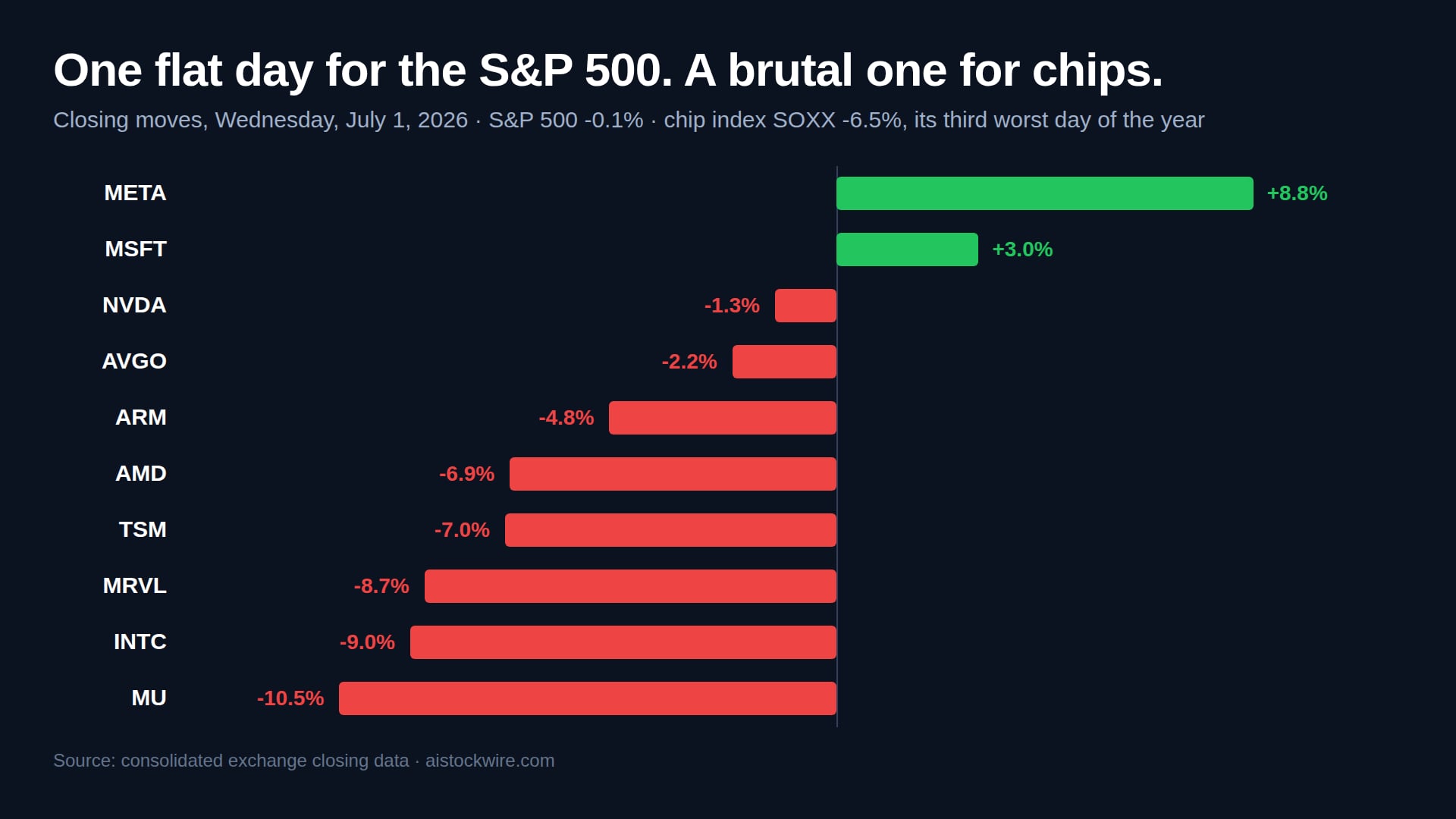
- The S&P 500 closed July 1 down about 0.1% while the chip index SOXX fell 6.5%, its third worst day of 2026.
- Micron (MU) dropped 10.5% to $1,033.29, Intel (INTC) lost 9.0%, and TSMC (TSM) fell 7.0%. Nvidia (NVDA) slipped just 1.3%.
- The money went to software: Meta (META) closed up 8.8% on its plan to rent out spare AI compute, and Microsoft (MSFT) rose 3.0%.
- So far this reads as rotation inside the AI trade, not an exit from it. The first level to watch is SOXX's late-June low near 590.
Here is the strangest part of Wednesday's session. If you only looked at the S&P 500, nothing happened. The index closed down about 0.1 percent, a rounding error. But if you owned chip stocks, July 1 was one of the worst days of the year. The chip benchmarks got crushed, with the SOXX semiconductor ETF down 6.5 percent for its third worst day of 2026. Only the June 5 plunge and the June 23 selloff were bigger.
That gap between a flat market and a bleeding sector tells you what actually happened. Money did not leave the market. It left the chip trade and went somewhere else, on the very first day of the new quarter.
The damage, name by name
| Stock | July 1 close | Day move |
|---|---|---|
| Micron (MU) | $1,033.29 | -10.5% |
| Intel (INTC) | $127.02 | -9.0% |
| Marvell (MRVL) | $271.95 | -8.7% |
| TSMC (TSM) | $444.36 | -7.0% |
| AMD (AMD) | $540.89 | -6.9% |
| Western Digital (WDC) | $598.37 | -6.3% |
| Super Micro (SMCI) | $27.65 | -5.7% |
| Seagate (STX) | $915.25 | -5.2% |
| Arm (ARM) | $337.47 | -4.8% |
| Broadcom (AVGO) | $369.35 | -2.2% |
| Nvidia (NVDA) | $197.58 | -1.3% |
The ETFs tell the sector story in one line: SOXX fell 6.5 percent and SMH fell 5.5 percent. Meanwhile the other side of the ledger was green. Meta closed at $612.92, up 8.8 percent. Microsoft gained 3.0 percent, and the IGV software ETF rose 3.1 percent. The Nasdaq-100 split the difference, down about 1.5 percent, and the S&P 500 barely moved at all.
The worst pain was not even in the chips. The neoclouds, the companies whose whole business is renting out AI compute, got hit hardest: CoreWeave (CRWV) fell 13.9 percent and Nebius (NBIS) dropped 17.0 percent by the close, even deeper than the midday numbers in our story on that group.
What set it off
The trigger was Meta. Bloomberg reported that Meta is building a cloud business to sell its spare AI computing power to outside customers, and the market spent the whole day working out the implications. For Meta, it means the $125 to 145 billion it plans to spend on data centers this year can start paying for itself. For everyone who sells AI hardware, it raises an uncomfortable question. If the biggest buyers of chips can rent out capacity they already own, do they need to keep buying at the same pace?
We walked through the mechanics in our rotation piece earlier in the day. What changed between then and the close is that the selling accelerated into the bell. The chip ETFs finished near their lows of the day, and midday drops of around 4 percent became closing drops of 5.5 and 6.5 percent.
The quarter turned, and the winners got sold
The second force at work was the calendar. July 1 was the first trading day of the third quarter, and the names that fell hardest were almost exactly the names that had run the most. Micron came into the day up about 304 percent for the first half, the best performer on our H1 scoreboard. Intel was up about 278 percent and Marvell about 251 percent. Those three finished as Wednesday's three biggest losers among the big chips.
Now look at Nvidia. It gained only about 7 percent in the first half, and on Wednesday it fell just 1.3 percent. The pattern is hard to miss. The selling tracked first-half gains almost perfectly, which is what profit taking looks like when a new quarter starts and funds lock in a monster run. Micron's own news on Wednesday was actually mixed, not bad. The company announced a long-term supply agreement with General Motors in the morning, locking in memory for GM's vehicles. The bear case making the rounds was a downgrade note on Seeking Alpha arguing that added supply from SK Hynix could ease the memory shortage into year-end and cool the pricing behind Micron's run. That debate is worth watching. But a stock that reported the best quarter in its history a week ago does not fall 10.5 percent on one cautious note. It fell because it had the biggest gains to take.
Rotation or something worse?
Here is the honest read. A flat S&P with software up 3 percent and chips down 6 percent is rotation, not liquidation. The money stayed in the market and it stayed in the AI theme. It just moved from the companies that build AI capacity to the companies positioned to monetize it, a debate we have been covering since the bubble-or-dip selloff in June. We now score that debate continuously in our AI Bubble Index.
That said, the chip tape is damaged. SOXX gave back all of Tuesday's 4.3 percent rally and more, closing back below Monday's close. Micron closed at $1,033.29, under the $1,100 level we flagged as the trend line on this week's Bullish Watch. The first test from here is SOXX's late-June closing low near 590. If that holds, Wednesday was a violent rebalancing day inside a bull market. If it breaks, the early-June floor around 540 comes back into the conversation, and the "rotation" story gets a lot weaker.
Thursday is the last trading day before the July 4 holiday, with markets closed Friday. Thin holiday tape cuts both ways, so expect the moves, in either direction, to look bigger than the conviction behind them.
Sources
- The Motley Fool, Market indexes start July with a tale of two tech stories (Meta's cloud announcement)
- Seeking Alpha, Micron is now everyone else's problem (rating downgrade) (the July 1 bear case on memory pricing)
- Closing prices and daily moves computed from consolidated exchange closing data, July 1, 2026.
This is general market commentary and opinion, not investment advice. Prices are July 1, 2026 closing prices and will move. Markets can go down as well as up, and you can lose money. Always do your own research and consider speaking with a licensed financial professional before making any investment decision.