Key points
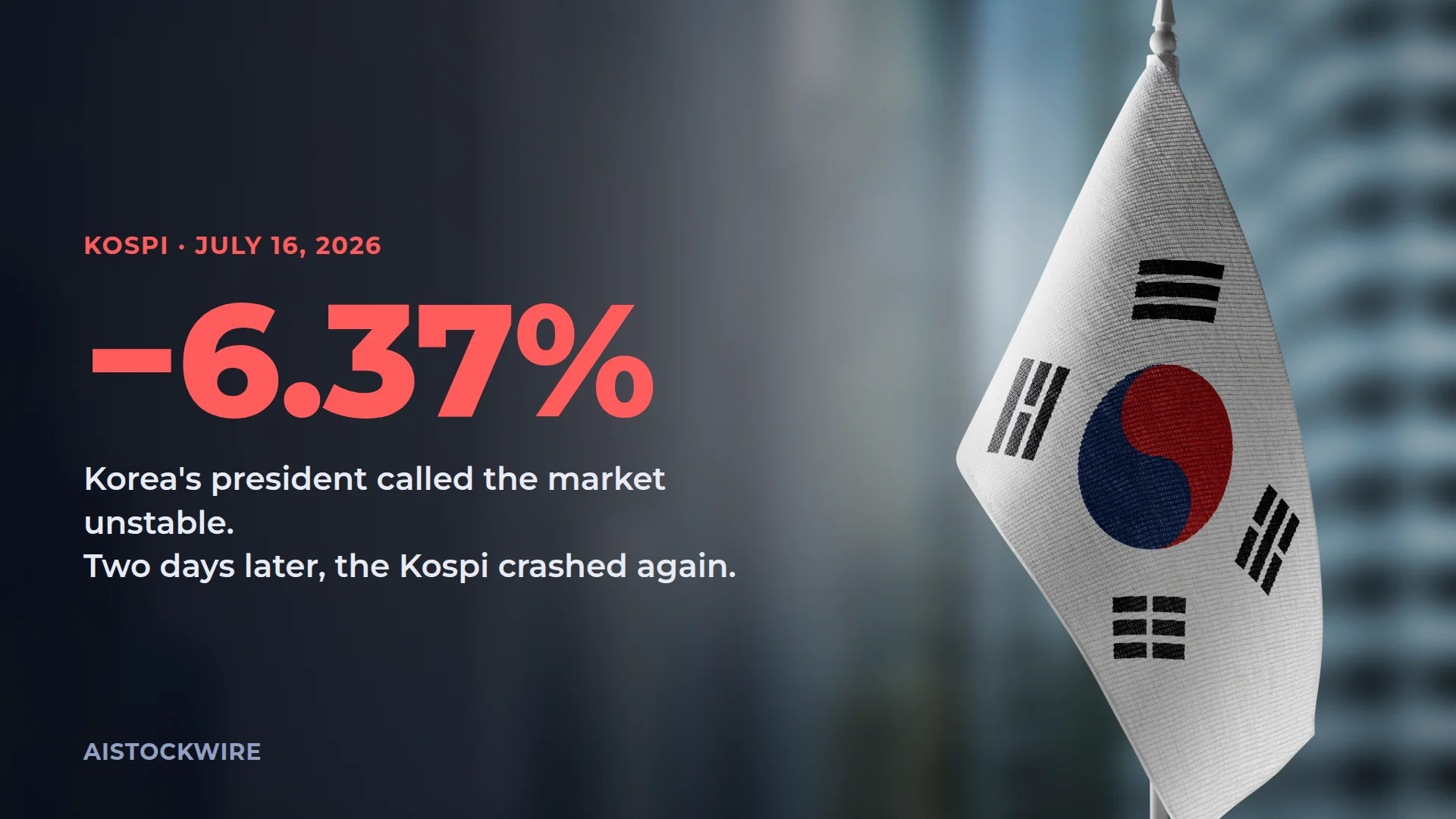
- The Kospi fell 6.37% Thursday to 6,820.60, its third close below 7,000 in a week, after a surprise Bank of Korea rate hike triggered a sell sidecar.
- Samsung Electronics fell 8.23% and SK Hynix fell 11.53% the same day, extending this month's memory-sector selloff.
- Two days earlier, President Lee Jae-myung called the market "quite unstable" and blamed leveraged ETFs tracking the two chipmakers for amplifying the moves.
- Regulators are also launching a debt hotline, 1375, in October after more than 320,000 accounts were forcibly liquidated and retail investors lost about 2.15 trillion won this month.
Update, July 17: Korean markets are closed Friday for Constitution Day, a national holiday that Korea brought back as a day off in 2026. That gives the Kospi a one-day pause after this week, and regular trading is set to resume Monday.
I wrote about a Kospi crash just a few days ago, and I did not think I would be back again so soon. The index fell another 6.37% on Thursday, the third time it closed below 7,000 in less than a week. Two days before that, President Lee Jae-myung said the market is unstable, in plain words, at a policy meeting in Seoul. Then the government did something I have not seen here before: it rolled out a new hotline aimed at stopping leveraged stock losses from turning into suicides.
A rate hike broke the climb
The Korea Exchange tripped a temporary sell sidecar Thursday morning after the index briefly fell more than 7% intraday, a mechanism that slows down program-driven selling without fully halting the market. By the close, the Kospi was down 463.81 points, or 6.37%, at 6,820.60. The Kosdaq, the smaller exchange, fell 4.53% to 791.84.
This time, the trigger sat inside Korea's own economy, not the Middle East. The Bank of Korea raised interest rates in a surprise move, its first hike since 2023 according to local reporting, right as investors were already looking to sell after months of AI chip gains. Higher rates make the leverage everyone here has been using more expensive to carry, on top of tightening financial conditions generally. The United States and Iran are still trading threats too, the same conflict that first triggered a circuit breaker here three days earlier, and it kept sentiment shaky underneath everything else going on Thursday.
Samsung Electronics closed at 255,000 won, down 8.77%. SK Hynix closed at 1,842,000 won, down 11.53%, worse than Samsung again, a pattern this site has flagged before. Money moved into safer stocks instead. Biotech and healthcare names gained 3.8% to 6% on the day, a sign people had stopped trying to buy right into the drop.
The president said what everyone already knew
On Wednesday, before any of this, Lee Jae-myung told a policy meeting in Seoul: "Our domestic stock market is quite unstable." He said the market had gone through what he called a historically unprecedented surge in such a short period that it would take time and more volatility to settle down. This time he went further and named the actual problem: leveraged ETFs tracking Samsung and SK Hynix, which rebalance every day to deliver their promised return and end up amplifying whatever direction the two stocks are already moving. He directed the heads of the Financial Supervisory Service and the Korea Exchange to prepare fixes quickly. Market watchers expect that could mean higher minimum deposit requirements on those ETFs, among other measures.
Hearing a president say this out loud felt strange to me, honestly, mostly because none of it was news to anyone who actually trades here. The Kospi is still up more than 70% for the year even after a 20% drop from its June peak put it in a technical bear market. It rose 6.2% on the very same Wednesday he spoke. A market that can gain more than 6% and lose more than 6% inside 48 hours is exactly what he meant by unstable. Two stocks are close to half the index here, and the leverage tools traders use go up to ten times their money. I wrote about why that combination makes the Kospi move this way here.
What the leverage crisis is doing to ordinary traders
A few numbers from South Korean regulators show the size of it this month.
| Measure | Figure |
|---|---|
| Forced liquidations, July 13 alone | 344.2 billion won |
| Forced liquidations, single day, July 9 | 142.2 billion won |
| Accounts that hit margin call levels this month | Over 1.2 million |
| Accounts actually forced to sell | 320,000 to 460,000, some into negative equity |
| Total retail losses this month | About 2.15 trillion won, close to $1.5 billion |
| Share of affected accounts held by investors in their 20s and 30s | 62% |
That last line stands out to me. It says something real about who is actually exposed here. The chip gains that started this whole run pulled in a lot of younger traders who had not been through a real correction before. When Samsung and SK Hynix move the way they did this month, the people holding the most leverage are often the ones with the least room to absorb it.
Behind the new hotline
Two days before Thursday's crash, the Financial Services Commission unveiled what it is calling the Economic Crisis Family Suicide Prevention Plan. The centerpiece is a new nationwide number, 1375, launching in October and run by the Credit Counseling and Recovery Service. 1375 is different from Korea's existing 24-hour suicide prevention line, 1393. It routes callers into debt restructuring and bankruptcy filing help, plus employment and welfare support, on the idea that fixing the debt itself is the fastest way to help someone in this situation. The line is toll-free.
FSC Chairman Lee Eog-weon put the reasoning bluntly. At a cabinet meeting, he said: "The suicides caused by the economic crisis are a form of social murder." Officials do not use a phrase like that lightly. To me, it reads as the government finally treating this month's losses as a public health problem, the same weight it would give an actual health emergency.
If you or someone you know is struggling, Korea's Suicide Prevention Hotline is 1393, available 24 hours.
What regulators do next
Financial regulators were expected to hold an emergency meeting on Thursday, the same day the Kospi fell again, to discuss tighter restrictions on the leveraged ETFs the president named two days earlier. Samsung and SK Hynix together make up close to half of the entire Kospi, so whatever comes out of that meeting could shape how violently this index moves well past this month. Our markets desk also looked at how this crash spread into US chip stocks the same day.
Sources
- Seoul Economic Daily: Kospi closes down 6.37% at 6,820.60
- Sunday Guardian Live: Why the Korean stock market fell on July 16
- BigGo Finance: South Korea's retail investors lose 2.15 trillion won; government launches 1375 debt hotline
- Our earlier coverage: why Kospi moves so violently, the July 13 circuit breaker, and the Samsung and SK Hynix rebound
Figures in this piece are sourced from South Korean financial media, Korea Exchange trading data, and public statements from the Financial Services Commission and President Lee Jae-myung. This is not investment advice. If you are in financial distress, please reach out to a licensed professional or Korea's Suicide Prevention Hotline, 1393.