Key points
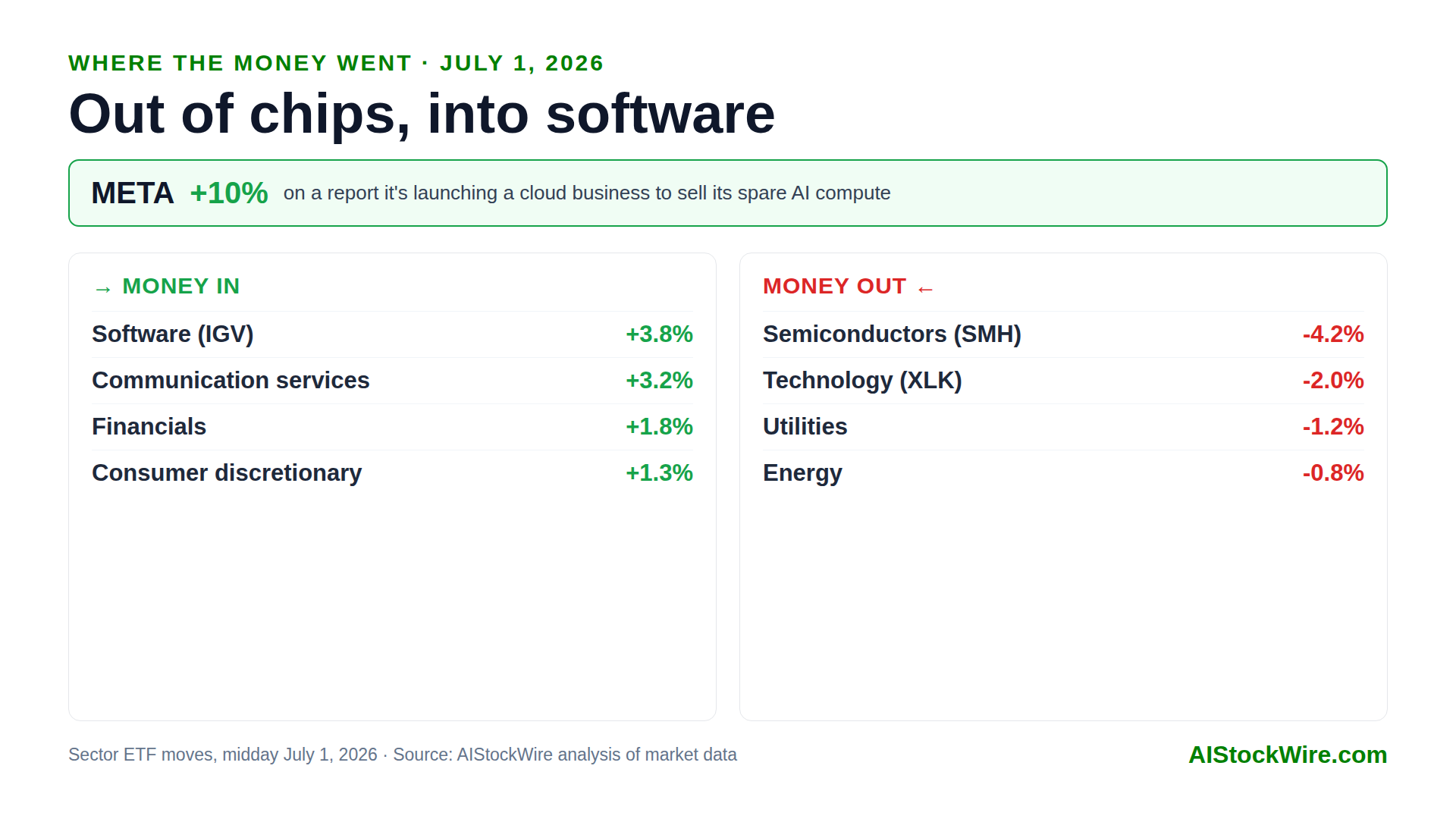
- Money rotated out of chips and into software on July 1, 2026. The software ETF (IGV) rose about 3.8% while the semiconductor ETF (SMH) fell about 4.2%.
- Meta (META) jumped about 10% on a report it will launch a cloud business selling its spare AI computing power. It was the day's biggest story.
- Six of the Magnificent Seven rose, led by Meta, with Microsoft (MSFT) up about 3% and Apple (AAPL) about 2%. Only Nvidia (NVDA) fell, down about 2% with the chips.
- SaaS names ran hard: ServiceNow (NOW) +6%, Salesforce (CRM) +5%, Palantir (PLTR) +9%. Financials (+1.7%) also had a strong day.
The headline numbers looked sleepy on Tuesday. The S&P 500 was basically flat by late morning. But that calm hid one of the sharpest rotations in weeks. Under the surface, traders were pulling money out of the chipmakers that led the AI trade for two years and pushing it into software, and the spark was a single headline out of Meta.
The one-line story: out of chips, into software
Here is the whole day in two numbers. The software ETF (IGV) rose about 3.8 percent. The semiconductor ETF (SMH) fell about 4.2 percent. That is an eight-point gap between two corners of tech in a single session, and it tells you exactly where the money went.
The Nasdaq (QQQ) actually finished the morning down about 1 percent, dragged lower by the chips, even as the average stock did fine. This was not a "risk-off" day. It was a "different risk" day.
Meta's cloud bombshell
The catalyst was Meta (META), up about 10 percent. Bloomberg reported that the company is building a cloud business to sell its spare AI computing power to outside customers, the same thing Amazon does with AWS and Microsoft does with Azure. Meta has guided to $125 billion to $145 billion of capital spending in 2026, most of it on AI data centers, and investors have spent months worrying about that bill. Turning that hardware into a product that other companies rent flips the story: the capex stops being a black hole and starts being a revenue line. It also makes Meta a rival to the neo-clouds like CoreWeave and Nebius we have written about. We track that spending against what has actually been committed in our AI Bubble Index.
The software and SaaS surge
Meta was the loudest name, but the move was broad across software. ServiceNow (NOW) rose about 6 percent, Salesforce (CRM) about 5 percent, and Palantir (PLTR) about 9 percent. Adobe (ADBE), Datadog (DDOG) and Snowflake (SNOW) all gained 2 to 3 percent. When an entire sector moves together like that, it is a rotation, not a reaction to any one company's news.
The rest of the Magnificent Seven came along for the ride. Microsoft (MSFT) added about 3 percent, Apple (AAPL) about 2 percent, Amazon (AMZN) about 1.5 percent, Tesla (TSLA) about 1.3 percent, and Alphabet (GOOGL) about 1 percent. Six of the seven were green.
The odd one out: chips paid for it
The seventh was Nvidia (NVDA), down about 2 percent, and it had company. The whole semiconductor group was the source of funds for the day's buying. SMH fell about 4.2 percent and the broad tech sector (XLK) dropped about 2 percent, almost entirely because of the chips inside it. Nothing about the AI build-out changed on Tuesday. Money simply moved from the companies that make the picks and shovels to the ones that sell the software running on top. We mapped this same shift earlier in the week in our AI rotation map.
What else was working
The buying went beyond software. Financials (XLF) rose about 1.7 percent, one of the day's quiet winners. Consumer discretionary (XLY) added about 1.1 percent, helped by Amazon and Tesla. Health care and materials each gained less than a percent. On the other side, the defensive and cyclical corners lagged: utilities fell about 1.1 percent, energy about 0.8 percent, and industrials about 0.6 percent, alongside the chips. It was a day that rewarded software and banks and punished hardware and bond-proxy sectors.
Why it matters
Zoom out and this is the trade of 2026 quietly changing shape. For two years the winners were the companies that build AI: Nvidia and the chip supply chain. Tuesday was a bet on the companies that monetize it: the software platforms that turn AI into products people pay for, and now Meta, which is trying to rent out the very infrastructure it built. That does not mean chips are finished. It means the market is starting to ask a harder question about who actually makes money from all this spending. Rotations like this can reverse in a day, so one session is a clue, not a verdict.
Bottom line
A flat tape hid a real move on July 1: out of semiconductors, into software and the AI platforms. Meta's plan to sell its spare computing power was the spark, SaaS names and the rest of the Magnificent Seven caught the updraft, and the chips funded it all. Watch whether the software strength holds into the rest of the week or whether the chips snap back, because the two have been trading places all year.
This article is for information only and is not investment advice. Prices are intraday and approximate as of midday on July 1, 2026, and will change. Always do your own research before buying any stock.