Key points
- SharonAI Holdings (SHAZ) is a small, fast-growing GPU-cloud company that rents out Nvidia AI chips. It is one of only three Nvidia Cloud Partners in Australia.
- Leopold Aschenbrenner's Situational Awareness fund opened a stake in its May 13F and just took it to 19.9%, while co-anchoring a $1.6 billion fundraise.
- Since that stake first became visible in mid-May (around $57.50), SHAZ has climbed to about $88, up more than 50%, with a spike to a $97 high on June 17.
- It is a high-risk name: only about 12.6 million shares trade freely, no profits, founded only in December 2024, and big dilution coming from the raise. The story is real, but so is the volatility.
The fun of running a fund tracker is catching a filing like this one: a sharp investor quietly builds a position, the disclosure hits, and you get to watch what happens next. SharonAI Holdings (SHAZ) is exactly that kind of story. Leopold Aschenbrenner, the former OpenAI researcher whose "Situational Awareness" essay made him a name in AI circles, has been buying it, and the stock has been on a tear. Here is the company, the position, and the price action from when we could first see it to now.
What SharonAI actually does
SharonAI is in the business of renting out AI computing power. Training and running modern AI models takes enormous numbers of Nvidia GPUs, and most companies cannot or do not want to spend billions building their own data centers to get them. SharonAI buys and operates that hardware and rents it out, a model often called a neo-cloud, the same lane as larger names like CoreWeave and Nebius. Its customers are AI labs, big tech companies, research institutions, and industries with strict rules about where their data lives.
The detail that sets it apart is its position in Australia. SharonAI is one of just three Nvidia Cloud Partners in the country, which means it gets early access to Nvidia's newest chips and can sell directly to enterprise customers. It has lined up a six-year collaboration with Nvidia valued at up to $4.88 billion to build out AI infrastructure there, including 72 megawatts of new data center capacity and up to 40,000 of Nvidia's Grace Blackwell GB300 GPUs. On the demand side, it has signed two big multi-year deals. One is a $1.25 billion, five-year contract with ESDS, an IT services firm in India. The other is a $950 million, five-year take-or-pay deal with an unnamed Asia-Pacific tech firm, which means the customer pays whether or not it actually uses the capacity.
Those are very large numbers for a very small company. SharonAI was founded only in December 2024. It's headquartered in New York, run by CEO James Manning, and has around 30 employees, with a market value near $1.5 billion and no profits yet.
Why Leopold Aschenbrenner's involvement matters
Aschenbrenner runs Situational Awareness LP, an AI-focused fund that has grown quickly, disclosing about $13.7 billion in reportable securities in its most recent quarterly filing, more than double three months earlier. He is not a passive index buyer; he places concentrated bets around a specific view of how the AI buildout plays out, and the market pays attention when he moves. Notably, his fund pairs big bets on AI infrastructure with large put positions against semiconductor stocks, a barbell that says he is positive on compute capacity but cautious on chip valuations.
His SharonAI position has grown in two steps. First, Situational Awareness disclosed its position in the May 18 quarterly 13F filing, valued at roughly $18 million, which is when the rest of us could first see it. Then, on June 30, a Schedule 13G revealed the fund had taken its stake all the way to 19.9 percent of the company, holding about 1.7 million shares plus warrants for another 6.4 million. Alongside that, Situational Awareness co-anchored a $1.6 billion private placement: roughly $900 million in stock and pre-funded warrants, plus $700 million in convertible notes due 2032. That money is earmarked for the Nvidia data center buildout. This is the same fund that also holds a stake in IREN, another compute-and-power name, so SharonAI fits a clear pattern in how Aschenbrenner is playing the theme.
The price action, from when we could see it to now
When that first 13F hit on May 18 and the position became public, SHAZ was trading around $57.50. As of midday on June 30 it was near $88, up about 9 percent on the day on the news of the 19.9 percent stake. That is a gain of more than 50 percent in the roughly six weeks since the stake became visible, and the stock had already run far before that, from a 52-week low of $0.99 last July.
| Date | What happened | SHAZ price |
|---|---|---|
| Jul 2025 | 52-week low | $0.99 |
| May 18, 2026 | Situational Awareness 13F discloses the stake | about $57.50 |
| Jun 17, 2026 | Run to a 52-week high | $97.48 (intraday high) |
| Jun 30, 2026 | 13G shows the 19.9% stake | about $88 (+9% on the day) |
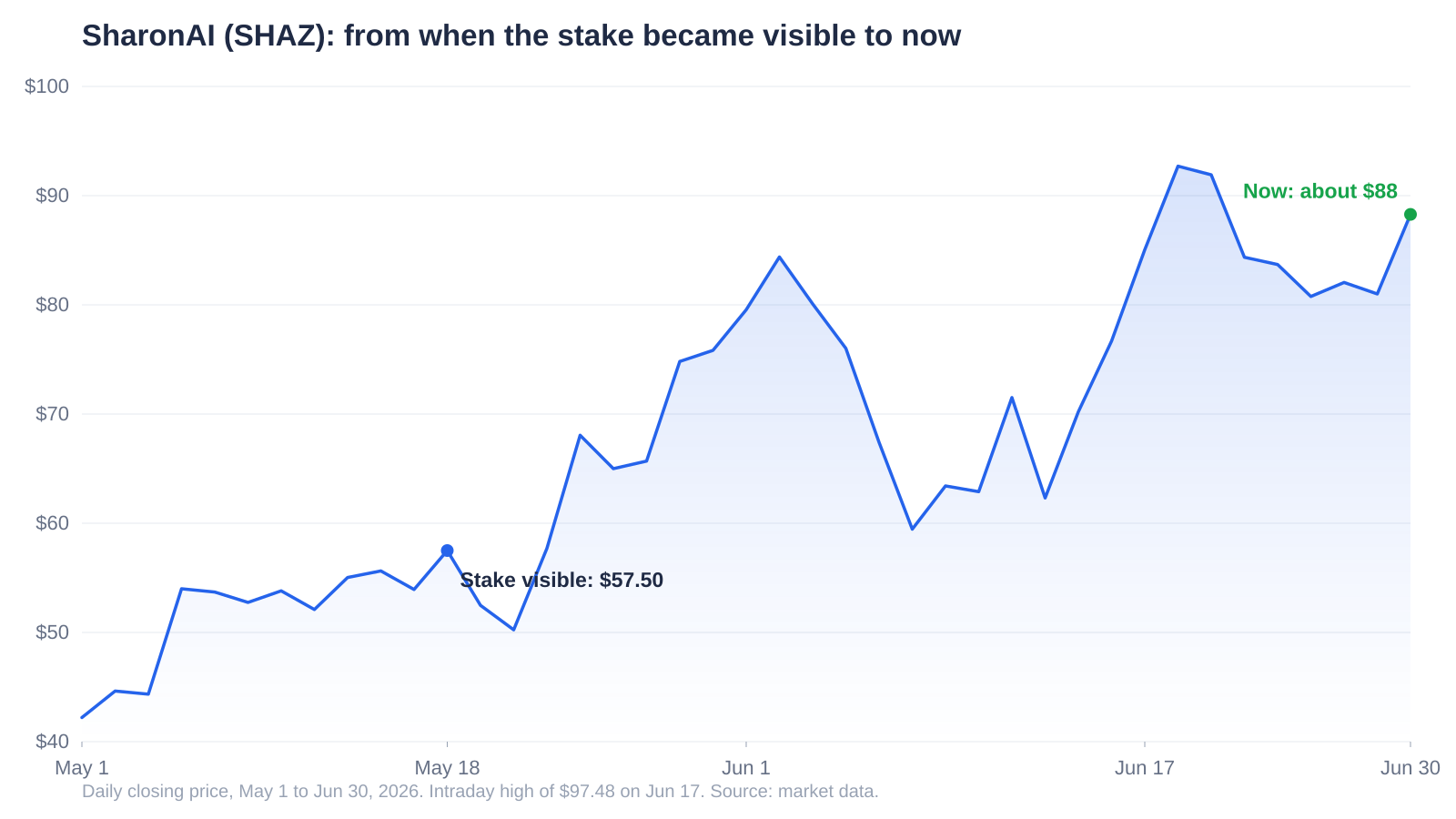
A big reason the moves are this violent is that only about 12.6 million shares trade freely, so it does not take much buying or selling to move the price several percent. That cuts both ways, and it is the first thing to understand before reading anything into a one-day move.
Why it has run, and what could trip it up
The climb has come from a mix of real catalysts and market mechanics. On the catalyst side: AI computing is in short supply, SharonAI has early access to Nvidia's newest chips in a region with demand, it has signed multi-year, multi-billion-dollar contracts, and a closely watched investor keeps adding to it. On the mechanics side, only about 12.6 million shares trade freely, so relatively small amounts of buying or selling move the price a lot.
The same factors cut the other way. The company is barely a year old and not profitable. The contracts are large but unproven, and a take-or-pay deal is only as good as the customer behind it. The $1.6 billion raise that funds the buildout also means heavy dilution down the line, a lot more shares and warrants. That same thin trading powers the upside and the downside equally fast, and the valuation already assumes a lot goes right. None of that says the story is wrong, only that the margin for error is thin.
What to watch
The things that would move the story from here: progress and revenue from the ESDS and Asia-Pacific contracts, how quickly the Nvidia GPUs actually get deployed in Australia, the terms and timing of the $1.6 billion financing as it converts into shares, and whether Situational Awareness adds to or trims the position. You can follow Aschenbrenner's filings on our Situational Awareness fund page. None of this is investment advice; it is a map of what a notable investor bought, what the company is, and what the stock has done.
This is general market commentary and opinion, not investment advice. Markets can go down as well as up, and you can lose money. Always do your own research and consider speaking with a licensed financial professional before making any investment decision.