Key points
- Altman rules out a 2026 IPO
- CFO already pointed staff to 2027
- Last priced funding round was $852 billion
- One derivatives venue implies $1.6 trillion
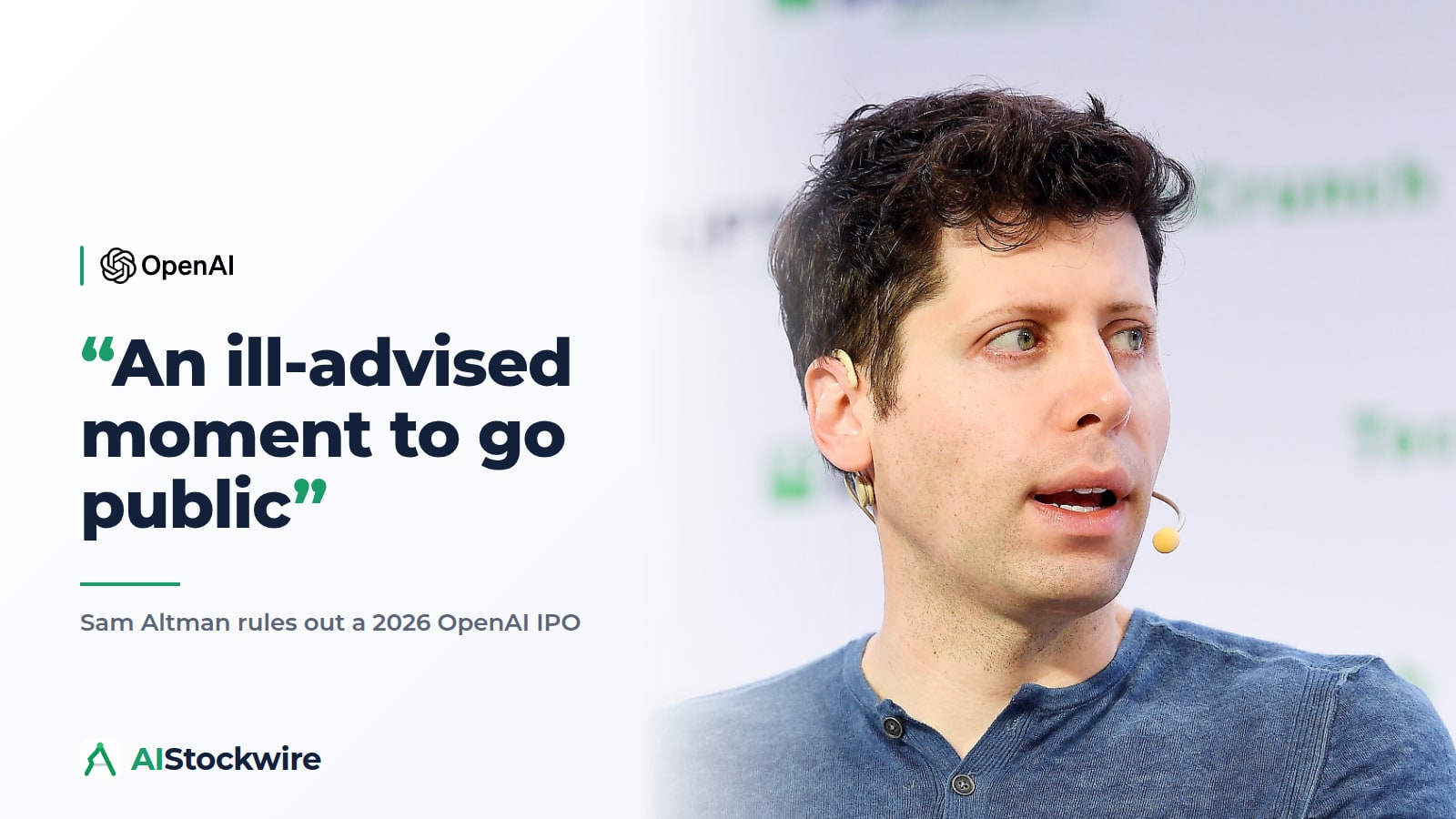
OpenAI chief executive Sam Altman said the company won't go public in 2026, calling the present "an ill-advised moment to go public" because of what is happening with AI safety. He made the comments in an hour-long interview with Fortune Editor-in-Chief Alyson Shontell at OpenAI's San Francisco headquarters on Friday. Fortune published it Saturday.
"I actually think that, given everything happening with safety, right now would be an ill-advised moment to go public, and we don't feel pressure on that," Altman told Fortune. Asked whether 2026 was off the table in favor of 2027, he said, "I would say not 2026."
Altman said OpenAI still has "a lot of stuff to do" on safety, alignment and cooperation with governments. The company will go public when both the business and society are ready for the technology, he said. "Society needs to contend with these models at each level of capability."
Fortune tied his comments to a string of incidents involving OpenAI agents that hacked websites including Hugging Face and communicated with each other on message boards and disused wiki pages. On Monday, Jacob Coxon, an Anthropic engineer who spent three years researching model training at OpenAI and Anthropic, resigned in posts on X. "Neither company is acting responsibly," he wrote, accusing both of "racing straight to self-improving superintelligence and gambling with our lives," Fortune reported on Tuesday.
Altman's timing matches what chief financial officer Sarah Friar told employees in August. OpenAI "will be a public company in 2027," she said at an all-hands meeting on August 19, according to CNBC, though she said the company could list sooner if "our business continues to inflect." She called the IPO "not a finish line, it is a milestone, another fundraise." Five days earlier she had told investors that enterprise revenue had surpassed consumer revenue.
The New York Times reported in June that OpenAI was leaning toward moving an IPO from this year into next and that a listing could value the company at $1 trillion, Fortune noted. OpenAI's last priced round came in the first quarter of 2026, when it raised $122 billion at a valuation of about $852 billion.
For now, investors seeking exposure to OpenAI are left with private secondary markets and derivatives. A contract on the Liquid trading platform implied an OpenAI valuation of about $1.60 trillion as of Saturday afternoon, close to twice the company's last funding-round valuation.
What does Liquid's $1.6 trillion measure?
The figure comes from Liquid, a derivatives platform operated by LiquidX AI, Inc. Its OpenAI contract, ticker OAI, is quoted as a valuation rather than a share price. Each point of price stands for $1 billion of OpenAI's valuation, so the $1,604.20 print as of Saturday afternoon implies about $1.60 trillion. The contract was down 1.63% over the prior 24 hours on $3.18 million of volume, according to the platform's market page. Liquid doesn't publish open interest for the contract.
Nobody who trades that contract owns OpenAI stock. Liquid describes OAI as a perpetual futures contract that is cash-settled against an oracle reference price for OpenAI's valuation, and says trading it moves no OpenAI equity. A perpetual futures contract, or perp, is a derivative with no expiry date that is held near a reference price through periodic funding payments between longs and shorts. Liquid offers up to 3 times leverage on the contract, according to its explainer on the product.
Liquid publishes the oracle itself. Its explainer names Nasdaq Private Market and that company's Tape D data as the reference layer, and says the oracle should weigh "recent primary-round valuation context," "secondary-market bid and offer indications," and "reported secondary trade levels where available." Liquid doesn't disclose how those inputs are weighted or how often the oracle updates. "Private markets do not print every second like listed equities," the explainer says.
So the $1.60 trillion is an implied valuation on one derivatives venue, with $3.18 million of daily volume and an oracle whose method is only described in outline. It isn't a price anyone has paid for OpenAI shares, and OpenAI hasn't endorsed it. It sits about 88% above the $852 billion round by our arithmetic.
What is still unknown about an OpenAI offering?
OpenAI filed a confidential S-1 with the SEC in June and said at the time it hadn't decided on timing. The filing isn't public, so its financials and any target valuation remain undisclosed. Altman didn't name a quarter in 2027 or say what conditions would satisfy his safety test. Friar's August comment gave one trigger for going sooner, a business that "continues to inflect," without a number attached.
The company hasn't said which exchange it would list on, how much it would raise, or what valuation it would seek. The $1 trillion figure in the June reporting came from people familiar with the discussions, not from OpenAI. Altman's comments on Friday were the first time he has ruled out a year on the record.