Key points
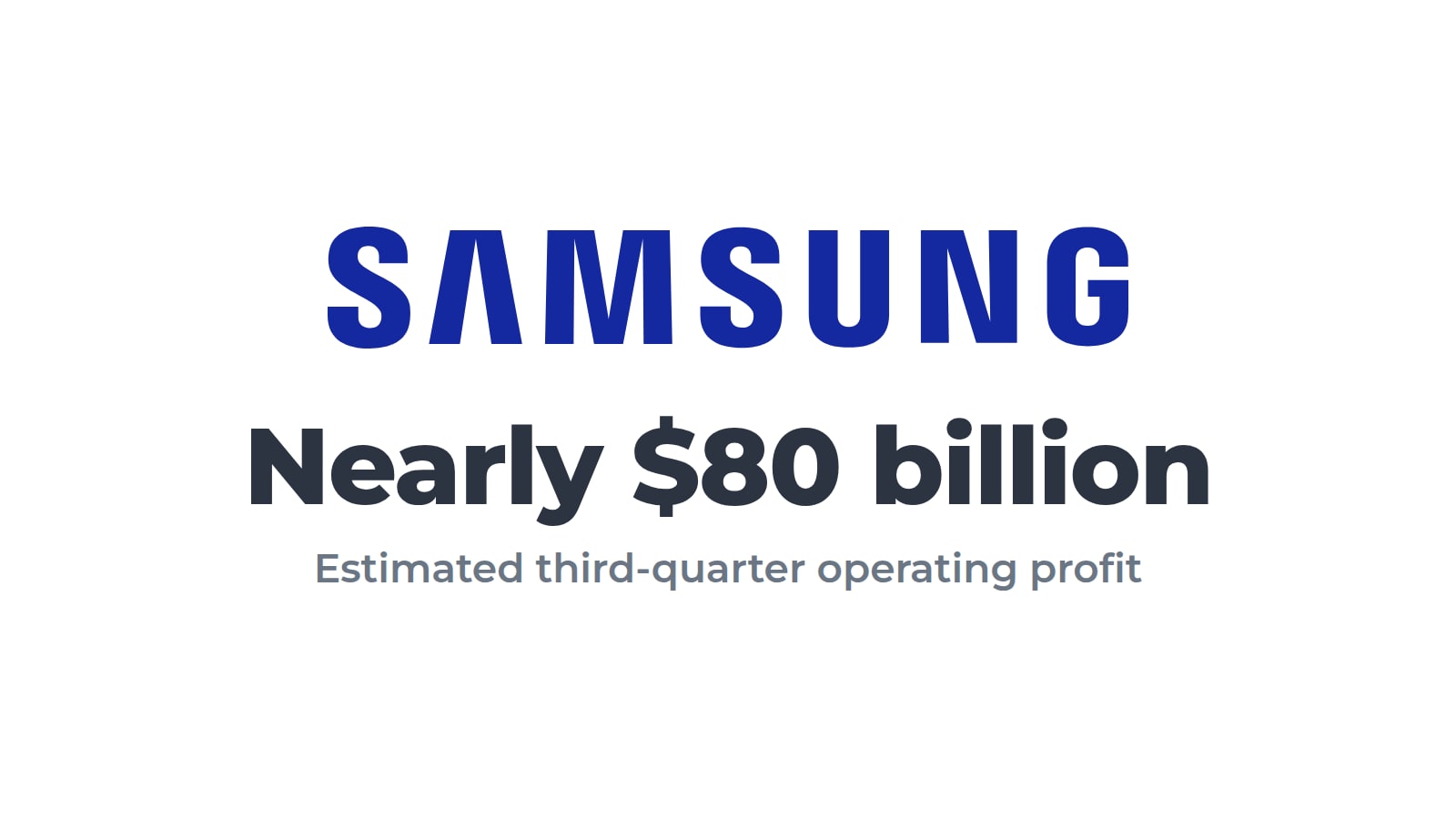
- Samsung estimates third-quarter operating profit at 107.4 trillion won ($79.9B)
- That's almost nine times the profit a year earlier
- The operating margin reached a record 55.1%
- Detailed results come out October 29
On October 8, Samsung Electronics (005930) estimated its third-quarter operating profit at 107.4 trillion won ($79.9B), putting Samsung on course to become the first Korean company to report more than 100 trillion won ($74.4B) in quarterly operating profit. Reuters called it "a world first for a technology company."
A year earlier, Samsung's operating profit was 12.17 trillion won ($9.1B). The new figure is 782.5% higher, or almost nine times as much. Revenue rose 126.6% to 195 trillion won ($145.0B).
Samsung's operating margin was 55.1%, a record for the company. This is Samsung's fourth straight quarter of record operating profit.
Memory profit beat Meritz's forecast
The estimate came in slightly above an LSEG SmartEstimate of 106.1 trillion won ($78.9B). The result was below the FnGuide consensus of 108.7 trillion won ($80.8B) a week earlier.
Samsung's preliminary numbers don't split profit by business, so the memory figure below is a broker's own estimate. Kim Sun-woo (김선우), an analyst at Meritz Securities (메리츠증권), said memory profit beat the firm's latest forecast by more than 2.2 trillion won ($1.6B).
"Even though the sharp rise of the won created an unfavorable business environment, a firm pricing policy that again beat the industry average drove the results," Kim said.
"As the industry leader, Samsung Electronics is keeping its price leadership in DRAM and NAND over its competitors, based on the pricing power it built up through many past industry cycles," Kim continued.
Samsung shares fell with the Kospi
Samsung shares closed down 2.42% at 262,000 won ($195) on October 8, their third straight decline. The Kospi fell 2.62% to 6,625.93, and SK Hynix fell 2.44%. Samsung's record close was 362,500 won ($270) on June 18.
Maeil Business (매일경제) pointed to an ETF rebalancing and the end of Samsung's buyback, along with higher US bond yields and oil prices. Some semiconductor ETFs had to cut Samsung below 25% of their holdings in a rebalancing, which brokers estimated at about 200 billion won ($149M) of selling. Samsung also finished buying back shares for employee stock awards and hasn't bought any since October 7.
Kim Dong-won (김동원), head of research at KB Securities (KB증권), called the current valuation extreme. "With the price-to-earnings ratio staying at around 5 times, the current situation is an extreme undervaluation, and it is hard to find grounds to justify a valuation discount," Kim said.
Investors are asking about 2027 and 2028
Han Ji-young (한지영), an analyst at Kiwoom Securities (키움증권), said the market's question has moved past this year.
"Rather than worries about the chip industry getting worse, it is because the market's expectations for chip stocks have risen that the focus has shifted from earnings for the rest of this year to whether profits can last from next year on," Han said.
"In the end, the market's concern is less about changes in memory demand right now than about whether tight supply and high margins can hold after 2027 and 2028, when the three memory makers' capacity expansions get fully underway," Han continued.
Samsung will release detailed results, including profit by business, on October 29, and hold a conference call the same day. Analysts expect fourth-quarter profit to grow 8.2% from the third quarter. The third quarter grew 20% from the second, when operating profit was 89.4 trillion won ($66.5B).
Meanwhile, Korea's stock market is closed on October 9 for Hangeul Day. Trading resumes on October 12.
The analyst comments are translated from Korean. Won figures are converted at 1,344.5 won to the dollar, the Naver Finance rate on October 8, 2026.