Key points
- A former energy CEO now sits in the Senate
- Sold up to $25M of Williams stock in June
- The August entries are logged as options
- We could not read the underlying filing
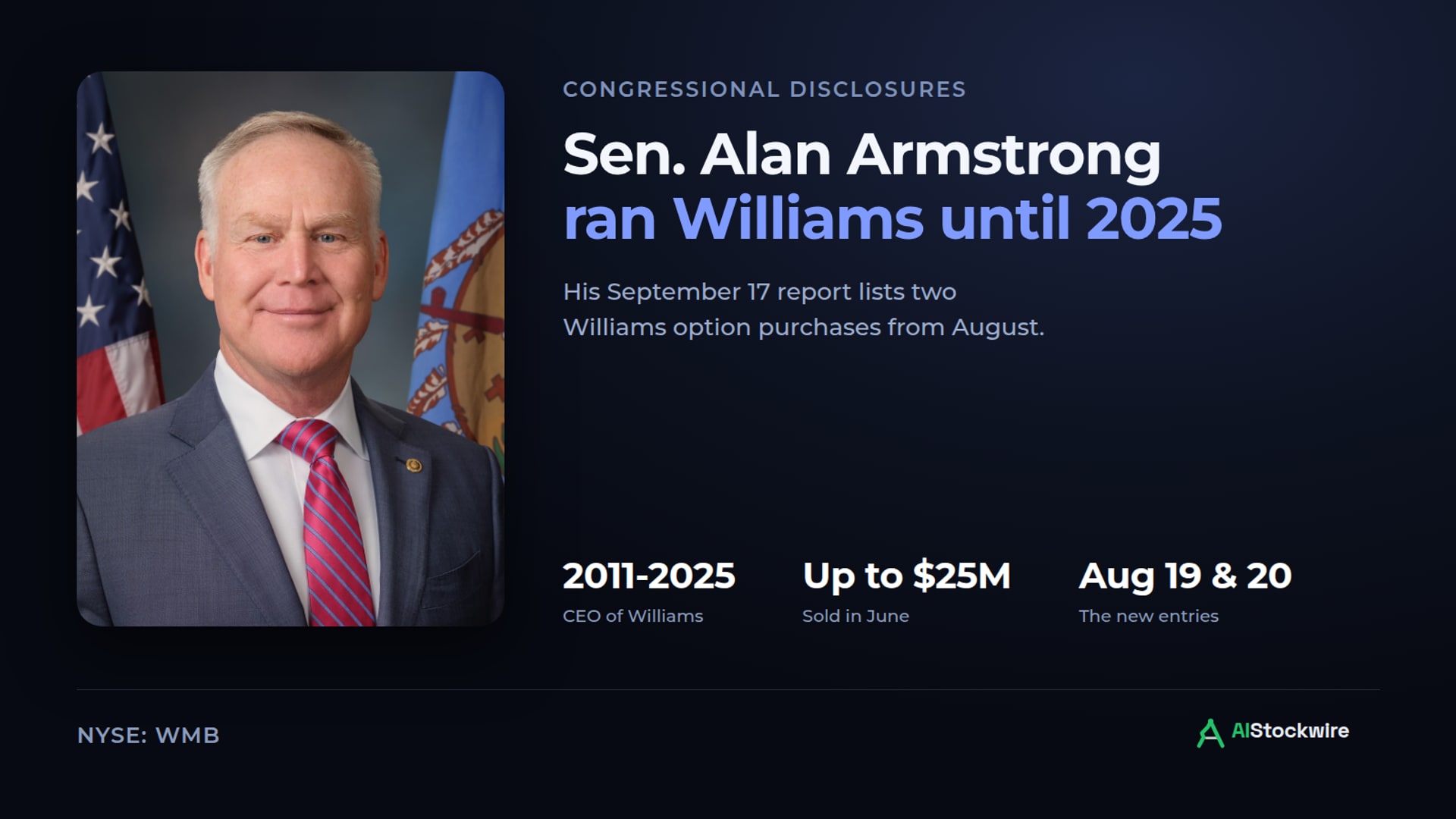
Senator Alan Armstrong spent nearly four decades at Williams Companies (WMB), including 14 years as CEO. That history caught our attention when two Williams option purchases appeared on our congressional trading tracker. Both are listed in his September 17 report, and a second data provider shows matching dates, dollar ranges and transaction types. Our methodology page explains the sources.
The entries are dated August 19 and August 20, for $1,001 to $15,000 and $15,001 to $50,000, respectively. Those ranges are what the disclosures provide; we do not have exact amounts. The report also lists an August 14 exchange involving AvalonBay Communities (AVB), valued between $1,001 and $15,000.
Armstrong joined the Senate in March, when Governor Kevin Stitt appointed him to replace Markwayne Mullin, who left to lead the Department of Homeland Security. Chuck Grassley swore him in on March 24. It was Armstrong's first public office. Under Oklahoma law, he cannot run for the seat in November, and his service is scheduled to end in January 2027.
He did step back from the companies on his way in. He resigned from the Constellation Energy (CEG) board on March 23, effective immediately, according to Constellation's filing with the SEC, and he gave up the executive chairmanship of Williams at the same time.
Transactions continued to appear in his disclosures. A NOTUS review published in July by The Washington Sun found that Armstrong had reported roughly 700 stock trades months past the deadline the STOCK Act sets. Those late trades came to between $3.24 million and $16.05 million combined, and a note on the filings attributed the March activity to a direct indexing strategy run by an outside adviser.
His Williams selling was a separate matter, and it was reported on time. He sold $5 million to $25 million of Williams stock on June 24 and at least $250,000 of Williams options on June 22. A spokesperson for Armstrong told the publication that "There is no conflict of interest in Senator Armstrong's intense focus on permitting reform and his long term holding in The Williams Companies stock."
The August entries follow substantial Williams sales in June. But the available data does not explain the nature of the option transactions, which limits what we can conclude from that sequence.
What the data does not settle
Both August entries are categorized as options rather than shares. An option is a contract giving its holder the right to buy or sell a stock at a set price. The available entries do not establish whether these were new purchases in the market or transactions connected to compensation granted years earlier. Those would say very different things about a senator's view of a company he used to run.
We could not read the underlying document. Senate filings go to a viewer at efdsearch.senate.gov that requires a session, with no public direct link. Our tracker handles Senate and House filings differently as a result. Two providers agreeing supports the account, but they may draw on the same underlying feed, and agreement is not a substitute for reading the filing.
On timing, the STOCK Act requires a report "no later than 30 days after receiving written notification that a transaction has occurred, but in no case later than 45 days after the transaction date." Based on the providers' dates, both Williams entries were reported within 30 days of the transactions and therefore within both disclosure deadlines.
Williams closed at $71.82 on Thursday, up 1.3% from Wednesday's $70.90. The providers' data doesn't show how Armstrong holds his remaining Williams stake. Direct ownership and an arrangement that limits his own control are very different things, and that second one is the question a blind trust is meant to answer. It also doesn't establish the reason for the transactions. Committee assignments and trading do overlap in Congress more than people assume, and we've counted how often. A disclosure entry is still a record of a transaction and nothing else. If you're tempted to read any of this as a signal, the data on copying these trades is worth a look first.