Key points
- Four S&P 100 swaps take effect September 21
- All four additions are technology companies
- Sandisk joined the S&P 500 only last November
- Nike leaves the index near a 52-week low
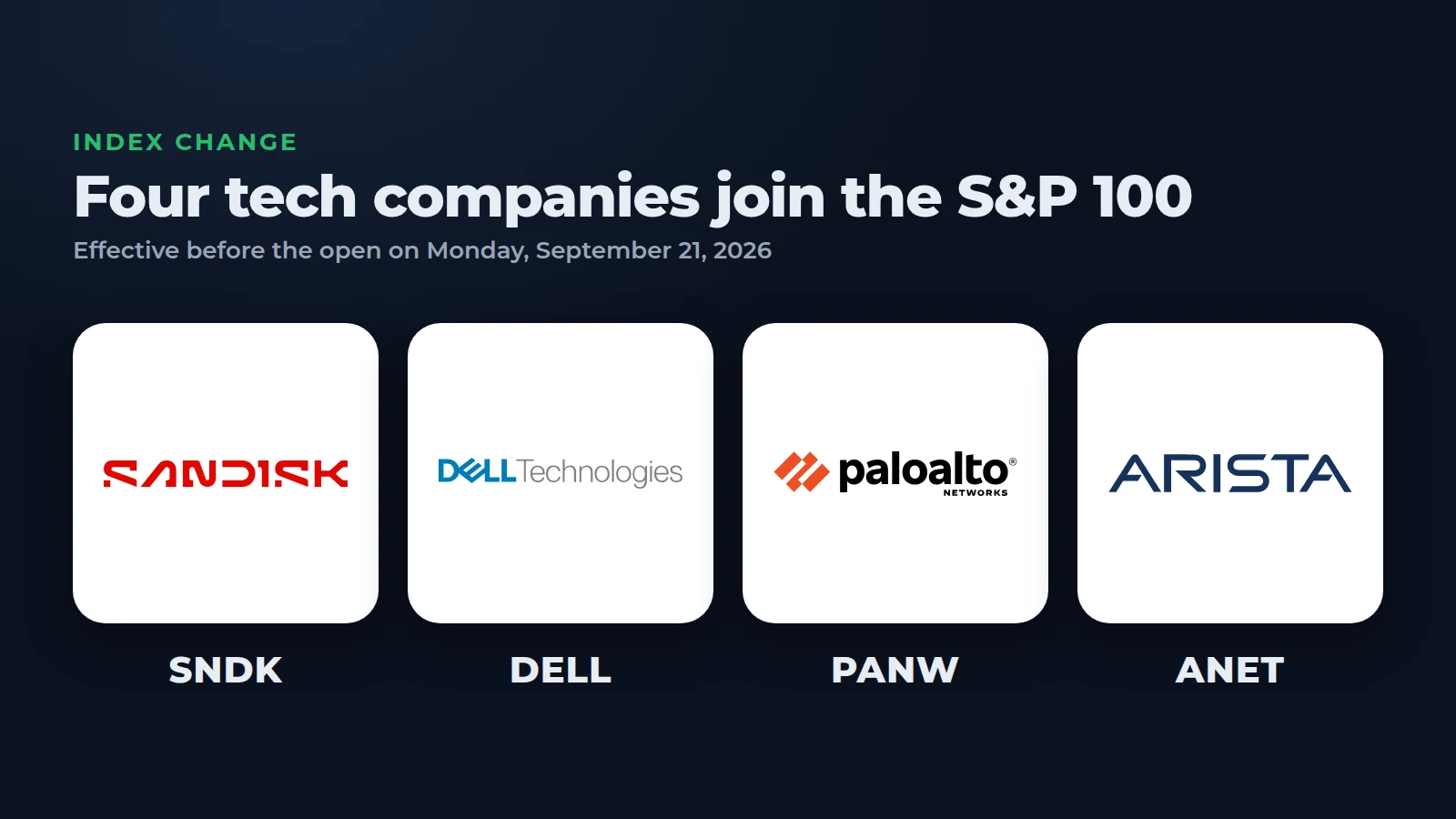
The S&P 100 is adding four technology companies. S&P Dow Jones Indices announced Friday evening that Sandisk (SNDK), Dell Technologies (DELL), Palo Alto Networks (PANW) and Arista Networks (ANET) will enter the index before trading begins Monday, September 21. They will take the places of Nike (NKE), Colgate-Palmolive (CL), Simon Property Group (SPG) and Honeywell Aerospace (HONA).
Made up of 100 of the S&P 500's largest and most established companies, the S&P 100 is tracked by the iShares S&P 100 ETF (OEF). All four additions belong to the Information Technology sector. The departing companies represent four other sectors: Industrials, Consumer Discretionary, Real Estate and Consumer Staples. In its announcement, the index provider gave a single explanation for the changes: "The changes ensure that each index is more representative of its market capitalization range."
Dell closed Friday with a market value of about $340 billion, Palo Alto at $272 billion, Sandisk at $255 billion and Arista at $244 billion. Colgate-Palmolive was worth about $71 billion, Simon Property $68 billion, Nike $57 billion and Honeywell Aerospace $51 billion.
| Company | Action | Sector | Market cap | Friday close | Friday move |
|---|---|---|---|---|---|
| Dell Technologies (DELL) | Added | Information Technology | $340B | $523.93 | +1.5% |
| Palo Alto Networks (PANW) | Added | Information Technology | $272B | $333.22 | +0.4% |
| Sandisk (SNDK) | Added | Information Technology | $255B | $1,739.81 | +11.9% |
| Arista Networks (ANET) | Added | Information Technology | $244B | $193.77 | +1.2% |
| Colgate-Palmolive (CL) | Removed | Consumer Staples | $71B | $88.76 | -1.5% |
| Simon Property Group (SPG) | Removed | Real Estate | $68B | $209.32 | -1.0% |
| Nike (NKE) | Removed | Consumer Discretionary | $57B | $38.41 | -0.9% |
| Honeywell Aerospace (HONA) | Removed | Industrials | $51B | $161.01 | +3.9% |
Market caps and closes are as of Friday, September 4, 2026, from Robinhood market data.
The announcement came after the close, so Friday's regular-session moves were not reactions to it. Sandisk had already gained 11.9% in the regular session to finish at $1,739.81, its third straight daily gain, after a similar late-day surge on August 31 tied to its addition to the MSCI World index. In after-hours trading Friday it changed hands near $1,734.
Western Digital (WDC) spun the flash-memory business off in February 2025, and S&P Dow Jones added it to the S&P 500 on November 28, 2025, in place of Interpublic Group. The stock traded at $63.74 on September 5 of last year. It has since reached as high as $2,354.39 on June 22 before falling back, a run tied to a NAND memory shortage that we covered in our August note on record memory prices.
Dell set a 52-week high of $534.99 during Friday's session before closing at $523.93. On September 1 the company raised its full-year outlook by $25 billion and reported an AI server backlog of $95 billion.
Nike leaves the index one day after setting a 52-week low of $37.95. The stock is down about 50% from its 52-week high of $76.97 in October 2025. The company reported fiscal 2026 revenue of $46.4 billion on June 30, flat as reported and down 2% on a currency-neutral basis. In July we looked at how the end of the Vietnam tariff advantage affected Nike's sourcing.
Honeywell Aerospace is the youngest name in the group, and it entered the S&P 100 through the spin-off rather than a routine addition. Honeywell completed the spin-off on June 29, distributing one Aerospace share for every two Honeywell shares held, according to the company's closing announcement. S&P Dow Jones placed the new company in the S&P 100 in its parent's seat effective June 30, so HONA has been an S&P 100 member since its second day of trading. Less than three months later, it is being removed.
Changes to the S&P 500
The same release moves three companies into the S&P 500. Bloom Energy (BE), Everpure (P) and Illumina (ILMN) replace Molson Coors (TAP), The Trade Desk (TTD) and Builders FirstSource (BLDR), also before the open on September 21. We covered the Bloom Energy addition, and a July purchase of the stock by the Pelosi household, on Friday night.
Index funds that track the S&P 100 rebalance to match the new membership at the close on Friday, September 18, the last trading day before the changes take effect.