Key points
- Korea's chip exports nearly tripled to $26 billion in the first 20 days of August, a record 47.2% of all exports.
- Its semiconductor export price index has quadrupled since 2023, though the monthly increases are shrinking.
- NAND left Korea at $99,573 per kilogram, up from about $62,000 in July.
- Spot DDR4 costs more than the newer DDR5, $90 against $53.
- Micron trades near 22 times earnings and SK Hynix near 10, multiples that price these profits as a peak.
The Korea Customs Service published its August 1-20 trade figures on Friday. Semiconductor exports came to $26 billion, nearly triple the same stretch a year earlier. They made up 47.2% of everything Korea sold abroad, and both figures are records. Total exports rose 56% to $55.2 billion for the strongest 20-day August on record. Shipments to China more than doubled to $15.26 billion.
Korea's semiconductor exports and memory prices are still setting records. Memory stocks are not. Eight companies across four countries peaked within eight days in June and have since fallen between 21% and 51%. That split, booming current results against falling expectations, is now the central question in the memory trade.
Underneath the export total sits the number that matters to anyone who buys memory. Citrini Research, working from the same customs data, puts Korea's NAND flash export price at $99,573 per kilogram for the first 20 days of August, up from about $62,000 in July. That's a 61% jump in three weeks. DRAM came in at $92,200 per kilogram. Its trough in late 2022 was $7,400. Both series now sit at their highest levels in the data, and flash has overtaken DRAM on a per-kilogram basis. In Citrini's series, which begins in early 2022, DRAM had been the more expensive of the two every month until now, including at both of their troughs.
The Bank of Korea's export price index for semiconductors, measured in dollars, sat at 59.2 in August 2023, which was the bottom of the last memory bust. By July 2026 it had reached 234.8, almost four times higher and up 173% in twelve months. One strong month has little to do with it.
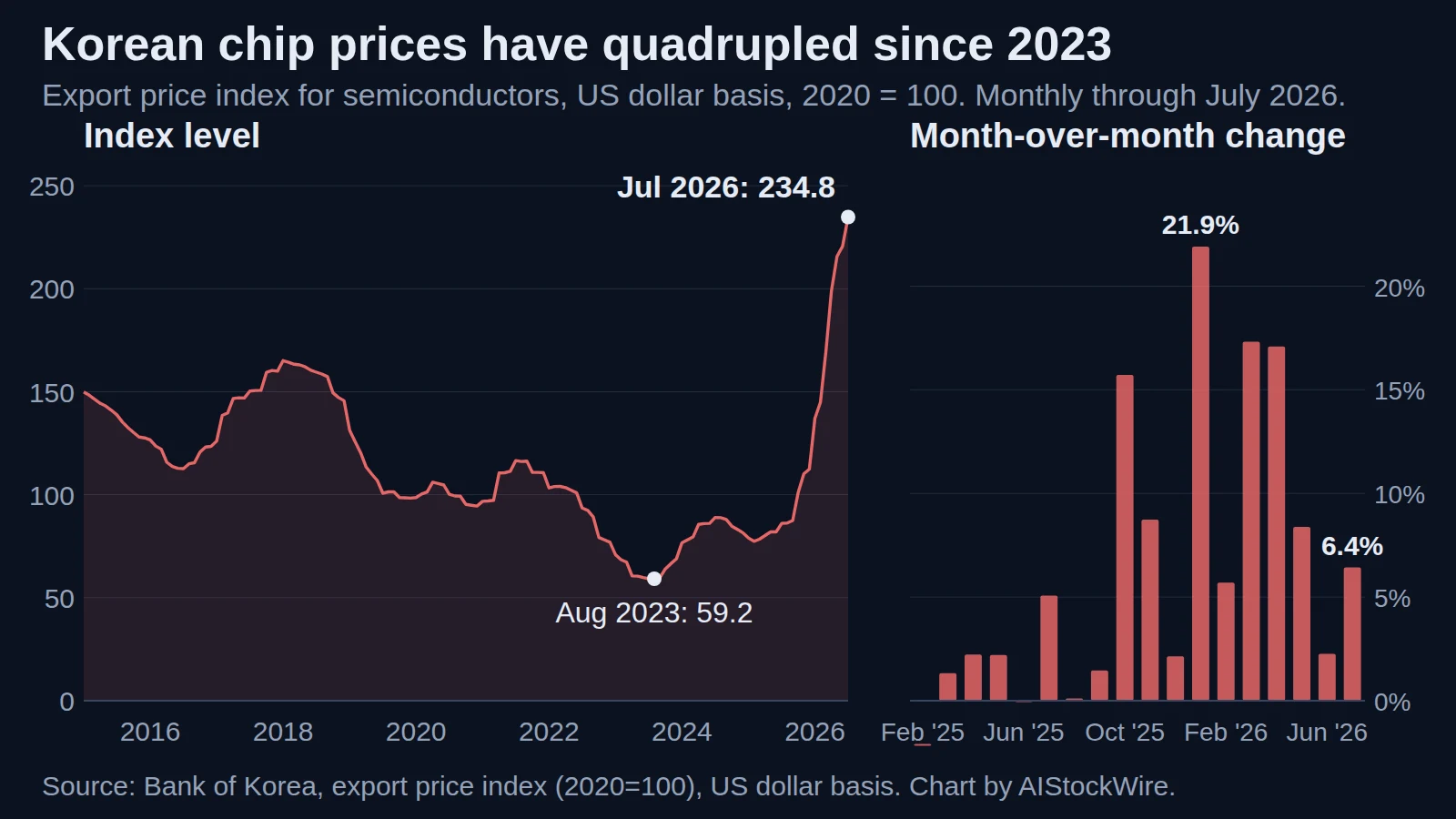
Prices keep climbing every month, at a slower and slower rate. The increase peaked at 21.9% in January 2026 and reached 6.4% by July, so the level sets records while the rate of change fades. That's where the argument lives.
The old chips now cost more than the new ones
Spot pricing tells a stranger version of the same story. DRAMeXchange data circulated by BofA Global Research has 16Gb DDR4 near $90 and 16Gb DDR5 near $53, so the older chip carries the higher price. That inversion is what happens when every manufacturer moves capacity toward high-bandwidth memory and server DRAM, leaving the DDR4 lines to a customer base that still needs them and has nowhere else to go. For scale, DDR4's previous peak was near $10 in October 2017. NAND wafer prices had been flat to slightly lower through the second quarter before turning sharply higher in early August.
Contract prices, which is what large buyers actually pay, are still climbing but they've slowed hard. TrendForce forecasts conventional DRAM contracts rising 13% to 18% in the third quarter and NAND rising 10% to 15%. In the second quarter those figures were 90% to 95% and 55% to 60%. That's a sharp deceleration, and it's the strongest card the bears hold. TrendForce blames buyers instead of supply, saying consumer customers have reached the limit of what they'll pay. Read that carefully. Supply is as tight as it ever was, and the customers simply ran out of room.
The stocks topped two months ago
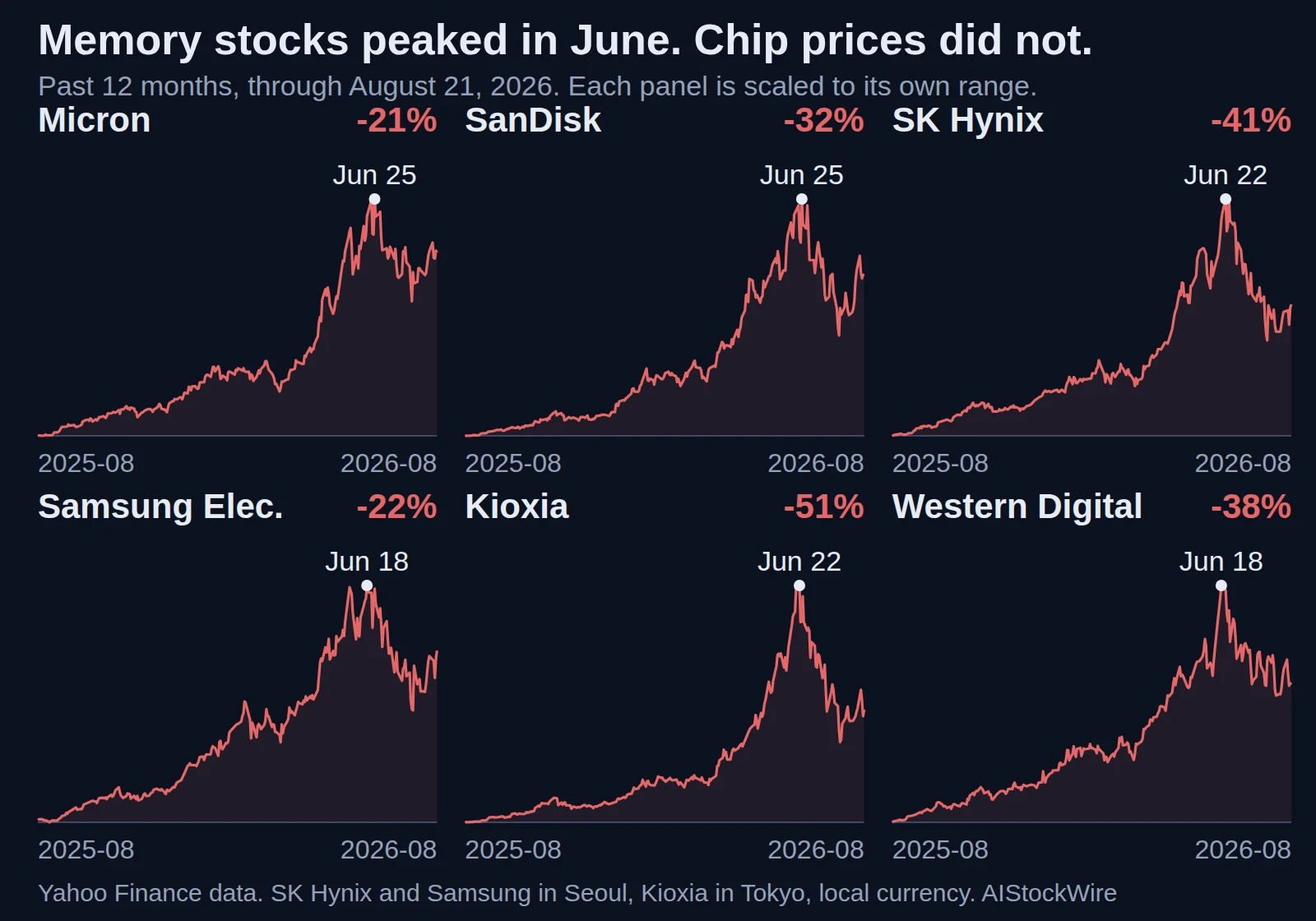
The pattern is unusually tight, and it runs wider than the six panels above. On a 52-week-high basis, Western Digital (WDC) and Seagate (STX) topped on June 18, and so did Samsung Electronics. June 22 brought the highs for SK Hynix, Kioxia and SanDisk (SNDK), along with Silicon Motion, which makes the controllers that run flash drives. Micron (MU) followed on June 25.
| Company | Price | From June peak |
|---|---|---|
| Micron (MU) | $964.48 | -21% |
| SanDisk (SNDK) | $1,594.35 | -32% |
| SK Hynix, Seoul | 1,730,000 won ($1,248) | -41% |
| Samsung, Seoul | 281,500 won ($203) | -22% |
| Kioxia, Tokyo | 52,950 yen ($333) | -51% |
| Western Digital (WDC) | $465.29 | -38% |
The American prices are from Friday midday with the session still running. Seoul's figures are Friday closes, where SK Hynix rose 2.31% and Samsung 3.87%. Kioxia's is Thursday's close in Tokyo, the most recent available. Currency conversions use 1,386 won and 159 yen to the dollar. A year ago SanDisk traded at $45.50 and Kioxia at 2,305 yen ($14.50), so even after halving, Kioxia is up more than twentyfold in twelve months and SanDisk more than thirtyfold. These are drawdowns inside an enormous run, and the run itself is still intact.
The rest of AI hardware kept going
That June cluster is hard to explain as a market-wide rotation, because everything around it moved on its own schedule. Nvidia (NVDA) set its 52-week high on May 14, five weeks before the memory group. Broadcom (AVGO) topped on June 3. Dell (DELL), which buys memory instead of selling it, set a 52-week high on August 13, eight days ago.
The chip equipment makers are the telling exception, and their timing is the giveaway. Applied Materials (AMAT) and Lam Research (LRCX) both set their highs on June 30, as did KLA (KLAC), one week after the memory names and the same day as TSMC (TSM). Lam and Applied sell the deposition and etch tools that memory fabs buy, so a memory top followed a week later by an equipment top is the order you'd expect if the market were repricing memory capital spending instead of technology broadly.
Rising Treasury yields and an August 18 Wall Street Journal report on about $3 trillion of off-balance-sheet AI commitments explain individual sessions well enough. SanDisk fell 9% on that report, Micron 7% and Western Digital 7%. What those forces leave unexplained is why memory turned in June while one of its largest customers went on making new highs into August.
Record quarters, falling shares
The earnings landed while the stocks were going the other way. SK Hynix reported second-quarter revenue of 79.32 trillion won ($57.2 billion) and operating profit of 60.54 trillion won ($43.7 billion), a 76% operating margin. Revenue rose 257% from a year earlier and operating profit rose 557%. Net income of 93.92 trillion won ($67.8 billion) landed above revenue, inflated by a gain of about 40 trillion won ($28.9 billion) on revaluing the Kioxia stake we've written about before.
Samsung's split is starker. Operating profit reached 89.5 trillion won ($64.6 billion), up 1,814% from a year earlier, and the Device Solutions chip division supplied 89.2 trillion won ($64.4 billion) of it. Everything else the company makes came to almost nothing. Samsung said its memory business "achieved another record-breaking quarter by proactively addressing AI demand despite limited capacity with a primary focus on server products." Its Galaxy division went the other way, booking an operating loss of 0.7 trillion won ($505 million) on what the company called "elevated component cost pressures across the industry." Samsung has become good enough at selling memory to lose money buying it.
Micron's fiscal third quarter brought $41.46 billion of revenue at an 84.9% gross margin, against 39% a year earlier. SanDisk reported fiscal fourth-quarter revenue of $8.97 billion on August 5, up 372% from a year earlier. It guided the current quarter to between $10.30 billion and $10.80 billion. Its stock fell on the report, which by now is the pattern. The same thing happened the last time SanDisk beat and raised.
The multiples are where the disagreement shows plainly. Micron trades near 22 times trailing earnings and SanDisk near 22. Western Digital sits near 19, while SK Hynix's US shares (SKHY) sit near 10. A market that expected these earnings to hold would pay a good deal more than that. A company earning a 76% operating margin at 10 times earnings is a forecast, and the forecast says the margin fades.
What settles it
Two things over the next several weeks will settle it. The first is fourth-quarter contract pricing. Third-quarter DRAM contracts rose 13% to 18%, down from 90% to 95% in the second quarter. If the fourth-quarter figure comes in positive but smaller again, the deceleration is a trend instead of a base effect, and the stocks were early. If it reaccelerates, June looks like a scare.
The second is Micron's fiscal fourth quarter, due in late September. Management has already said its gross margin outlook reflects a moderation in the rate of price increases, and that guidance, more than any spot print, is what the market will trade on. We laid out the supply math last week, and it still holds: the new plants open in 2027 and 2028.
Until then the export data and the share prices point in opposite directions, and they're both current.
Higher memory prices are also squeezing Korea's parts makers. Device makers have asked many Korean suppliers of phone, laptop and TV parts to cut costs by 10 to 20 percent, Hankyung reported on September 23.
For how Micron, SK Hynix, Samsung, Sandisk, and Kioxia differ as businesses, see our comparison of the five memory stocks.
A month later, Acer's CEO argued the shortage is overstated and will not last to 2030, a counter to the suppliers' outlook.
LSEG and FactSet both ranked Micron ahead of Nvidia as a contributor to S&P 500 earnings growth for the second quarter.
By October, the memory shortage was showing up in gadget prices, including a $100 increase on Nvidia's Shield TV Pro.