Key points
- Dell (DELL) and Marvell (MRVL) led overnight gains last month, both about 32%.
- Dell's came almost entirely from one earnings night; the rest of the month was near zero.
- Marvell's was a real, repeating run after Jensen Huang called it "the next trillion-dollar company."
We took our whole list of AI-related stocks, around 100 names, and pulled the last month of trading for each one. Then we split every stock's move into two buckets: what happened overnight (from one day's close to the next day's open) versus what happened during regular trading hours (open to close). The goal was simple, to see where the gains actually came from. The answer turned out to be more interesting than we expected.
Dell and Marvell led the overnight gains
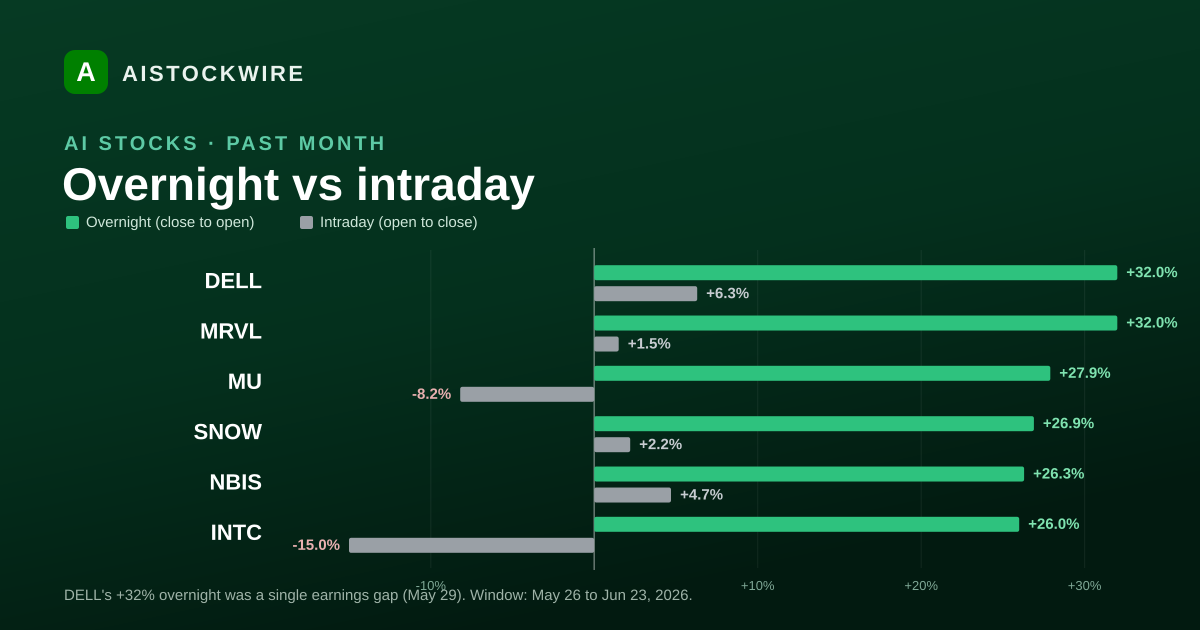
Over the past month (May 26 to June 23), two names jumped out for overnight gains: Dell (DELL) and Marvell (MRVL), both up about 32% overnight. Here is the top of the list, with the overnight piece, the intraday piece, and the full month total side by side.
| Ticker | Overnight | Intraday | Month total | Gapped up |
|---|---|---|---|---|
| DELL | +32.0% | +6.3% | +40.2% | 63% |
| MRVL | +32.0% | +1.5% | +34.0% | 58% |
| ELMT | +28.9% | -8.6% | +17.9% | 53% |
| MU | +27.9% | -8.2% | +17.4% | 74% |
| SNOW | +26.9% | +2.2% | +29.7% | 47% |
| NBIS | +26.3% | +4.7% | +32.3% | 58% |
| INTC | +26.0% | -15.0% | +7.1% | 58% |
| EU | +22.9% | -24.3% | -6.9% | 58% |
Quick note on a couple of those: ELMT and EU are small, low-priced stocks that swing hard on single headlines, so do not read too much into them. The names worth focusing on are the bigger, more liquid ones like Dell, Marvell, Micron, and Nebius.
Here is the catch with Dell
If you only saw that 32% number, you might picture Dell quietly grinding higher night after night for a month. It did not. Almost all of that gain came from one single night. Dell reported earnings after the close on May 28, and the next morning it opened about 32% above the previous day's close. Take that one night out, and Dell's overnight return for the entire rest of the month is basically zero, about +0.1%. After the gap, the stock mostly chopped sideways.
So to be fair to the data, "Dell made its gains overnight" is technically true, but what it really means is "Dell made its gains in one night." That is an earnings reaction, not an overnight pattern, and those are two very different things.
Marvell had a real catalyst, and it has a name
Marvell's run was not random, and it was not an earnings report either. On June 1, at the Computex show in Taipei, Nvidia CEO Jensen Huang got on stage with Marvell CEO Matt Murphy and called Marvell "the next trillion-dollar company." That was the spark. The very next day, June 2, Marvell had its biggest one-day gain ever, up about 32%, and our data shows it split almost evenly between the two sessions: a +15.5% jump overnight (the gap we flagged earlier) and another +14.7% during the day.
What makes Marvell different from Dell is that the move did not stop there. The stock kept gapping up on other nights too, on June 3, June 8, June 17, and June 18, helped along by follow-on news like Nvidia committing around $2 billion to Marvell. So even if you toss out that single biggest night, Marvell still gained about 14% overnight across the rest of the month. That is a catalyst plus real momentum, not a one and done pop.
One important caveat though: Jensen Huang saying it does not make it true. When he made the comment, Marvell was worth around $250 billion, which means it would need to roughly quadruple to actually become a trillion-dollar company. Some analysts even called the line "aspirational." It is a huge endorsement from the most important person in AI hardware, and it clearly moved the stock, but it is a vote of confidence, not a guarantee.
A lot of chip names made money at night and gave it back during the day
The bigger theme across the whole list showed up in the chip and memory names: the overnight session did the heavy lifting while regular trading was often a drag. Micron (MU) is the cleanest example. It was up almost 28% overnight but down about 8% during the day, for a net gain of around 17%. It also gapped up on 74% of the days in the month, the most consistent overnight mover in the entire group. Intel (INTC) looked similar, up 26% overnight and down 15% intraday.
Put another way, if you had only held some of these stocks during regular trading hours this month, you would have actually lost money on them, even though they finished higher.
And a few names did the exact opposite
Some stocks went the other way, bleeding overnight but ripping during the day. Palo Alto (PANW) was down about 17% overnight but up roughly 37% intraday. CrowdStrike (CRWD) was down 17% overnight and up 22% during the day. Those are the names where the action happens while you are watching the screen, not while you are asleep.
The takeaway
Two things stuck with us. First, be careful with overnight numbers. A stock can look like a steady night mover when really it just had one giant earnings gap, which is exactly what happened with Dell. Second, when the overnight strength is real and repeating, like it is with Marvell and Micron, that is worth paying attention to, because it means the gains are showing up before the market even opens. For anyone who only trades the regular session, that is a real disadvantage.
This is our own analysis using daily price data, and it is for information only, not investment advice. Past moves do not predict future ones. Always do your own research before buying anything.