Key points
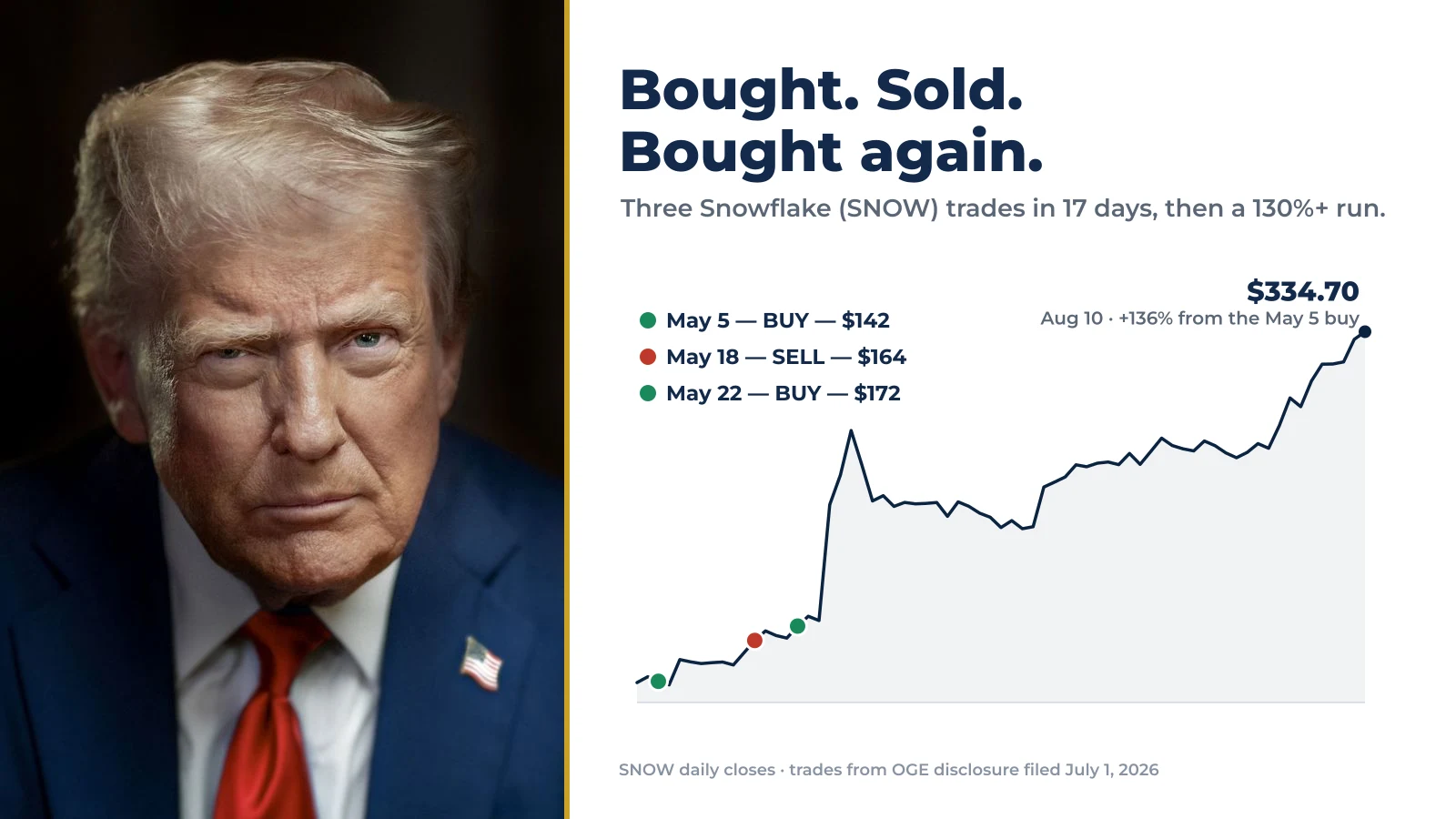
- President Trump's July 1, 2026 financial disclosure shows three Snowflake (SNOW) trades in 17 days: a purchase on May 5, a sale on May 18, and a purchase on May 22, each in the $1,001 to $50,000 range.
- A single-line alert would flag the buys: SNOW is up about 136 percent from the May 5 purchase and about 94 percent from the May 22 purchase.
- The same filing shows the account selling SNOW on May 18, nine days before the $6 billion Amazon deal and earnings beat that moved the stock on May 27.
- The Trump Organization says outside managers run the account with no advance notice to the president, and a buy-sell-buy in three weeks looks like an automated model at work.
Stock trackers turn every politician's filing into an alert: this senator bought a chip stock, that one sold a bank. President Trump's disclosures generate these by the thousand, and his Snowflake (SNOW) trades are a clean example of why the raw alert can mislead. His July 1 disclosure shows the account trading the data-cloud company three times in 17 days. It bought SNOW on May 5 in the $1,001 to $15,000 band, sold it on May 18, then bought again on May 22 in the $15,001 to $50,000 band. Bought, sold, bought back, all inside 17 days.
An alert would seize on the buys. From the May 5 purchase, SNOW is up about 136 percent; from the May 22 purchase, about 94 percent, after the stock jumped on a $6 billion Amazon deal and an earnings beat on May 27. The alert leaves out the sale wedged between the two buys.
What the filing actually shows
Whoever was running this account sold Snowflake on May 18, nine days before the news that sent the stock up about 37 percent. Someone sitting on a tip about that news doesn't sell right before it lands. The pattern fits an automated portfolio, the kind that rebalances, trims winners and harvests losses across hundreds of positions without much regard for which one is Snowflake.
The scale points the same way. These SNOW trades are a few lines from an account that ran more than 3,600 securities transactions in a single quarter, and over 21,000 in the president's first year back in office. The Trump Organization has said outside financial firms manage the money and make the buy and sell calls, running it through automated, model-based portfolios, and that Trump, his family and his company "play no role" in the trades and learn of them only afterward. Most of the money, by dollars and by number of trades, sits with Charles Schwab, UBS and JPMorgan. Buying a name, selling it, then buying it back in small lots over three weeks is routine for a model like that.
On timing, the account's disclosure didn't reach the public until July 1, well after Snowflake's late-May run. None of these trades was on file before the news broke.
What moved the stock
The jump happened in a single session, and earnings did most of the work. After the market closed on May 27, the company reported product revenue of $1.33 billion for its fiscal first quarter, up 34 percent from a year earlier, and adjusted earnings of $0.39 a share against the $0.32 Wall Street expected. It raised its full-year product-revenue guidance to $5.84 billion. Chief executive Sridhar Ramaswamy called the quarter "a clear inflection point" for the company's AI products.
The same evening, Snowflake said it would commit $6 billion to Amazon Web Services, the cloud arm of Amazon (AMZN), over several years. That one reads backward at first glance. Snowflake is the buyer. It agreed to spend the $6 billion on AWS computing capacity and Amazon's Graviton chips to run its own AI and data work out to about 2031. The money is leaving Snowflake's books, not arriving on them.
Investors got all three in one release, the earnings, the higher forecast and the AWS deal, and traded on them together. SNOW opened the next morning at $237, up from its $175.26 close, and ended the day near $239, one of the biggest single-session gains in its history. The run since the May buys is real enough. It started with an earnings report that came out weeks after the account had finished trading the stock.
None of this is really about Snowflake. An alert that a politician bought a stock before it rose skips the things that decide whether the trade meant anything. Did a person pick it, or a model? Was it a single bet, or one line in a thousand-name rebalance that had sold the same stock a week earlier? And plenty of these filings, this one among them, surface weeks after the move they look like they called. You only get that from the full disclosure. We've written on how to track trades by Congress and the president, on whether copying these trades actually works, and on why so few officials use a blind trust. This is general market commentary and not investment advice.
Sources
- U.S. Office of Government Ethics periodic transaction report for Donald J. Trump, disclosed July 1, 2026: Snowflake Inc. (SNOW) purchase dated May 5, 2026 ($1,001 to $15,000), SNOW sale dated May 18, 2026 ($1,001 to $15,000), and SNOW purchase dated May 22, 2026 ($15,001 to $50,000)
- CNBC, "JPMorgan, Schwab and UBS manage millions in Trump's $858 million investment portfolio," July 29, 2026
- Fortune, "Trump's 3,711 trades point to multiple stock-market strategies," May 23, 2026
- Snowflake Inc., "Snowflake Reports Financial Results for the First Quarter of Fiscal 2027," and "Snowflake Expands AWS Collaboration with $6B Commitment," May 27, 2026
- SNOW daily closing prices, May 5, 2026 through Aug. 10, 2026: $141.71 (May 5), $164.24 (May 18), $172.20 (May 22), $334.70 (Aug. 10)
- Later: Snowflake raised its full-year growth target from 31% to 36% and closed up 16.6% on September 3.
- The same short-lived pattern elsewhere: Trump praised Micron and the stock rose for two minutes.