Key points
- Treasury issues its first outbound investment fine
- The $200,000 penalty tops the $92,478 stake
- The fined firm is Plug and Play's parent
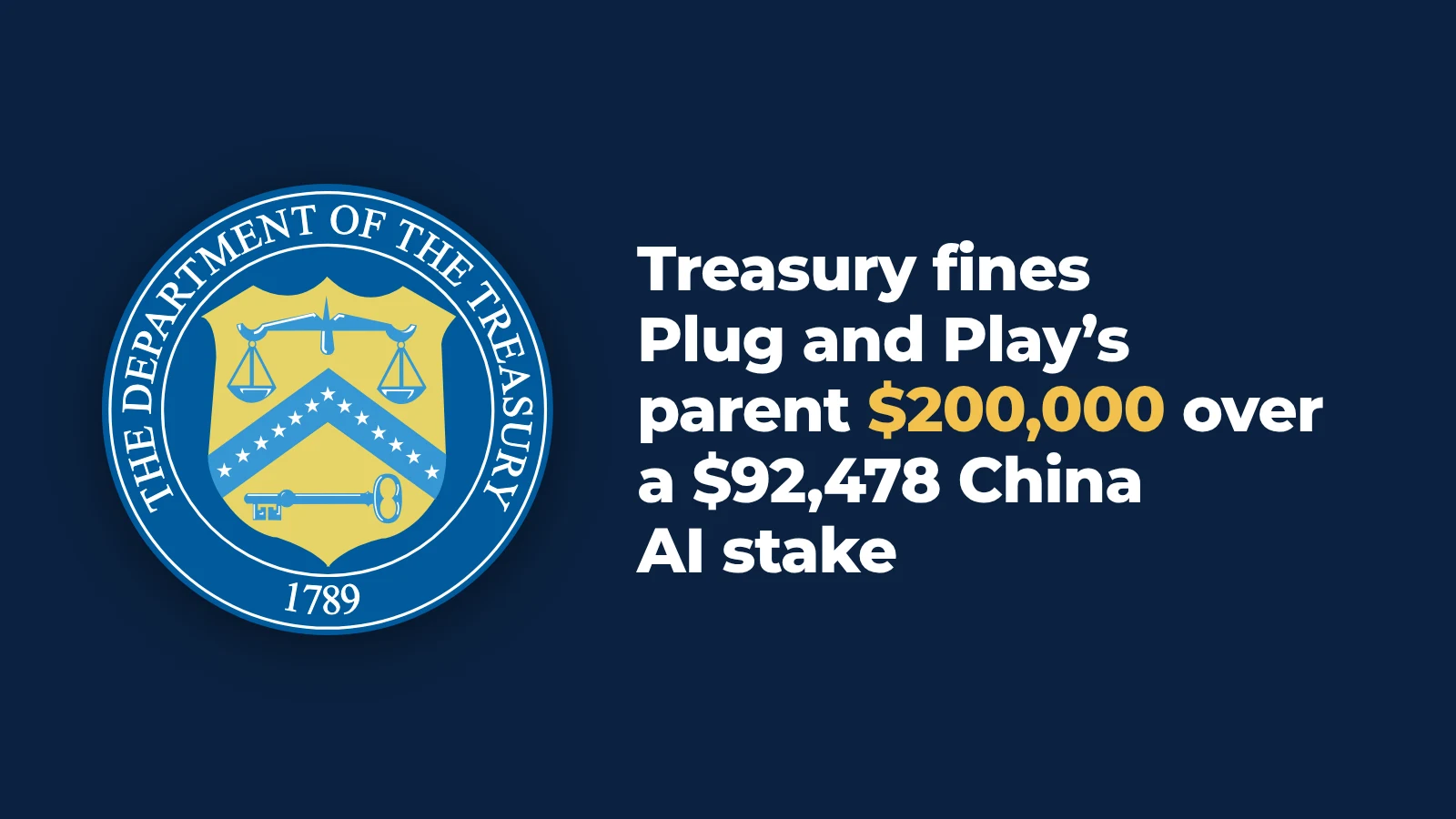
The Treasury Department has issued its first penalty under the rules that limit US investment in Chinese AI, chip, and quantum companies. It fined Amidi, LLC $200,000 for not telling Treasury about a roughly $92,478 investment in a Chinese AI and robotics startup, according to Treasury's announcement on October 7.
What caught my eye was the name in the middle of it. Amidi is the parent of the organization that does business as Plug and Play Tech Center, the Silicon Valley startup accelerator. And the fine is more than twice the size of the investment it's about.
What did Amidi do wrong?
Treasury penalized Amidi for failing to file a required notice, rather than for making a prohibited investment.
The Outbound Investment Security Program took effect on January 2, 2025. It bans some US investments in companies in China, Hong Kong, and Macau that work on AI, semiconductors, or quantum computing, and it requires investors to notify Treasury about others. The rules also reach a US company's controlled foreign subsidiaries. If one of those subsidiaries makes an investment that would need a notice coming from the US parent, the parent has to file one.
On April 19, 2025, Amidi's subsidiary, a Chinese fund, invested about $92,478 in Shanghai Qiongche Intelligent Technology, which goes by Noematrix. Treasury describes Noematrix as a private company that develops AI, robotics, and embodied intelligence, which is AI built into physical machines like robots. Amidi never filed the notice.
How big is a $200,000 fine under these rules?
Bigger than you might expect for a $92,478 stake, but not the most Treasury could have charged. The maximum penalty per violation is the greater of $377,700 or twice the value of the transaction, according to a January 2025 Federal Register notice, the most recent adjustment Treasury has published for the program. Twice this transaction would be about $185,000, so the $200,000 penalty lands between those two numbers.
Treasury actually imposed the penalty in July 2026 and announced it on October 7. It said it found the transaction through its own compliance and market monitoring.
Why does a first case matter?
Because it's the first public look at how Treasury enforces the rules, and the scope is about to get wider. Congress passed the Comprehensive Outbound Investment National Security Act in December 2025, which will extend the program to more countries and technology sectors, Treasury said.
Treasury Secretary Scott Bessent said the penalty announcement "underscores Treasury's commitment to safeguarding U.S. national security." The department's enforcement page lists Amidi as the only action so far.
What I'll be watching is whether Treasury brings more cases involving small investments through overseas subsidiaries. This one shows that a stake below $100,000 can still draw enforcement, and a penalty larger than the investment itself.