Key points
- Army buys a second source for a mortar explosive
- Private joint venture part-owned by listed Dyno Nobel
- One partner was called REPKON USA until March
- ProPublica examined a related plant last month
The Army awarded Nitradyn, a joint venture of Dyno Nobel and Paligen Technologies, an indefinite-delivery contract with a ceiling of $581.2 million on Wednesday to design, build and commission a plant that produces IMX-104, the explosive used in U.S. mortar rounds. Paligen is already building the Army's TNT plant in Graham, Kentucky under a separate contract with a ceiling of $435 million.
The contract is firm-fixed-price, with an estimated completion date of August 9, 2030, according to the Pentagon's daily contract list. The announcement lists no funds obligated at award. Work locations and funding are set with each order, so the $581.2 million is a ceiling on what the Army can buy over the life of the contract. Army Contracting Command at Rock Island Arsenal in Illinois is the contracting activity. It was the only Army item on Wednesday's list.
What IMX-104 is
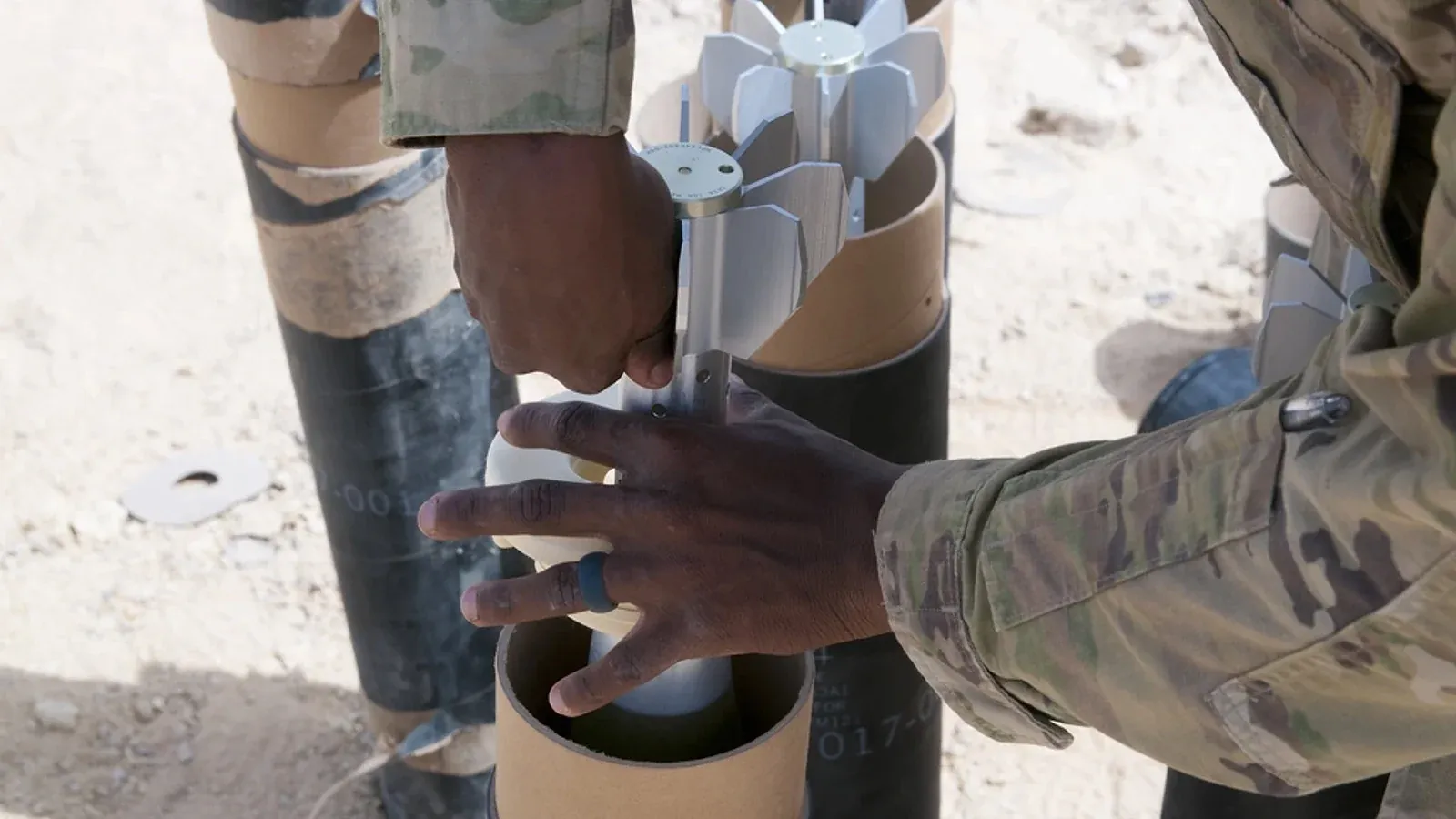
IMX-104 is an insensitive munition explosive, which means it's harder to set off by fire, shock or a stray round than the explosive it replaces. It goes into 60mm, 81mm and 120mm mortar rounds in place of Composition B. BAE Systems makes it for the Army at Holston Army Ammunition Plant in Kingsport, Tennessee.
The Army has been shopping for a second source since at least March 2025. A sources-sought notice that month asked for a government-owned, contractor-operated plant able to produce 6 million to 8 million pounds a year, at Holston or another site in the continental United States, with design and construction finished within 36 to 48 months. The notice said the Army intended to award the work without competition.
Who Nitradyn is
Nitradyn was launched in October 2025 by Dyno Nobel, Inc. and REPKON USA-Chemical Technologies, LLC to make high explosives, propellants and energetic materials, according to the companies' announcement. It's based in Tampa, Florida. Neither partner has disclosed how the venture is split.
Its president is Braden Lusk, named to the job on March 25, 2026. He previously ran Dyno Nobel's North and South American operations and was the company's chief technology and marketing officer, according to Nitradyn.
Dyno Nobel, Inc. is a subsidiary of Dyno Nobel Limited, the Australian explosives maker that traded as Incitec Pivot until April 2025. It's listed in Sydney under the ticker DNL.
The connection to the troubled Mesquite plant
Two companies in this story carry the Repkon name. Repkon is a Turkish metal-forming firm. REPKON USA is an American company formed in February 2024 as REPKON USA Holdings, Inc., which says on its website that it used the Repkon name with permission and that the two had "differing ownership groups, management, missions, and markets." It changed its name to Paligen Technologies in March 2026, and told ProPublica that it and Repkon are "different and wholly separate companies." ProPublica reported that Repkon Turkey's chief executive co-founded the American company. Repkon Turkey didn't respond to the outlet's requests for comment.
Repkon, the Turkish firm, supplied the machinery for a General Dynamics artillery factory in Mesquite, Texas that was built to make 155mm shells for Ukraine. As of a Defense Department inspector general review reported in July, the factory had not delivered a single usable shell. ProPublica reported the same finding on August 12. The cost to taxpayers was $533 million, per the Army. Reporter Jesse Coburn found that the Army bought three Repkon production lines without requiring a demonstration that one could make the shell to specification, and that General Dynamics missed eight deadlines before the Army halted two of the three lines in August 2025.
The Army told ProPublica it was seeking to recover money through discounts on future production orders. "Where vendors fail to meet contract specifications, as seen at the Mesquite facility, we are evaluating contract performance, seeking recoupment of funds, and pivoting resources," the statement read. General Dynamics spokesperson Jeff Davis said the reporting "fundamentally mischaracterizes the circumstances." The Army said it found no evidence of sabotage or spying at the plant.
Three awards in under two years
| Date | Entity | Value | What |
|---|---|---|---|
| Nov. 2024 | REPKON USA-Defense | Up to $435M | TNT plant, Graham, Kentucky |
| Spring 2025 | REPKON USA | Not disclosed | Bought General Dynamics' Garland, Texas bomb-body plant |
| Sept. 2026 | Nitradyn | Up to $581.2M | IMX-104 plant, site to be determined |
The Kentucky award, announced on November 8, 2024, covers the first domestic TNT plant since the 1980s. TNT is the main explosive fill in 155mm artillery shells. REPKON USA announced the Garland purchase on April 2, 2025, describing the site as a 38-acre metal parts plant for defense and aerospace. The Foundation for Defense of Democracies says Garland is the only domestic source of MK-80 series bomb bodies and that the Committee on Foreign Investment in the United States cleared the deal.
Who is asking questions
Sinan Ciddi, Turkey program director and senior fellow at the Foundation for Defense of Democracies, called on August 28 for Congress to require the Army to disclose every contract held by Repkon, REPKON USA and Paligen, along with the foreign-investment review record for the Garland deal. He also wants a ban on sole-source awards to foreign-controlled entities without a certified first article test.
"Rebuilding the arsenal is a national priority," Ciddi wrote in Real Clear Defense. "Outsourcing its chokepoints to Turkey is not resilience, but the creation of dependencies with better branding." The Foundation for Defense of Democracies is a Washington think tank that argues for a hard line on Turkey.
As of Wednesday we found no publicly announced congressional review of the Paligen contracts, and no Army statement about the award beyond the contract announcement itself.
General Dynamics Ordnance and Tactical Systems, the unit that ran Mesquite, received $2.5 billion in Army contract awards in the year after the service halted work there, the Army told ProPublica. The service said that money was for "distinct production lines and critical national defense requirements" unrelated to the Texas plant.
What it means for Dyno Nobel shareholders
Dyno Nobel Limited closed at 4.01 Australian dollars in Sydney on Wednesday, up 3.1%, at the top of a 12-month range that runs from 2.83 to 4.01. Its market value is about 7.02 billion Australian dollars. The Sydney session ended hours before the Pentagon published its contract list, so the close came before the announcement.
U.S. investors have limited convenient ways to trade it. The Sydney listing is reachable through brokers that handle foreign markets. The over-the-counter alternatives are thin: the ADR, DNLZY, has averaged 2,305 shares a day over the past month, and the ordinary shares quoted as ICPVF averaged five. An ADR is a U.S.-traded receipt that stands in for shares listed on a foreign exchange.
Dyno Nobel hasn't said what share of the $581.2 million it will book. The award goes to a joint venture whose ownership split neither company has published, it pays out order by order rather than in a lump, and it runs to 2030. Dyno Nobel reported revenue of 3.91 billion Australian dollars over the past twelve months.
The Army has been signing elsewhere too. Research Innovations won a contract worth up to $99.5 million for Nvidia-powered Dragonfly sensors.