Key points
- Army awards contract worth up to $99.5 million
- The contract drew 95 competing bids
- Dragonfly classifies signals on an Nvidia GPU
Research Innovations Inc. was awarded a $99,529,577 Army contract to procure, deliver and sustain Dragonfly payload systems, under contract number W56KGY-26-D-A002 from Army Contracting Command at Aberdeen Proving Ground, Maryland. It's a firm-fixed-price, indefinite-delivery/indefinite-quantity contract, so the figure is a ceiling on what the Army can order rather than money committed.
The contract first appeared in the Defense Department's August 26 notice, with an estimated completion date of August 31, 2031. The same contract number, dollar figure and vendor appeared again in the notice for September 3, with the completion date given as September 2, 2031. Neither entry is labeled a correction, and the department didn't explain the repeat.
Both notices state that bids were solicited over the internet and 95 were received. The largest award in the September 3 notice, $862,848,000 to Northrop Grumman (NOC) for precision guidance kits, drew one bid. Bid counts are not comparable across procurements, since the number of offers depends on how a requirement is scoped and who is eligible to compete.
What Dragonfly does
Dragonfly is a spectrum sensing device that weighs 3.5 pounds and requires no calibration before use. Research Innovations calls it "the industry's first GPU-accelerated Spectrum Cognition node" on its product page.
The processing happens on the device itself. Dragonfly carries an Nvidia (NVDA) RTX A4500 graphics processor with 384 Tensor Cores, an eight-core Intel Xeon W server processor and about 7TB of onboard storage. The company lists the system's reachback requirement as zero, meaning it classifies what it hears without sending anything back to a network.
| Specification | Dragonfly |
|---|---|
| Weight | 3.5 pounds |
| AI accelerator | Nvidia RTX A4500, 384 Tensor Cores |
| Processor | Intel Xeon W, eight cores |
| Onboard storage | About 7TB |
| Reachback required | None |
The company says the sensor detects, categorizes and classifies signals across the spectrum. It finds the direction and location of emitters, and identifies drones by their radio emissions, one of the counter-drone missions the Pentagon has been funding this year. A feature called Retroactive Direction Finding holds up to 60 minutes of signal history, so an operator can locate an emitter that has already gone quiet. Units network together into a swarm. Dragonfly feeds the Army's Electromagnetic Warfare Planning and Management Tool and its Command Post Computing Environment natively, and the company lists integration with the ATAK situational awareness app as coming soon.
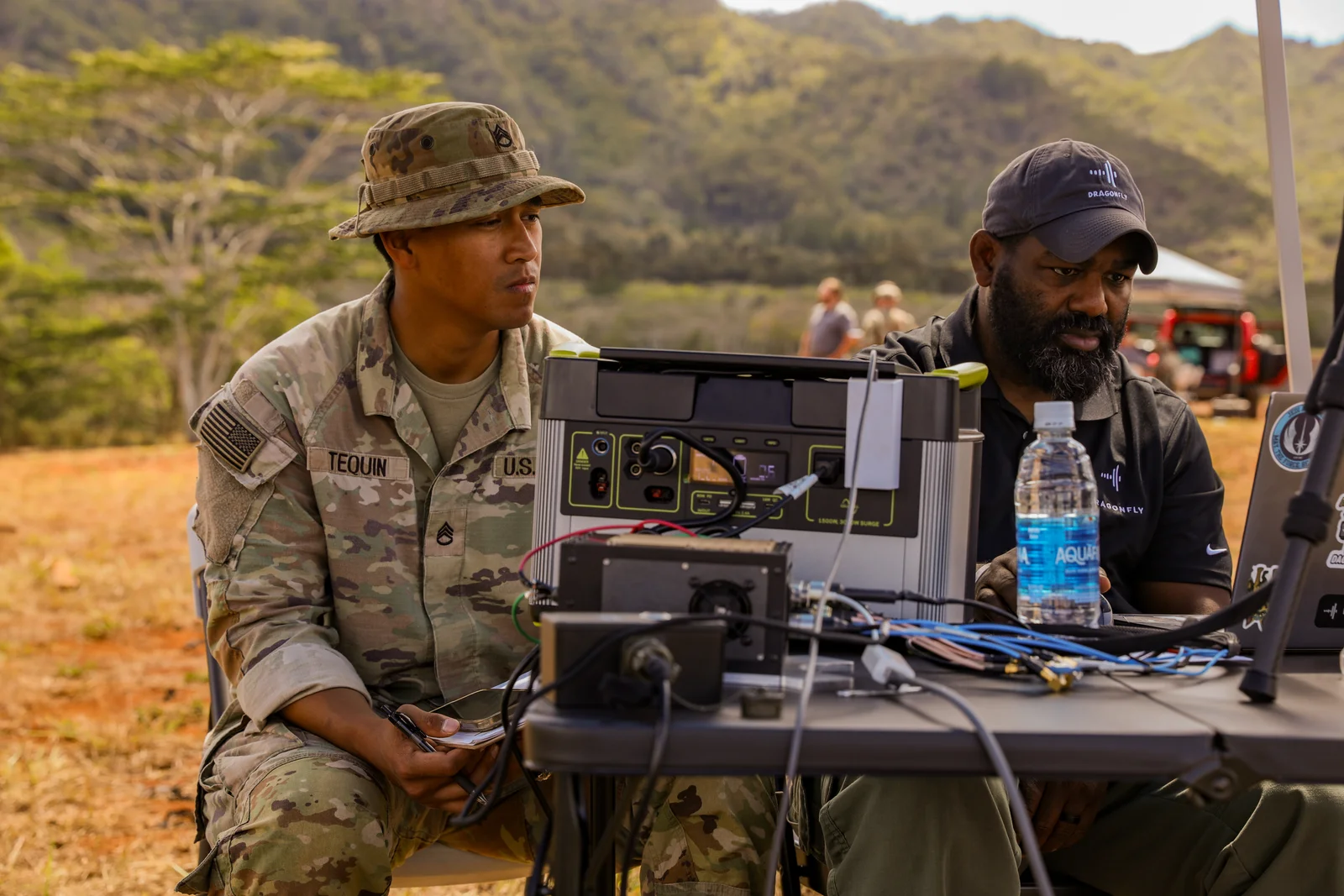
Electromagnetic warfare specialists in the Multifunctional Reconnaissance Company of the 2nd Mobile Brigade, 25th Infantry Division have used Dragonfly to detect signals of interest, part of an Army effort to test commercial spectrum sensing equipment in the Pacific. The system was added to the General Services Administration's Multiple Award Schedule on June 24, 2026.
Rich Briggs incorporated Research Innovations in January 2009, and Jack Harrington is chief executive. The company is based in Alexandria, Virginia, with offices in Melbourne and St. Petersburg, Florida, San Antonio and London, and it doesn't publish financial results. It reported 76% revenue growth over two years when it placed 114th on Inc. magazine's 2024 Mid-Atlantic regional list, its second consecutive year on it.
Dragonfly isn't the company's only recent federal work. The Army Geospatial Center gave it a place on the GRIDS IV multiple-award contract in July 2025, the Army named it sole awardee for the second phase of its Unified Network Operations Tactical NetOps prototype in October 2025, and the Missile Defense Agency added it to the SHIELD contract in January 2026. SHIELD carries a $151 billion ceiling shared across every company on it, which caps total ordering rather than describing what any one awardee receives.
Can you invest in Research Innovations?
No. Research Innovations is privately held. We found no SEC registration statement and no publicly announced outside investment: a full-text search of the agency's EDGAR database on September 3 returned no filings by the company, and neither Research Innovations nor any private equity firm has announced a stake. That's not the same as proving none exists, but there's no public signal of an IPO in motion.
The tradable connection is Nvidia, and it's a thin one. The $99.5 million is a ceiling on five years of ordering rather than money already booked, work locations and funding are set with each individual order, and one graphics processor per sensor is a small piece of a company that reported $96.2 billion in revenue in the quarter ended July 26. The Army has committed larger sums to other counter-drone systems this year, including AeroVironment's $464.8 million Locust laser production contract.
Dragonfly sits on the GSA schedule in two configurations, which the company lists as Tactical DF System and Spectrum Dominance.