Key points
- Congressman Gil Cisneros (D-CA) disclosed a purchase of Argan (AGX) dated June 30, 2026, in the $15,001 to $50,000 range.
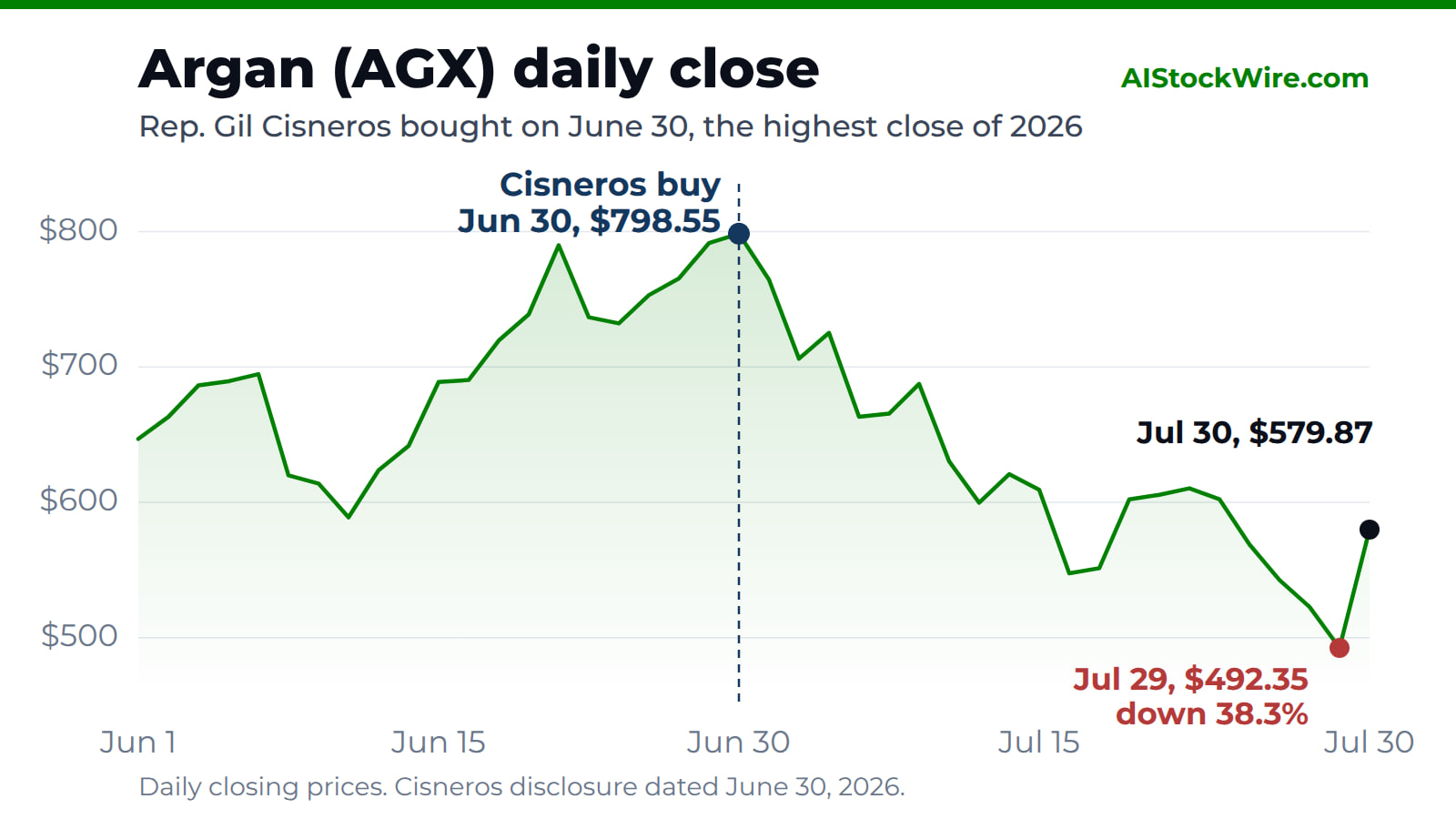
- Argan closed at $798.55 that day. That was its highest close of 2026. It closed at $579.87 on July 30, down 27.4% from the date of the trade.
- Five Argan insiders sold $84.0 million of stock between June 12 and June 22. Not one of those six filings was made under a prearranged 10b5-1 trading plan.
- Argan's July decline was not company-specific. It has filed no 8-K since June 10, and competing power-infrastructure stocks fell and recovered alongside it.
- Argan builds power plants and data center infrastructure for the AI buildout. Its backlog was $2.9 billion at its last fiscal year end.
Update, July 31, 2026: This piece first ran on July 3, when Argan was down 11.6% from the date of the Cisneros purchase. Two things have changed since. The stock is now down 27.4%, and the original version said Argan's chairman and chief executive together sold about $56 million in June. That figure was wrong. It folded in a David Watson sale from April. The June selling was in fact larger, $84.0 million, but it came from five insiders rather than two. Corrected figures are below.
Congressional trade disclosures are one of my favorite things to dig through, and this one turned up in our own Congress stock tracker. Congressman Gil Cisneros disclosed a purchase of Argan (AGX) dated June 30, 2026. Of all the days available to him that year, he picked the one the stock closed higher than it ever had in 2026.
What was disclosed
Cisneros represents California's 31st congressional district and sits on the House Armed Services Committee. His periodic transaction report, signed and filed July 2, 2026, shows a purchase of Argan (AGX), a construction and engineering company, dated June 30, 2026. The dollar amount is reported only as a range, $15,001 to $50,000, which is how the STOCK Act works: members disclose a bracket, not an exact price or share count.
That bracket, and the reporting lag that comes with it, are worth keeping in mind with any of these filings. Members of Congress have up to 45 days after a transaction to disclose it, so a trade that looks "new" in a tracker can sometimes be a month or more old by the time it is public. This one was fast: Cisneros signed and filed it just two days after the trade, and it was one of dozens of positions in the same filing, which is part of why we built a tracker to keep up with active traders like him.
What Argan did after the trade
Argan closed at $798.55 on June 30, 2026, the date on the disclosure. It has not closed higher since. The stock slid through the first half of July, dropped hard in the last full week of the month, and then recovered a good part of that on July 30.
| Date | Close | From June 30 |
|---|---|---|
| June 30 (trade date) | $798.55 | n/a |
| July 1 | $764.56 | -4.3% |
| July 2 | $706.15 | -11.6% |
| July 17 | $551.26 | -31.0% |
| July 29 | $492.35 | -38.3% |
| July 30 | $579.87 | -27.4% |
The disclosure gives a date, not a time or an exact execution price, so there is no way to know whether Cisneros bought at the open, the close, or somewhere in between on June 30. The closing price that day is the fairest reference point available, and by that measure the position is down 27.4% as of the July 30 close.
Why Argan fell
Two separate things happened, and they are worth keeping apart.
The first is that Argan insiders had been selling heavily in the weeks before the trade date. Five of them sold a combined $84,030,105 between June 12 and June 22, according to their Form 4 filings with the SEC.
| Insider | Role | Shares | Value |
|---|---|---|---|
| William F. Griffin Jr. | Director | 100,000 | $69.16M |
| David Watson | President and CEO | 11,873 | $7.84M |
| Peter Getsinger | Director | 6,728 | $4.75M |
| Cynthia Flanders | Director | 2,596 | $1.73M |
| Joshua Baugher | Chief Financial Officer | 760 | $557K |
| Total | 121,957 | $84.03M |
William F. Griffin Jr., who is a director and the non-executive chairman of Argan's Gemma Power Systems subsidiary, accounts for most of that on his own. He sold 50,000 shares on June 12 at $643.46, then another 50,000 across June 18 and June 22 at $725.85 and $760.43. Part of the second block came out of a family trust, which held 40,976 shares afterward.
Every one of those six filings has the Rule 10b5-1 box unchecked. That box, when checked, is the insider stating the sale was scheduled in advance under a written plan. None of these were. Insiders sell for all sorts of ordinary reasons, diversification and tax planning among them, and a sale outside a plan is not evidence of anything improper. It does mean nobody can point to a plan adopted months earlier to explain the timing.
The second thing is that July had almost nothing to do with Argan specifically. The company has filed no 8-K since June 10, when it declared a quarterly dividend. What actually happened is that the entire power-infrastructure trade broke down and then snapped back, and Argan moved with it. On July 30, the day of the recovery:
| Stock | July 30 move |
|---|---|
| Argan (AGX) | +17.8% |
| Quanta Services (PWR) | +17.3% |
| Sterling Infrastructure (STRL) | +17.5% |
| GE Vernova (GEV) | +9.1% |
| Modine Manufacturing (MOD) | +8.9% |
| Power Solutions International (PSIX) | +9.4% |
So the honest read is that Cisneros bought a stock at its high, and then the group that stock belongs to had a very bad month. There was also a small business wrinkle in the background: Argan's project backlog slipped from about $2.9 billion at its January 2026 fiscal year end to about $2.8 billion as of April 30, 2026, its most recently reported quarter.
What Argan actually does
Argan, mainly through its Gemma Power Systems subsidiary, designs, builds, and maintains power plants, mostly natural gas, along with data center and telecom infrastructure work. It reports results in three segments: Power, Industrial, and Teledata.
The business has become an AI-adjacent story because power is one of the real bottlenecks in building AI data centers, and Argan is one of the companies that builds it. CEO David Watson has pointed to rapid growth in AI and data centers, the broader push to electrify everything, and years of underinvestment in power infrastructure as the demand behind the company's backlog.
The numbers back that up. In its fiscal year ended January 31, 2026, Argan reported revenue of $944.6 million, up 8.1%, net income of $137.8 million, and a backlog of $2.9 billion. Its fiscal first quarter, reported June 4, 2026, was a record: about $291 million in revenue and near $46 million in net income. The board also raised its buyback authorization to $200 million from $150 million and declared a $0.50 dividend.
What this filing does not tell you
Quite a lot, actually. It does not say what price Cisneros paid, how many shares he holds, whether he has since sold, or whether he made the decision himself. It does not say whether the position is a small slice of a large portfolio or something more concentrated. The next periodic transaction report is the only way any of that becomes public, and it may not come for weeks.
What it does show is why "a member of Congress bought X" tells you so little on its own. Cisneros bought at Argan's high for the year, and the reason the stock fell afterward had far more to do with a sector-wide decline than with anything in his filing. The data on whether Congress actually beats the market runs into the same problem: by the time a trade is public, the moment that mattered has usually passed. If you want the mechanics of how these disclosures work, here is a walkthrough, and Argan's filing history is on its filings page.
Sources
- U.S. House Clerk, Gil Cisneros periodic transaction report, signed and filed July 2, 2026
- SEC EDGAR, Argan Form 4 filings by Griffin (June 12, June 18 and 22), Watson, Getsinger, Flanders and Baugher
- StockAnalysis.com, Argan (AGX) stock overview and financials
- Ballotpedia, Gil Cisneros
This article is for general informational purposes only and is not investment advice. Prices are as of the July 30, 2026 close and will change. Always do your own research and consider speaking with a licensed financial professional before making any investment decision.