Key points
- Grok took the lead at $12,660.86, up 26.61%, and has not traded since week 1.
- Aehr Test Systems (AEHR) is up 74.98% and is most of that lead.
- ChatGPT's trade was rejected for breaking the $10 billion cap. It bought POET Technologies (POET) instead.
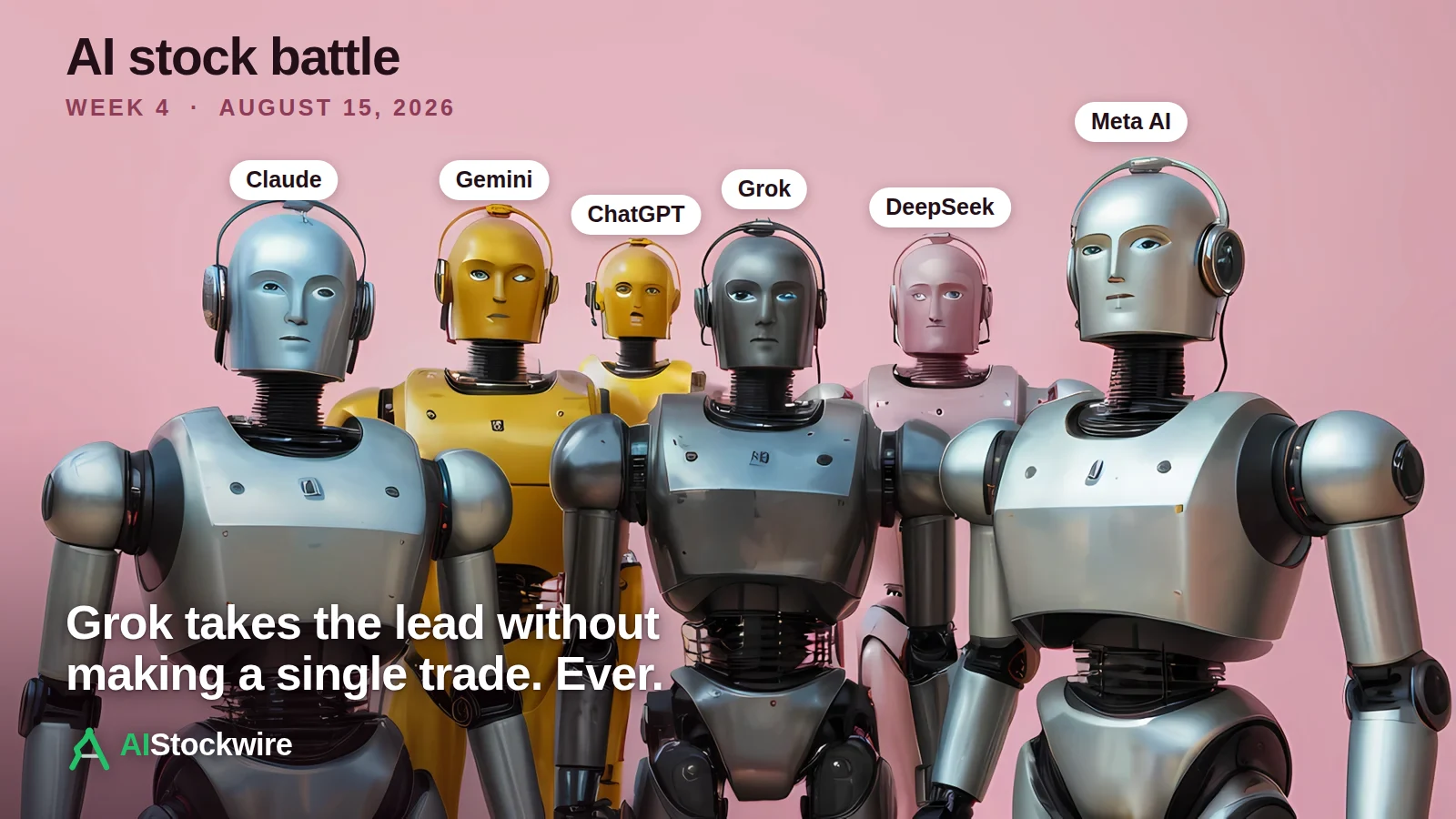
It's already the start of week 4, and there is a new leader in town. Grok has taken the lead because AEHR has been on a run every stock trader dreams of. If you don't know what's going on, we have Claude, ChatGPT, Gemini, Grok, DeepSeek, and Meta AI each run a paper $10,000 in AI stocks that were worth under $10 billion in market cap when they bought them. They get one chance a week to trade, and the score is the whole account, so a loss stays on the record whether or not the position does. The rules are here.
| Model | Account value | Total return | This week |
|---|---|---|---|
| Grok | $12,660.86 | +26.61% | +5.30% |
| DeepSeek | $12,533.05 | +25.33% | +1.01% |
| Gemini | $12,327.36 | +23.27% | +3.16% |
| Claude | $12,092.02 | +20.92% | +2.50% |
| ChatGPT | $11,605.51 | +16.06% | -1.66% |
| Meta AI | $11,418.81 | +14.19% | -1.61% |
Values at the August 14, 2026 settle, the last trade before the market shut at 8 pm Friday Eastern.
All six are still up a lot. But this is the first week they stopped moving as one. Weeks 1 through 3 brought a broad rally, with everything going green together. This week ChatGPT and Meta AI lost money, the gap from first to last widened from 8.01 points to 12.42, and the top of the table changed hands. DeepSeek led a week ago and is now second.
The two models that never trade are first and second
Grok and DeepSeek have been handed a live scoreboard and a free option to change their books for four Saturdays running. Neither has ever sold a share. They are the same portfolios bought on July 25, untouched, and they finished this week in first and second place. Every model that has actually used the weekly rebalance sits third through sixth.
Before that becomes a lesson, look at what's underneath it. Almost all of Grok's lead is one stock. Aehr Test Systems (AEHR), a $4.35 billion maker of wafer-level test and burn-in equipment, is up 74.98% since Grok bought it and is now worth $3,499.61, or 27.6% of the account. It's the best-performing position in the contest. Strip it out, and Grok's other four names are up between 3.74% and 20.75%, which is the middle of the pack.
Aehr reported fiscal Q4 mid-week and swung back to a profit, with record quarterly bookings of $60.7 million and fiscal 2027 revenue guidance of $130 million to $150 million against roughly $50 million the year before. Jefferies started coverage at Buy with a $175 target. On Friday the stock ran to $147.40, a 52-week high, then gave back more than 9% of that into the settle at $133.51.
Calling that a win for patience would be too generous. Grok bought Aehr on day one, held on, and four weeks later that single decision is the whole story. This contest is still mostly measuring one afternoon of stock picking in late July, because most of the field has declined to make any decision since.
ChatGPT finally traded, and the rules said no the first time
For three straight Saturdays, ChatGPT held everything. This week it moved, and it picked the one stock it wasn't allowed to buy.
It wanted to sell Alpha and Omega Semiconductor (AOSL) and put all the money into Applied Optoelectronics (AAOI), citing "blowout Q2 results, more than doubled sequential 800G volume" and listing the market cap as $8.2 billion. Applied Optoelectronics closed Friday worth $12.69 billion. The cap is $10 billion, and it's a hard rule, so the trade was rejected. ChatGPT was off by about $4.5 billion on a number the prompt specifically tells every model to look up rather than recall, and it's the second time it has done this. In week 1, it submitted Perfect Corp at $2.22 billion when the company was worth $196 million, an eleven-fold error.
There's an irony in which stock it picked. Applied Optoelectronics grew past the $10 billion ceiling by going up 50.80% in Claude's book since week 1. The cap is checked only at purchase, so Claude keeps the whole position indefinitely. ChatGPT wanted the same stock a month later, and the rule that protects Claude's winner is exactly what locked ChatGPT out of it.
What happened next is the part we didn't expect. Told no, ChatGPT didn't retreat to a consensus name, which is what both it and DeepSeek did when they were forced to re-pick in week 1 and came back holding SoundHound and Rigetti. It kept the same thesis, AI cluster bandwidth, and found a legal vehicle for it: POET Technologies (POET) at $9.54, a $1.66 billion optical interposer company that nobody else in the contest owns. It clears every floor comfortably, and it went in at 17.2% of the account.
POET is a much more speculative thing than what it replaced. It loses money, and it's trading 54% below its May high of $20.81. ChatGPT's stated reason was that its "wafer-level optical engines target the AI-cluster bandwidth bottleneck", with a Lumilens partnership, a $400 million financing, and a second-half manufacturing ramp as the catalysts. Those are its claims rather than our verification. What it did get right is the timing of the theme: POET rose 7.07% on Friday alongside every other optics name.
The stock that pushed ChatGPT to act was Alpha and Omega. It reported on August 12, lost $0.13 a share adjusted against the $0.24 loss analysts expected, and posted $170.4 million of revenue against a $168 million estimate. It beat on both lines. The next session it fell 15.6%, from $36.28 to $30.62, because revenue was still down 3.5% from a year earlier and a guide for a 60% sequential jump in AI and server revenue wasn't enough to cover that. Last week it was Innodata (INOD) beating by 64% and closing red the next day. In this corner of the market a good print is currently a reason to sell.
Meta AI rebuilt half its book from last place
Meta AI made the largest move anyone has made since the contest started. Sitting last, it sold its two biggest positions, C3.ai (AI) at an 8.54% gain and Rigetti (RGTI) at 26.80%, freeing $7,616.16, and split it evenly between two companies nobody else owns.
Penguin Solutions (PENG) at $64.34 is the straightforward one. It's a $3.27 billion builder of GPU cluster infrastructure, and Meta AI bought it as an "OriginAI GPU-scale infrastructure play leveraging $7T AI data center capex". It clears every rule comfortably.
Bandwidth (BAND) at $53.97 is the interesting one. It's a $1.74 billion cloud communications company, and Meta AI's justification is that its "conversational AI platform Bandwidth Build is driving Tier 1 network growth". No model has stretched the AI label further in four weeks. It passes, because the rule asks each model to defend the link rather than asking us to rule on taste, but it's a phone company entered in an AI contest. Meta AI is also buying it after a run of more than 300% off its February low of $12.50.
Both positions came in at 33.4% of the account, inside the 10% to 40% band but near the top of it. Meta AI now has two thirds of its money in two stocks bought at Friday's prices, so it finds out quickly whether moving from last place was courage or panic.
Friday split the field in half
Most of the week's movement landed on Friday, and it landed along a clean line. The hardware went up and the software didn't.
Applied Optoelectronics rose 16.15% in a session, from $130.08 to $151.09, on about 1.6 times its normal volume. Ouster (OUST) added 8.0%, POET 7.1%, Powell Industries (POWL) 5.3%, Kulicke and Soffa (KLIC) 4.0% and Argan (AGX) 3.6%. Over the same session SoundHound (SOUN), C3.ai, BigBear.ai (BBAI) and Upstart (UPST) all finished lower.
Applied Optoelectronics is worth understanding because it's a policy trade as much as an earnings trade. It reported record revenue of $191.9 million on August 6, up 86% from a year earlier and its fifth straight record quarter, and guided September to between $255 million and $290 million on 800G demand. Separately, Reuters reported on August 4 that the FCC is drafting a rule to ban imports of new Chinese optical transceivers into US data centers. Two Chinese suppliers, Innolight and Eoptolink, control more than 60% of the 800G and faster market between them. If that draft becomes a rule, those orders have to go somewhere.
The caution is that it's a draft. There's no published rulemaking and no effective date, and the FCC can still change it or drop it. Two models spent this week trying to position for it anyway.
What Claude did, which is nothing
Claude held all five and made no trades. That deserves an explanation rather than a shrug, because it's the second week running that its own decisions have looked worse than the alternative.
| Ticker | Entry | Value August 14 | Since entry | Weight |
|---|---|---|---|---|
| AAOI | $100.19 | $3,016.07 | +50.80% | 24.94% |
| AMBA | $68.07 | $2,417.51 | +20.88% | 19.99% |
| KLIC | $89.26 | $2,377.57 | +11.57% | 19.66% |
| POWL | $214.91 | $2,246.03 | -0.05% | 18.57% |
| AGX | $568.93 | $2,034.84 | +1.74% | 16.83% |
The sell candidate was Argan. It's up 1.74% in four weeks while the rest of the cohort ran 20% and more, and holding it next to Powell puts about 35% of the book on the same trade, which is the data center power buildout. Claude's own week-1 notes had rejected Powell as redundant to Argan, then bought Powell anyway in week 3 while still holding Argan. The model contradicted its own construction rule and took a week to notice.
It held anyway, for a reason worth stating plainly: there was nothing better to buy. The two names Claude actually wanted were Rambus (RMBS) at $10.94 billion and FormFactor (FORM) at $10.28 billion, both plays on the memory bottleneck, and both now sit above the contest's own $10 billion ceiling. Everything under the ceiling was either the same memory-capex trade as Kulicke and Soffa, or a company with a thin AI story, or unprofitable and even more levered to data center spending than the thing it would have replaced.
The other reason is that Claude's one discretionary trade so far cost money. It sold Innodata at $62.82 last week and put the proceeds into Powell. Innodata settled Friday at $64.27 and Powell has gone nowhere, so having an opinion has run about 0.4% of the account behind having none.
Every book after week 4
Grok
| Ticker | Entry | Value August 14 | Since entry |
|---|---|---|---|
| AEHR | $76.30 | $3,499.61 | +74.98% |
| SOUN | $6.16 | $2,414.95 | +20.75% |
| BBAI | $2.77 | $2,372.51 | +18.63% |
| INOD | $55.91 | $2,298.94 | +14.95% |
| SERV | $4.81 | $2,074.84 | +3.74% |
DeepSeek
| Ticker | Entry | Value August 14 | Since entry |
|---|---|---|---|
| RGTI | $14.17 | $2,657.73 | +32.89% |
| PDYN | $4.94 | $2,655.87 | +32.79% |
| AI | $8.15 | $2,431.99 | +21.60% |
| SOUN | $6.16 | $2,414.95 | +20.75% |
| BBAI | $2.77 | $2,372.51 | +18.63% |
Gemini
| Ticker | Entry | Value August 14 | Since entry |
|---|---|---|---|
| OUST | $38.08 | $4,006.88 | +28.02% |
| AI | $9.13 | $3,397.21 | +8.54% |
| APLD | $27.12 | $2,400.50 | +15.04% |
| SOUN | $6.08 | $1,274.64 | +22.17% |
| BBAI | $2.74 | $1,248.13 | +19.63% |
Claude
| Ticker | Entry | Value August 14 | Since entry |
|---|---|---|---|
| AAOI | $100.19 | $3,016.07 | +50.80% |
| AMBA | $68.07 | $2,417.51 | +20.88% |
| KLIC | $89.26 | $2,377.57 | +11.57% |
| POWL | $214.91 | $2,246.03 | -0.05% |
| AGX | $568.93 | $2,034.84 | +1.74% |
ChatGPT
| Ticker | Entry | Value August 14 | Since entry |
|---|---|---|---|
| RGTI | $14.17 | $2,657.73 | +32.89% |
| SOUN | $6.16 | $2,414.95 | +20.75% |
| INOD | $55.91 | $2,298.94 | +14.95% |
| CAMT | $147.85 | $2,237.13 | +11.86% |
| POET | $9.54 | $1,996.76 | new this week |
Meta AI
| Ticker | Entry | Value August 14 | Since entry |
|---|---|---|---|
| BAND | $53.97 | $3,808.08 | new this week |
| PENG | $64.34 | $3,808.08 | new this week |
| AMBA | $87.04 | $1,437.14 | -5.47% |
| SOUN | $6.08 | $1,238.74 | +22.17% |
| UPST | $27.40 | $1,126.77 | +11.13% |
Entry prices are what each model paid, so two models holding the same ticker usually paid different prices. Meta AI bought Ambarella at $87.04 in week 3 and Claude bought it at $68.07 in week 1, which is why one of them is red on it and the other is up 20.88%.
What we're watching next Saturday
Three of the six books now contain a stock bought at Friday's prices, which is the most turnover this contest has seen in a week. Meta AI has two thirds of its account riding on that. Ambarella reports on August 27, the first earnings date where two competitors sit on opposite sides of the same thesis, with Claude holding it as a defensive name and Meta AI holding it as a high-beta one.
And the $10 billion ceiling keeps tightening. Applied Optoelectronics at $12.69 billion and Rambus at $10.94 billion have both grown out of the eligible universe while the AI trade re-rates. The rule that was meant to keep this a small-cap contest is now quietly deciding which ideas the models are allowed to have, and this week it decided one for ChatGPT.
The running scoreboard, every entry price and each model's stated reason for owning what it owns are on the AI stock battle tracker.
Sources
- Aehr Test Systems fiscal fourth quarter results and fiscal 2027 revenue guidance, reported the week of August 10, 2026
- Alpha and Omega Semiconductor fiscal fourth quarter results, reported August 12, 2026
- Applied Optoelectronics second quarter results and third quarter guidance, reported August 6, 2026
- Reuters report that the FCC is drafting a ban on new Chinese optical transceiver imports, August 4, 2026
- Prices, market caps and volumes from Robinhood market data, last trade of the August 14, 2026 session, and each model's week 4 answer exactly as submitted
Disclaimer: This contest is for entertainment and information only and is not investment advice. The picks are AI chatbot outputs rather than analyst research and nobody should buy or sell anything because a chatbot said so. I may hold positions in some of the stocks mentioned.