Key points
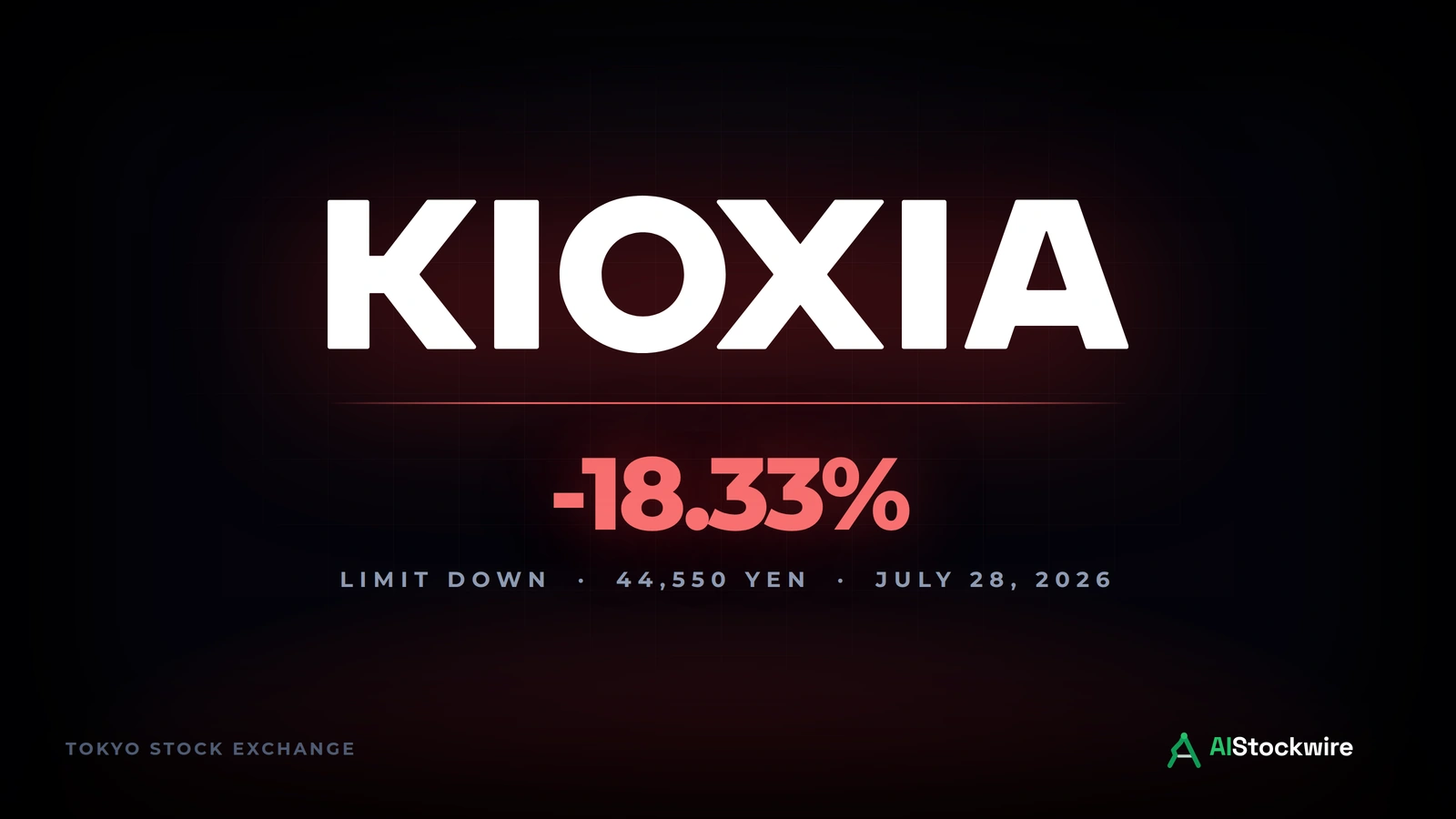
- Kioxia closed limit-down in Tokyo at 44,550 yen ($272 USD), down 10,000 yen ($61 USD) or 18.33%.
- It closed at that same floor on July 17, down 16% at 52,110 yen ($318 USD).
- The stock peaked at 112,700 yen ($688 USD) on June 22. It is now 60.5% below that.
- Kioxia and Sandisk (SNDK) jointly own the Yokkaichi and Kitakami plants that make the NAND. They are not two companies reacting to the same news.
- They extended the Yokkaichi joint venture in January 2026, from December 2029 out to December 2034.
- The Nikkei 225 closed down 3.95% at 62,364.92, a two month low, after falling more than 3,000 points intraday.
- Sandisk was down 15.51% at 1:49 p.m. ET Tuesday. Nvidia (NVDA) was up 0.40%.
Kioxia Holdings fell as far as the Tokyo Stock Exchange permits in a single session on Tuesday, and then stopped, because the exchange would not let it fall further.
The memory maker closed at its limit-down price of 44,550 yen ($272 USD), down 10,000 yen ($61 USD) from Monday's close of 54,550 yen ($333 USD). That is a decline of 18.33%. Japanese exchanges cap how far a stock can move in one day and halt it at the boundary, so the closing price is a floor the exchange set rather than a price buyers and sellers agreed on.
This is not the first time this month either. On July 17, Kioxia fell 16% to 52,110 yen ($318 USD) and stopped at the floor then as well. Nikkei reported that day that its market value had slipped below 30 trillion yen ($183 billion USD), letting Tokyo Electron pass it and pushing Kioxia to fifth among Japanese companies by market capitalization.
The stock reached 112,700 yen ($688 USD) on June 22, at the top of a run driven by demand for the SSDs that go into AI data centers. As recently as mid-July, it was the fourth most valuable listed company in Japan. Thirty-six days later it is 60.5% below that peak.
Kioxia and Sandisk are two halves of the same factory
The part of this that has not been widely reported in the United States is why Sandisk (SNDK) and Kioxia keep falling in the same direction on the same days.
They are partners in the plants. Kioxia and Sandisk jointly own and operate the Yokkaichi plant in Mie Prefecture and the Kitakami plant in Iwate Prefecture, which is where their NAND flash memory is physically made. The relationship runs back more than 26 years to Sandisk's original partnership with Toshiba, whose memory division became Kioxia.
In January 2026, the two extended the Yokkaichi joint venture by five years, from December 31, 2029 to December 31, 2034. The Kitakami contract already ran to that same date. Under the agreement, Sandisk pays Kioxia $1.165 billion for manufacturing services and continued product supply, in installments between 2026 and 2029. In July, the partners started producing tenth-generation 3D flash memory in the second Kitakami building, which has been running since September 2025 on the eighth generation.
So when the price of NAND moves, it does not hit two competitors. It hits one shared production base with two tickers attached, one listed in Tokyo and one in New York. Japanese technology outlet SBBit put it plainly, writing that if memory market conditions deteriorate, both companies are prone to taking the same hit, and describing Sandisk's drop as having triggered associated selling in Kioxia.
That is what happened this week in sequence. Sandisk fell more than 11% in New York on Monday. Kioxia opened in Tokyo on Tuesday and went limit-down.
The selloff went New York, Seoul, Tokyo, New York
The Nikkei 225 closed Tuesday at 62,364.92, down 2,566.27 points or 3.95%, its lowest close in two months. It was down more than 3,000 points at one stage and briefly traded under 62,000. The biggest drags on the index were Advantest, Tokyo Electron, Kioxia, SoftBank Group and Ibiden.
Nikkei described the session as selling in what it called AI pickaxe stocks, the suppliers that equip the buildout rather than the companies selling the models. It also called the day the second wave of the AI selloff that started in Korea.
The order matters. Nvidia (NVDA) fell about 5% in New York on Monday and Sandisk fell more than 11%. Korea's Kospi then fell 10.84% on Tuesday, and Korea Exchange halted every stock for 20 minutes, which we covered here. Tokyo took the same story a few hours later. Then New York opened and took it again.
By 1:49 p.m. ET Tuesday, Sandisk was down 15.51% at $1,080.00, Micron (MU) down 9.37% at $815.88, Western Digital (WDC) down 8.99% at $453.18 and Seagate (STX) down 8.65% at $746.34. Nvidia was up 0.40% at $197.30.
That last number is the one worth holding onto. Nvidia designs GPUs and buys memory. It was green. Every company that manufactures the memory was down between 8% and 16%. This is a repricing of memory supply, not of AI demand.
What actually changed
Two China headlines from Monday did most of it, and neither was about AI demand slowing.
ChangXin Memory Technologies, China's largest DRAM maker, closed its Shanghai debut up 465.82% and became one of the largest listed companies in mainland China, a listing we wrote about here. Separately, The Information reported that a state backed Shanghai firm has started building immersion deep ultraviolet lithography machines, the tools ASML has dominated.
Neither headline touches Nvidia's order book. Both go straight at the assumption that memory makers will keep earning record margins because supply stays tight. Korean brokers have separately been arguing that memory prices peak in the fourth quarter.
Kioxia is more exposed to that argument than most, because it is a NAND business rather than a diversified one. It does not have SK Hynix's high bandwidth memory franchise selling into Nvidia's racks to offset a downturn in commodity flash.
What comes next
Wednesday, July 29 is heavy. SK Hynix reports second quarter results, and even the lowest forecast beats what the company earned in all of 2025, though that quarter closed before any of this happened, so the guidance carries more weight than the print. The Federal Reserve announces its rate decision at 2 p.m. ET with Chair Kevin Warsh taking questions at 2:30. Microsoft (MSFT) and Meta (META) report after that close, and both are large buyers of the memory that just repriced.
For Kioxia specifically, a limit-down close is not a settled price. It is an unfinished auction. The orders that could not be filled on Tuesday are still there on Wednesday morning.
Sources
- Kioxia limit-down price and prior close: SBBit and THE GOLD ONLINE, July 28, 2026
- Kioxia's 112,700 yen high on June 22, 2026, the July 17 limit-down close at 52,110 yen down 16%, the sub-30 trillion yen market value and the fall to fifth behind Tokyo Electron: Nikkei, July 17, 2026
- Yokkaichi contract extension to December 31, 2034, the Kitakami contract already running to that date, and the $1.165 billion Sandisk payment for manufacturing services and continued product supply in installments from 2026 to 2029: Kioxia company release, January 30, 2026
- Kitakami K2 building producing tenth generation 3D flash from July 2026, in operation since September 2025 on the eighth generation: Kioxia company release, July 3, 2026
- Nikkei 225 close, intraday low, index drags and the AI pickaxe framing: Nikkei, July 28, 2026
- SNDK, MU, WDC, STX and NVDA prices as of 1:49 p.m. ET July 28, 2026 against settled July 27 closes, via Robinhood market data
- Kospi close and circuit breaker: our July 28 Kospi coverage
- Yen figures converted at 163.78 yen to the dollar, the rate quoted in Tokyo on July 28, 2026
This is general market commentary and opinion, not investment advice. Markets can go down as well as up, and you can lose money. Always do your own research and consider speaking with a licensed financial professional before making any investment decision.