Key points
- Korea Exchange raised the Kospi delisting floor to a 30 billion won ($20.9M USD) market value on July 1, 2026. Hansung Enterprise sat at 26.7 billion won ($18.6M USD) that day and Monami at 23.8 billion won ($16.6M USD).
- Retail investors organized on social media to buy the shares and keep the companies listed. Hansung rose 244.89 percent in the first half of July and Monami 210.83 percent, the two best returns on the market.
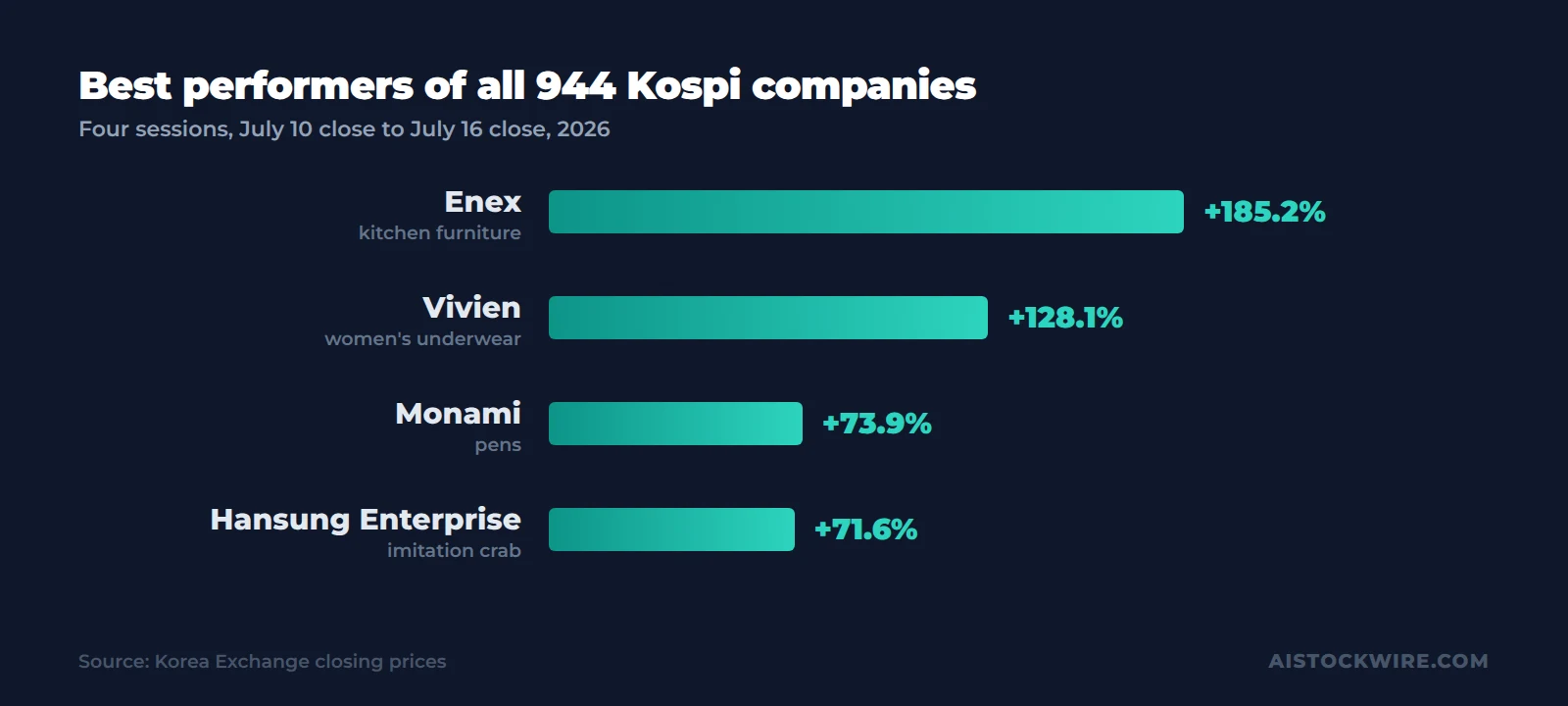
- Over July 13 to 16 the four best performers among 944 Kospi companies were a kitchen furniture maker, an underwear brand, a pen company and a crab stick producer.
- Korea Exchange suspended Hansung for a day on July 16, flagged Monami for the same, and put Enex and Vivien under investment caution. All four have since given back most of the move, and the delisting floor rises again to 50 billion won ($34.8M USD) in January.
On July 1, Korea Exchange raised the market value a Kospi company needs to stay listed. The new floor is 30 billion won, which is about $20.9 million, and it landed six months ahead of the schedule Korea first announced.
Hansung Enterprise did not clear it. Neither did Monami. The two were worth 26.7 and 23.8 billion won that morning, so each was short of the line by a few million dollars.
Neither is a company most Koreans would struggle to name. Hansung makes Cremy, the imitation crab sticks that sit in almost every refrigerator here. Monami makes pens. If you went to school in Korea you wrote with one.
What happened next did not come from a brokerage or a fund. It came from message boards.
The message boards decided to save them
Someone posted that Hansung had been quietly putting on concerts for Korean War veterans for about 25 years. The post moved around the investing communities and the mood settled quickly. "We cannot let our national companies disappear from the stock market like this," ran the line that spread with it.
Monami carried its own history. During the boycott of Japanese goods it was the pen Koreans reached for instead, and that is not something people here have forgotten.
So they bought. Hansung had closed the Friday before at 4,230 won. It ended the next Friday at 8,460. Exactly double, from under $3 a share to under $6, and on two of those five days it rose the daily limit, which in Korea is 30 percent. Monami did not double. It settled for 62 percent.
Then it spread. Enex, which makes kitchen furniture and had been noted in the communities for donating beds and cabinets to children's welfare homes, rose 185.2 percent in the four sessions to July 16. That was the best return of all 944 companies on the Kospi. Second place went to Vivien. It makes women's underwear, it was founded in 1957, and it has been listed since 1976. It rose 128.1 percent over the same four days. Monami came third and Hansung fourth.
The whole first half of July, Hansung was up 244.89 percent and Monami 210.83 percent, first and second on the market.
It is worth sitting with what that means. Korea was in the middle of the worst month the Kospi has ever recorded. Samsung Electronics and SK Hynix were falling hard enough to stop the market twice in two days. And the four best performing stocks on the exchange were kitchen cabinets, underwear, pens and imitation crab.
Korea Exchange stepped in
On July 16 the exchange suspended trading in Hansung for a day and listed Monami as a stock facing the same. Enex and Vivien were placed under investment caution. The reasoning was ordinary enough. Prices had moved a long way in a short time on buying that had nothing to do with the businesses.
The buying did what it was meant to do first. By July 10 Hansung was worth 52.5 billion won. In dollars, about $36.5 million. That cleared the line with room to spare, and Monami cleared it too.
Then it came back down
Monami peaked at 3,730 won on July 16. By July 24 it was back to 1,755. On Thursday it closed at 1,453, which is a little over a dollar and leaves it a tenth above where the buying began. Hansung reads worse laid out than described. It touched 14,520 won inside the month and ended Thursday at 5,840. Enex went to 2,755 and came back to 1,490.
The campaign lifted four companies to a tripling or better and then handed most of it back inside three weeks.
And the rule was written to survive exactly this. Under the reform a company that gets flagged has to clear the standard for 45 of the following 90 trading days. That replaced an older version where holding the price for a handful of days was enough, which is precisely the sort of rescue a burst of buying can produce and then fail to sustain.
The floor also keeps moving. On January 1 it becomes 50 billion won, a bar nearer $35 million than the $21 million these companies just scrambled over.
Monami's own numbers explain the difficulty better than the share price does. About 90 percent of what it sells is stationery, in a country with fewer schoolchildren every year and a population that writes on screens. One industry official, quoted by Hankook Ilbo, put it plainly. "Emotional buying based on preserving domestic companies caused short-term stock surges, but investment markets ultimately move according to profitability," the official said. "If the company fails to improve earnings or show growth potential, conditions will worsen again."
The point about earnings is right. Earnings still do not explain what people did in July. In the middle of the largest loss of wealth the Korean market has ever produced in a single month, with investors sending funeral wreaths to the National Assembly, a few thousand of them decided the thing to do with their money was keep a pen company on the exchange.
They may not have managed it. The buying is already gone from the price. But it is the only part of this month that anyone here has smiled about.
Sources
- 파이낸셜뉴스, 퇴출 위기 몰린 '국민 기업' 구하자, on the community buying and the Hansung price move
- 아주경제, 상폐 막겠다며 몰린 '애국 개미', on the exchange designations and the July 13 to 16 returns
- 한국일보, 애국 매수에 '돈쭐난' 모나미, on Monami's stationery revenue and the industry comment
- 한국거래소 상장규정, the 30 billion won floor from July 2026 and 50 billion won from January 2027
Won figures are converted at 1,437 won to the dollar, the July 30, 2026 rate. This article is for information only and is not investment advice.