Key points
- Korea's KOSPI fell 8.19% and halted, its fifth circuit breaker of the year.
- The cause was a roughly $9 billion unwind of leveraged single-stock ETFs, not weak demand.
- Micron (MU) fell about 7% overnight then settled down about 3.5%; DRAM prices are still up as much as 98%.
South Korea hit the brakes again. On Friday the KOSPI fell 8.19 percent to 8,198.33, and the Korea Exchange froze all trading for 20 minutes when the circuit breaker tripped at 12:10 p.m. local time. A sell-side sidecar had already fired about an hour earlier, around 11:10 a.m., trying to slow the futures down before it got that far. It did not work.
The full list, by exchange code and supply-chain role, is on our Korean AI stocks page.
This is becoming a pattern, so here are the actual numbers, because that is the part everyone is getting fuzzy on. Friday was the fifth circuit breaker on the KOSPI this year, and the third full trading halt this week alone. Add in the sidecars, which are a softer five-minute pause on program trading, and the market has been stopping and starting for days. The June 8 plunge and the brutal June 23 session, a drop of about 10 percent with two sidecars and a circuit breaker, were the warm-up. Friday was the latest leg.
The two names doing the damage are the same two that drove almost all of Korea's gains this year. Samsung Electronics (005930.KS) fell about 9.21 percent and SK Hynix (000660.KS) fell about 9.43 percent. When two stocks are that big a share of an index, the index basically is those two stocks. They go, it goes.
Micron took the round trip overnight
Because this is really a memory-chip story, it spilled straight into Micron (MU) here in the U.S. Micron closed Thursday at $1,213.56 after its blowout quarter. Overnight, the Korea selloff dragged it down hard, and by early Friday it was off about 7 percent, trading near $1,128 in the premarket. It opened around $1,139, still down about 6 percent, then clawed back a good chunk of the damage through the morning, running up to a high of about $1,199 before settling near $1,165, down roughly 3.5 percent on the day. So it recovered part of the overnight drop, but it never got back to even or reclaimed Thursday's close.
So what is actually going on? It is tempting to say memory demand fell off a cliff. It did not.
This is a positioning unwind, not a demand collapse
A few things are happening at once. First, Korea let retail traders pile into a batch of single-stock ETFs tied to Samsung and SK Hynix that only launched in late May. Sixteen came to market, fourteen of them leveraged to move at 2x the stocks' daily price, and together they swelled to about 14 trillion won, roughly $9 billion, in barely a month, with retail investors holding around 92 percent of the assets. When the country's top financial regulator said he regretted ever approving them and warned they had become high-risk bets, the momentum reversed, and leverage cuts both ways. That forced selling is a big reason the moves have been violent enough to trip circuit breakers.
Second, the macro turned. U.S. PCE inflation came in hot at 4.1 percent, with core at 3.4 percent, and suddenly the market is pricing in the chance that new Fed Chair Kevin Warsh restarts rate hikes. High-flying tech is the first thing people sell when rate fear shows up.
Third, there was a sell-the-news moment. Samsung spent the week teasing a plan to spend about 1,000 trillion won, around $648 billion, over the next decade, much of it on new chip plants, and its executives are headed to the government's "Korea Great Leap" conference on June 29. Good long-term story. Traders sold it anyway, because that is what an overbought market does with good news.
The scarcity is real, and that is the whole point
Here is the part that should keep memory bulls calm. The actual product is tight, and not by a little. DRAM prices jumped as much as 98 percent in the first quarter and are set to climb another 58 to 63 percent this quarter, with NAND flash up 70 to 75 percent, as AI data centers buy up the world's supply. It has gotten bad enough that Apple (AAPL) is raising prices on Macs and iPads to cover its memory bill, with some models up $200 or more. Micron just printed its best quarter ever and guided well above estimates. SK Hynix reports on July 29 and is expected to do the same. None of that says demand problem. We broke down Micron's quarter in Micron just had its best quarter ever, and what SK Hynix's number could look like in our SK Hynix preview.
What got expensive was the stocks, not just the chips. Korea ran too far, too fast, on too much leverage, and now it is giving some back. That is a valuation and positioning reset. It is not the AI memory upcycle ending. We argued the broader version of this in Did the AI bubble just pop, or was that a dip to buy?
If you are watching the group, the U.S.-listed ways to play it are Micron (MU), Sandisk (SNDK), Western Digital (WDC) and Seagate (STX), with Kioxia (285A.T) and the Korea names overseas. We mapped the whole complex in the memory stocks to watch.
The bottom line: a market that has to halt itself five times in a year is a market that got too crowded, not necessarily a business that broke. Watch whether the selling stays contained to the leveraged Korea trade or starts showing up in the actual demand numbers. So far, it is the former.
Earnings watch
Micron (MU) is the cleanest US-listed read on the memory cycle, and it reports every quarter. See its next date on our earnings calendar.
Nothing here is investment advice. Memory stocks are volatile and can move double digits in a day, as this week made very clear. Do your own research.
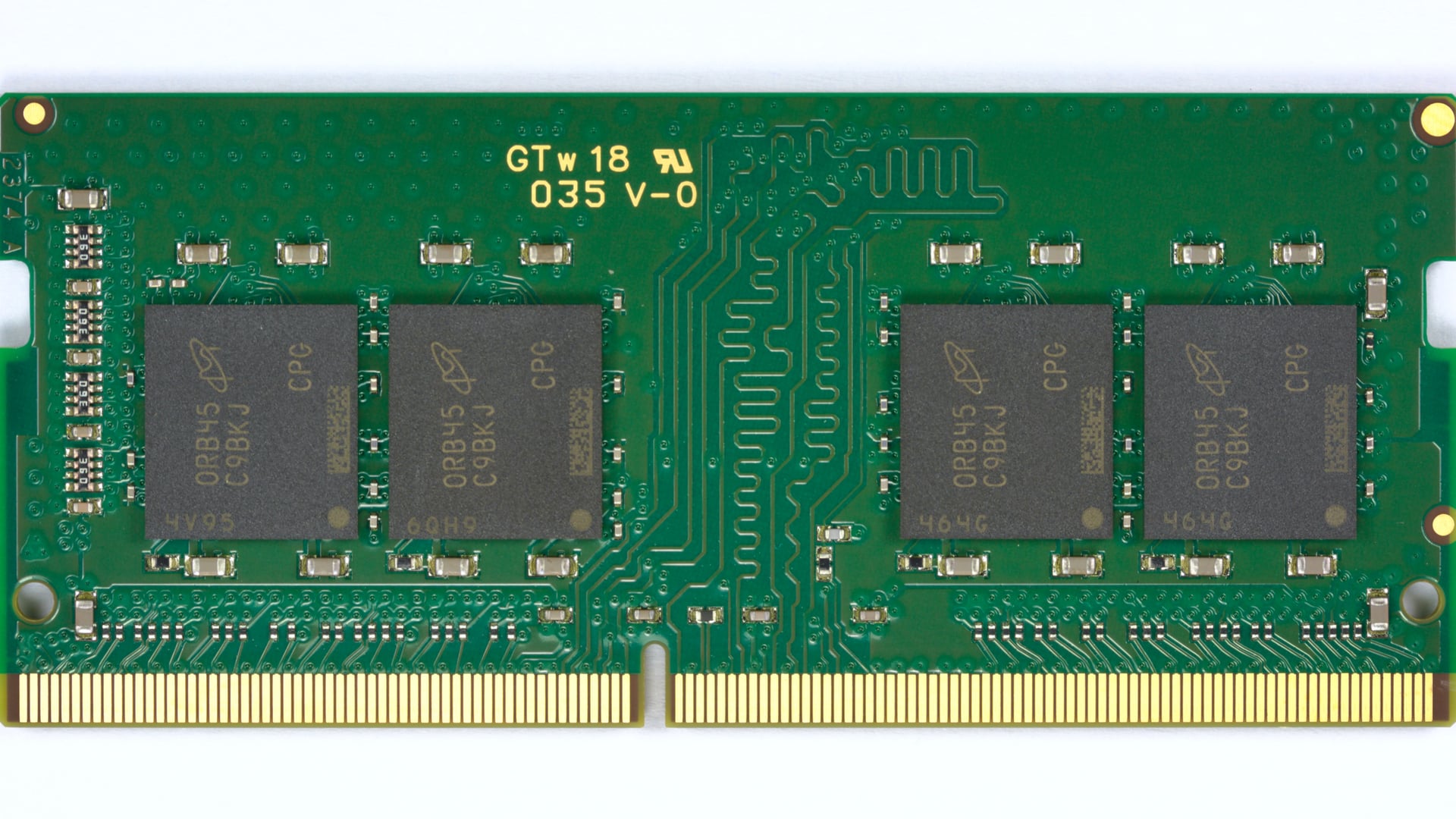
Cover photo: DDR4 memory module built on Micron DRAM, by D-Kuru / Wikimedia Commons, CC BY-SA 4.0, cropped.
This is general market commentary and opinion, not investment advice. Markets can go down as well as up, and you can lose money. Always do your own research and consider speaking with a licensed financial professional before making any investment decision.