Key points
- Muse goes after forgotten subscriptions
- What forgetting is worth to sellers
- How subscription companies may respond
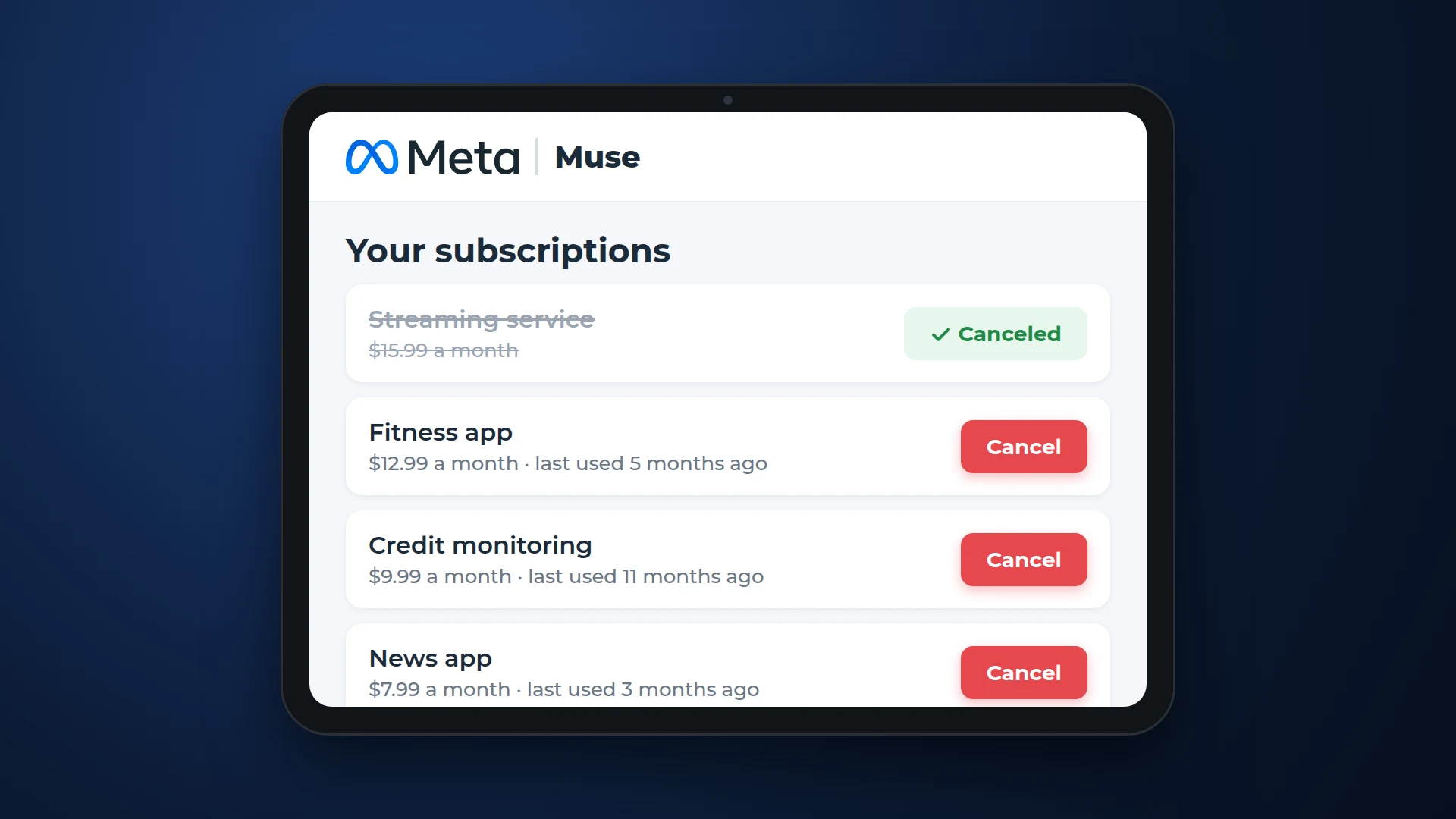
Meta's (META) new Muse AI agent can help people find and cancel recurring subscriptions, CNBC reported on Sunday. That puts Muse up against what CNBC called one of the economy's most profitable weak spots: customers who keep paying for services they forgot to cancel.
Liran Einav, Ben Klopack, and Neale Mahoney studied subscription payments using data from a large card network. Their 2025 American Economic Review paper estimated that inattention and switching costs roughly doubled sellers' revenue on average for the subscriptions studied, assuming the same number of initial subscribers. "We found that when people are forced to decide, they are about four times more likely to cancel," Mahoney told CNBC.
The pool is growing. In a report with FT Strategies, Mastercard found that 44% of U.S. consumers spent more on subscriptions in 2025. The report surveyed more than 10,000 consumers and more than 100 executives at subscription businesses. Subscription spending rose 7.7% from a year earlier in July, faster than overall card spending, according to Bank of America Institute data.
Which subscriptions are exposed
Not every subscription is equally at risk. Mahoney told CNBC that a physical subscription such as pet food is hard to forget because the product keeps arriving, while a digital service such as credit monitoring can keep billing long after a customer stops thinking about it.
Many subscribers are already paying without using the service. Among the subscription businesses in Mastercard's survey, more than half of U.S. companies said at least 10% of their subscribers are inactive. Mastercard's report puts average monthly churn at 20%. Subscription-management company ScribeUp told CNBC its users are 1.8 times as likely to start a cancellation as they were a year ago, led by health and fitness services.
How subscription companies may respond
Subscription companies already have ways to retain customers who want to stop paying. Those tools could become more important if agents make cancellation easier. Top brands that offered a "pause before cancel" option saw pause usage rise 337%, and three out of four customers who paused returned within months, according to Recurly, which studied 76 million subscribers. Mastercard found 74% of consumers are more likely to sign up when canceling is easy.
"The best defense against AI-assisted cancellation is not friction," Hitee Chandra Jha, a principal product manager at Zendesk, told CNBC.
The same logic could reach bank deposits. Apollo chief economist Torsten Slok wrote that agents like Muse could sweep household cash into accounts paying 3.3% to 5.0% instead of the 0.1% national average on checking accounts, CNBC reported. Options traders have already bet on that risk against Schwab.
Muse has limits. Amazon blocked it from shopping on its site, saying the agent's access violated its terms of service, according to CNBC. Meta launched Muse this month with a free tier and plans up to $100 a month.