Key points
- D-Wave (QBTS) reports Thursday morning, Rigetti (RGTI) Thursday afternoon. IonQ (IONQ) goes first, Wednesday.
- Rigetti booked $33.1M of GAAP net income in Q1 on a warrant revaluation. Its operating loss was $26M.
- Commerce committed $100M each to D-Wave and Rigetti in May and took equity for it. IonQ was not on the list.
- The Street wants $5.13M of revenue from Rigetti and $4.02M from D-Wave. The market caps are $5.8B and $8.2B.
- The group rose 7% to 10% Tuesday on a BTIG note calling for a $7B to $10B market by 2030.
Rigetti made money last quarter, on paper. The $33.1 million it booked as net income came from revaluing warrants, not from selling anything. Strip that out and the company lost $26 million at the operating line.
Rigetti Computing (RGTI) reports again Thursday afternoon. D-Wave Quantum (QBTS) goes Thursday morning, and IonQ (IONQ) reports first, on Wednesday, August 5.
Analysts want $5.13 million of revenue from Rigetti. That would be a 185% increase from a year ago. D-Wave's number is $4.02 million. IonQ operates at a different scale entirely and is expected to post $66.47 million. Consensus has Rigetti losing five cents a share and D-Wave losing ten.
Why did quantum stocks rise Tuesday?
An analyst note, not company news. BTIG published a bullish report on the sector projecting the market growing from about $1.75 billion today to between $7 billion and $10 billion by 2030. The firm said quantum simulation is likely to become the first commercial application. It put early fault-tolerant machines between 2028 and 2030, based on public roadmaps.
Wedbush analyst Matt Bryson rates Rigetti, D-Wave and IonQ Outperform. He does not carry a target on Quantum Computing.
| Stock | Tuesday | Bryson target |
|---|---|---|
| Rigetti (RGTI) | $17.60, +9.9% | $40 |
| D-Wave (QBTS) | $21.79, +9.0% | $40 |
| IonQ (IONQ) | $41.81, +7.6% | $75 |
| Quantum Computing (QUBT) | $9.32, +6.6% | n/a |
What has the government already put in?
Both of Thursday's reporters have federal money committed, and Washington took stock in exchange. The Commerce Department signed nine letters of intent on May 21 worth $2.013 billion, drawn from the CHIPS and Science Act.
| Company | Allocation | Status |
|---|---|---|
| IBM | $1B | foundry, public |
| GlobalFoundries | $375M | foundry, public |
| Atom Computing | $100M | private |
| D-Wave (QBTS) | $100M | public |
| Infleqtion | $100M | public |
| PsiQuantum | $100M | private |
| Quantinuum | $100M | private |
| Rigetti (RGTI) | up to $100M | public |
| Diraq | up to $38M | private |
IonQ is not on that list. It is the biggest of the three by revenue and the only one without a Commerce allocation.
Commerce said it "will receive a minority, non-controlling equity stake in each company as a condition for receiving the funds to enhance the return for the U.S. taxpayer." Commerce Secretary Howard Lutnick said the investments have the administration "leading the world into a new era of American innovation."
Why is Washington spending on this now?
China outspends it. The Special Competitive Studies Project estimates Chinese government spending on quantum reached "roughly $15 billion by late 2024." It puts total United States government quantum research investment at "roughly $6 billion" over the past seven years. The group describes China's approach as "a centralized, multi-decade strategy embedded in its Five-Year Plans."
The same scorecard counts between 39 and 73 quantum computers deployed by US entities as of 2025. China had about 15 to 18. The group notes the Chinese number may be understated.
Congress has not finished its own piece. The National Quantum Initiative lapsed, and reauthorization bills are moving separately in each chamber. S.3597 cleared Senate Commerce and H.R.8462 cleared House Science. Neither has passed its full chamber. The Senate text authorizes $85 million a year for quantum research at NIST through 2030, $25 million at NASA, and up to $18 million for each quantum center.
None of that reaches Thursday's income statements. The Commerce awards are letters of intent rather than closed transactions, and the reauthorization is not law yet.
What did Rigetti report last quarter?
Revenue came in at $4.4 million, against an operating loss six times that size.
| Rigetti, Q1 2026 | Figure | Note |
|---|---|---|
| Revenue | $4.4M | |
| Operating loss | $26M | |
| GAAP net income | $33.1M | warrant revaluation |
| GAAP diluted EPS | $(0.06) | a loss, despite the net income line |
| Non-GAAP net loss | $14.7M | four cents a share |
| Cash and investments | $569.0M | no debt |
Chief executive Subodh Kulkarni said the company "continued to execute on our strategy by bringing our 108-qubit Cepheus-1-108Q system into general availability" on Rigetti QCS, Amazon Braket, Microsoft Azure Quantum and qBraid. He attributed the revenue growth in part to "new on-premises Novera QPU sales."
What did D-Wave report last quarter?
Revenue fell hard in the same quarter that bookings hit a record.
| D-Wave, Q1 2026 | Figure | Year earlier |
|---|---|---|
| Revenue | $2.9M | $15.0M |
| Bookings | $33.4M | $1.6M |
| Remaining performance obligations | $42.4M | $6.4M |
That year-earlier figure included $12.6 million from the company's first sale of an annealing system. Bookings count orders, not recognized revenue. The quarter's bookings included a $20 million system purchase by Florida Atlantic University and a $10 million, two-year quantum-computing-as-a-service agreement with an unnamed Fortune 100 company. D-Wave lost $18.4 million, or five cents a share, and closed March holding $588.4 million in cash and marketable securities.
D-Wave also bought Quantum Circuits during the quarter, a developer of error-corrected superconducting gate-model systems. Chief executive Alan Baratz said the acquisition "is expected to meaningfully accelerate our delivery of a scalable, error-corrected gate model system, while our record-setting $10 million quantum computing as a service agreement with a Fortune 100 company reinforced growing demand for our annealing systems."
How do the valuations compare with the revenue?
| Company | Market value | Q2 revenue estimate |
|---|---|---|
| IonQ (IONQ) | $17.7B | $66.47M |
| D-Wave (QBTS) | $8.2B | $4.02M |
| Rigetti (RGTI) | $5.8B | $5.13M |
Headcount runs 164 at Rigetti, 388 at D-Wave and 1,132 at IonQ. All three carry negative price-to-earnings ratios. The $1.75 billion BTIG cited covers the entire quantum computing market, not any single company's sales.
Each stock still sits well below last October's high, a run we covered in a breakdown of government investment in the sector. Rigetti and D-Wave both bottomed on the same day, March 30. Remaining performance obligations, the third line in D-Wave's table, is one of the terms defined in our investing glossary.
D-Wave describes itself as the only company selling both annealing and gate-model machines. Baratz said that leaves it "uniquely positioned to participate in the full addressable quantum computing market."
The government later took equity in both companies. The US bought stakes in D-Wave, Rigetti and Quantinuum at a 15% discount to the prior Friday's close.
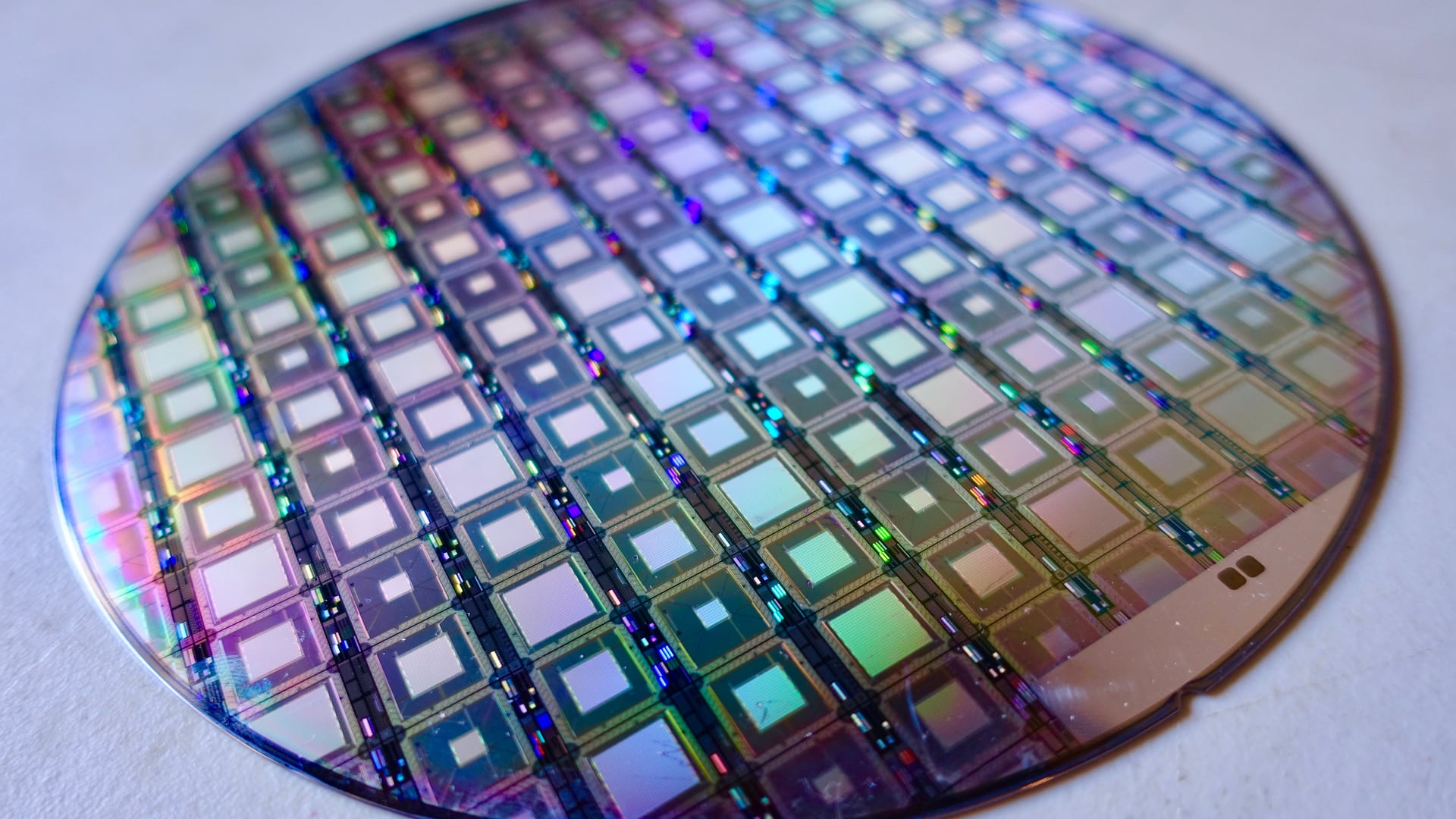
Cover photo: a wafer of D-Wave quantum processors. Steve Jurvetson / Flickr, CC BY 2.0. Cropped.