Key points
- A Seoul court ordered SK chairman Chey Tae-won to pay Roh So-young 944 billion won ($644M USD), the largest property division in Korean history.
- SK Telecom (017670.KS) rose as much as 5.33% on the ruling and closed up 0.50%, on a day Kospi fell 5.72%.
- SK Inc (034730.KS) fell 3.82%, SK Square (402340.KS) fell 9.17% and SK Hynix (000660.KS) fell 8.34%.
- The court priced his SK shares at April 2024 levels, not the 5x higher price they reached last month.
On July 24, the Seoul High Court ordered SK Group chairman Chey Tae-won to pay 944 billion won ($644M USD) to Roh So-young, director of Art Center Nabi, ending a property division case that has run for nine years. It is the largest divorce settlement a Korean court has ever handed down.
The ruling landed around 2 p.m. Seoul time, in the middle of one of the worst sessions the market has had this year. Kospi was on its way to closing down 5.72%, with a sidecar firing on one of Korea's two exchanges for the fifth session in a row, and almost everything was red. Then the SK companies split apart. SK Telecom (017670.KS) rose as much as 5.33% and finished the day green. SK Inc (034730.KS), SK Square (402340.KS) and SK Hynix (000660.KS) all fell.
I want to explain why one ruling pushed four companies in the same group in opposite directions.
What the court decided
Family Division 1 of the Seoul High Court, with presiding judge Lee Sang-joo, held that Chey's SK Inc shares count as marital property and must be divided. The split was set at two thirds for Chey and one third for Roh. The order requires him to pay in cash, with 5% annual interest running from the day after the judgment becomes final.
The number came down from where it stood before. In May 2024 an appellate court had put the figure at 1.3808 trillion won ($941M USD). The Supreme Court sent the case back in October, saying that 30 billion won ($20M USD) which appeared to be bribe money received while Roh's father was president could not be counted as her contribution. Take that out, and the award falls by more than 430 billion won ($293M USD).
Chey's lawyer spoke to reporters right after the decision. "Over a trial process of close to 20 years, the divorce itself was already settled by the Supreme Court ruling, and what was handed down today is the remand court's decision on the property division," the lawyer said. "Chairman Chey feels apologetic for the concern he has caused so many people over the course of these proceedings," the lawyer continued. Asked whether he will appeal again, the lawyer would only say, "We will give our specific position after reviewing the written judgment closely."
Roh's representatives left the courtroom without answering any questions.
The share price the court used was from two years ago
This is the part that decided the size of the award, and it is worth slowing down on.
Korean case law says the value of an asset in a division case is fixed at the date the trial arguments closed. For this case that date is April 16, 2024, and SK Inc closed at 160,000 won ($109 USD) that day. By the time arguments closed in the remand trial, on June 26 of this year, SK Inc was at 815,000 won ($556 USD). The stock had risen more than five times over while the case moved through the courts.
The court used the older price anyway. It did not ignore the rise, though. "In order to divide the couple's joint property fairly, we took into account the circumstance that the share price rose sharply when calculating the property division ratio," the court explained. So the increase shaped the one third and two thirds split rather than the underlying valuation.
Chey holds 17.9% of SK Inc, or 12.97 million shares, which makes him the largest shareholder. Had the court priced those shares at last month's level instead, the award would have been several times larger.
Why SK Telecom went one way and the rest went the other
Traders read the smaller award as one thing above all, which is that Chey is now much less likely to sell SK Inc stock to raise the money. That stake is what holds the whole group together, so any forced sale would have been a control problem for every company under it.
It helps to know how the group is stacked. SK Inc is the holding company at the top, and Chey's 17.9% of it is what gives him control of everything below. SK Telecom sits under SK Inc. So does SK Square, which was split off from SK Telecom in November 2021 and is now SK Hynix's largest shareholder with 20.5%. That makes SK Hynix three steps down from the shares the court just divided, which is why a family court ruling ends up mattering to a memory chip company.
SK Telecom was the stock that benefited. It had been falling with everything else in the morning, down 5.23% at its low. After the ruling it turned around and reached up 5.33%, then settled back to close right at the 100,000 won mark ($68 USD), up 0.50%. The close is a small gain. The path to it was not small. Volume ran well above the previous day.
The rest of the group tracked the market down. SK Inc fell 3.82%, SK Square fell 9.17%, and SK Hynix fell 8.34% in the broader chip selloff I wrote about in Friday's crash piece.
The dividend argument
The reason SK Telecom specifically went up is a bet on dividends.
If Chey will not sell shares, he needs cash from somewhere, and the cleanest source is the dividends his subsidiaries pay up to the holding company, some of which reaches him directly as its largest shareholder. SK Telecom generates more steady cash than anything else in the group.
Hana Securities named SK Telecom its top pick on exactly that logic. "Expanding dividends at quality subsidiaries is effectively the only way to reduce the governance-related problems at SK Group," the firm wrote. Kim Hong-sik, the analyst who covers the telecom sector at Hana Securities, put it more plainly. "There is a strong possibility that the subsidiaries move to expand their dividends, starting with SK Telecom, which has the most room to do it," Kim said.
Lee Dong-seop, secretary general of the Korea Corporate Governance Forum, made the same argument from the governance side. "Because the chairman's SK stake is not all that high, I expect this goes toward expanding dividends or selling assets rather than selling shares," Lee said. "Expanding dividends is something most ordinary shareholders welcome, and it also fits the government's capital market advancement policy," Lee added.
There is a timing detail that makes the bet look reasonable. On July 23, one day before the ruling, SK Telecom's board approved a quarterly dividend of 830 won ($0.57 USD) per common share, 176.8 billion won ($121M USD) in total, with an August 31 record date and payment on September 17. The board did not know how the court would rule. But investors now have a company that already pays quarterly, and a controlling shareholder who suddenly needs cash.
The other ways he could raise the money
Nobody in the Korean market thinks dividends alone cover 944 billion won ($644M USD). The expectation is a mix.
Oh Il-seon, director of the Korea CXO Research Institute, laid out the arithmetic. "The value of his SK Inc stock has passed 8 trillion won [$5.5B USD], and the dividends the chairman has received over 10 years alone come to more than 770 billion won [$525M USD]," Oh said. "Selling shares to pay would be the fastest method," Oh continued, before adding that it is "likely to be the last resort."
The two other levers are borrowing and asset sales. Chey has already pledged 45% of his SK Inc shares, 5.88 million of them, as collateral against 488.6 billion won ($333M USD) in loans. The recent run in SK Inc raised what that collateral is worth, but it does not make borrowing capacity unlimited.
The asset piece is SK Siltron, the silicon wafer maker. Chey controls 29.4% of it through a total return swap, which is a contract where a financial firm holds the shares in name while the investor keeps the returns. AI chip demand has pushed the company's estimated value toward 7 trillion won ($4.8B USD), and SK has been in talks with Doosan Group about a sale. Those talks have no confirmed close date.
The Korean investment industry's general read is that all three run at once, which is borrowing against the stake, larger dividends from the subsidiaries, and the Siltron disposal, rather than any one of them on its own.
What has to happen next
The payment clock has not started. Chey's side said they will decide on a further appeal after reading the judgment, and if they appeal, the cash is delayed while the 5% interest keeps running.
That leaves the dividend expectation as something investors are pricing well ahead of any actual decision. No SK board has announced a policy change. What changed on Friday is only that the market now has a reason to expect one.
Meanwhile, SK Hynix reports its quarterly results on July 29, which is the next SK event with a date attached to it. I wrote a preview of that report here. And a week before this ruling, Chey stood up at a business forum and told nervous investors to stop trading SK Hynix and simply hold it. He is now the one in the group who may need to raise cash.
Sources
- Etoday (Korean language): the ruling, the court's reasoning, and the 2024 valuation date
- Hankyung (Korean language): SK shares treated as marital property and valued at the two year old price
- Newsis (Korean language): the statement from Chey's lawyer after the ruling
- EBN (Korean language): SK Telecom's move on the ruling and the Hana Securities note
- Hankyung (Korean language): Kim Hong-sik of Hana Securities on subsidiary dividends
- Hankook Ilbo (Korean language): Oh Il-seon and Lee Dong-seop on how the cash gets raised
- Newspim (Korean language): the pledged shares, the loans, and the SK Siltron total return swap
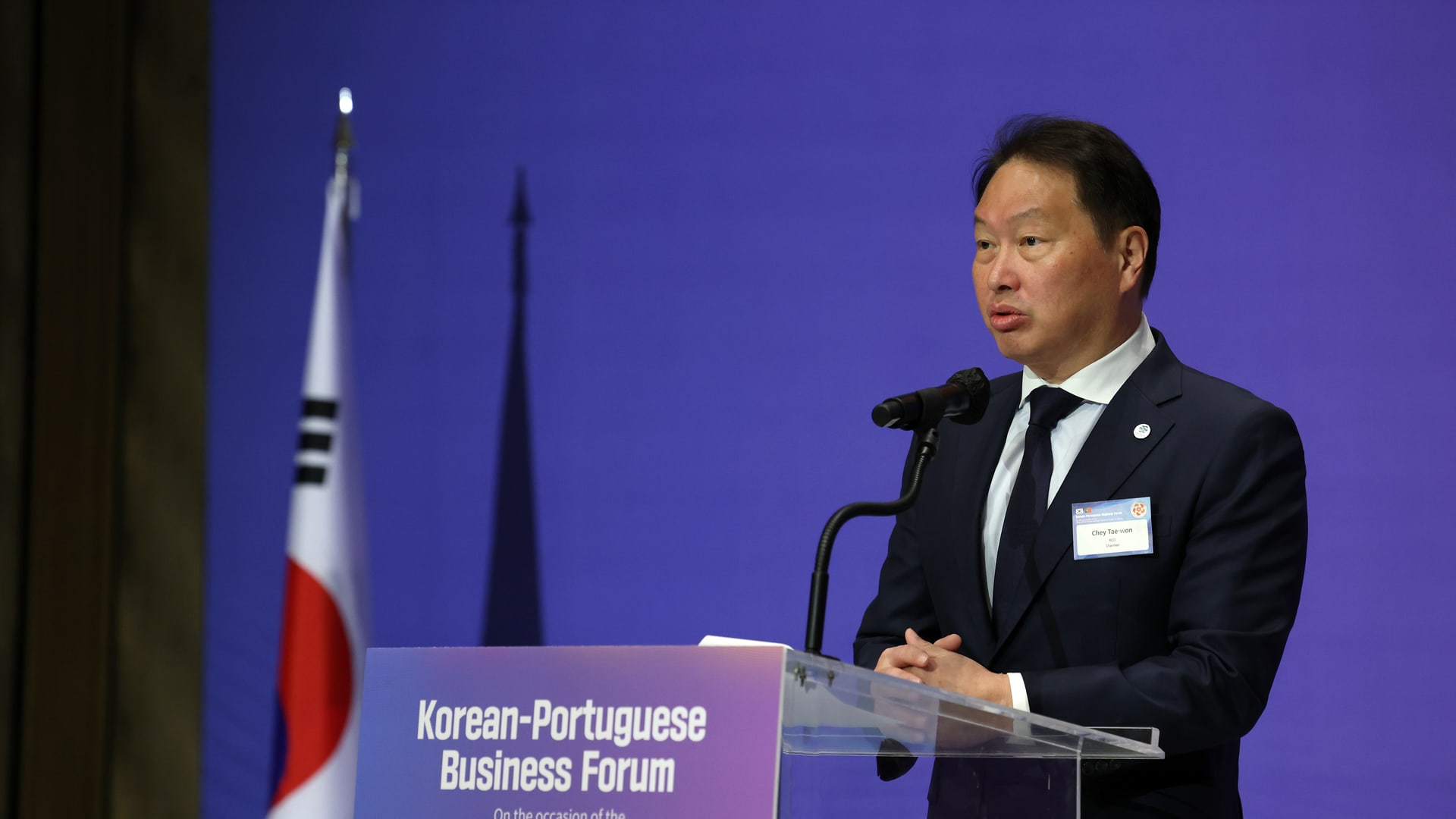
Cover photo: SK Group chairman Chey Tae-won at the Korean-Portuguese Business Forum in Seoul, April 2023. Republic of Korea / Korea.net via Wikimedia Commons, CC BY-SA 2.0, cropped to 16:9.
Figures in this piece are sourced from Korea Exchange trading data via Naver Finance, Seoul High Court rulings as reported by Korean news outlets, and South Korean financial media. Won amounts are converted at the July 24 Seoul close of 1,466.8 won per dollar. This is not investment advice.