Key points
- The exchange has demanded an explanation by Friday
- Trading moves to 30-minute auctions
- The stock rose 58% in three sessions
- It's still 54% below its offer price
The Korea Exchange has asked the first British company on the Kosdaq to explain what is happening to its share price. TeraView Holdings (테라뷰홀딩스) rose about 58 percent over three sessions this week. From Friday its shares will trade only once every 30 minutes.
The exchange sent the question at 4:38 p.m. Seoul time on Thursday, asking whether the company has anything to disclose in connection with the price move. TeraView has to answer by 6 p.m. on Friday. At 8 p.m. the exchange added two more measures. It gave advance notice of an investment warning designation, and it named the stock a short-term overheated issue from September 11 through September 15, which means trades are matched at a single price every 30 minutes instead of continuously. If the closing price on the last day is 20 percent or more above the close before the designation, the exchange can extend that by another three trading days, once.
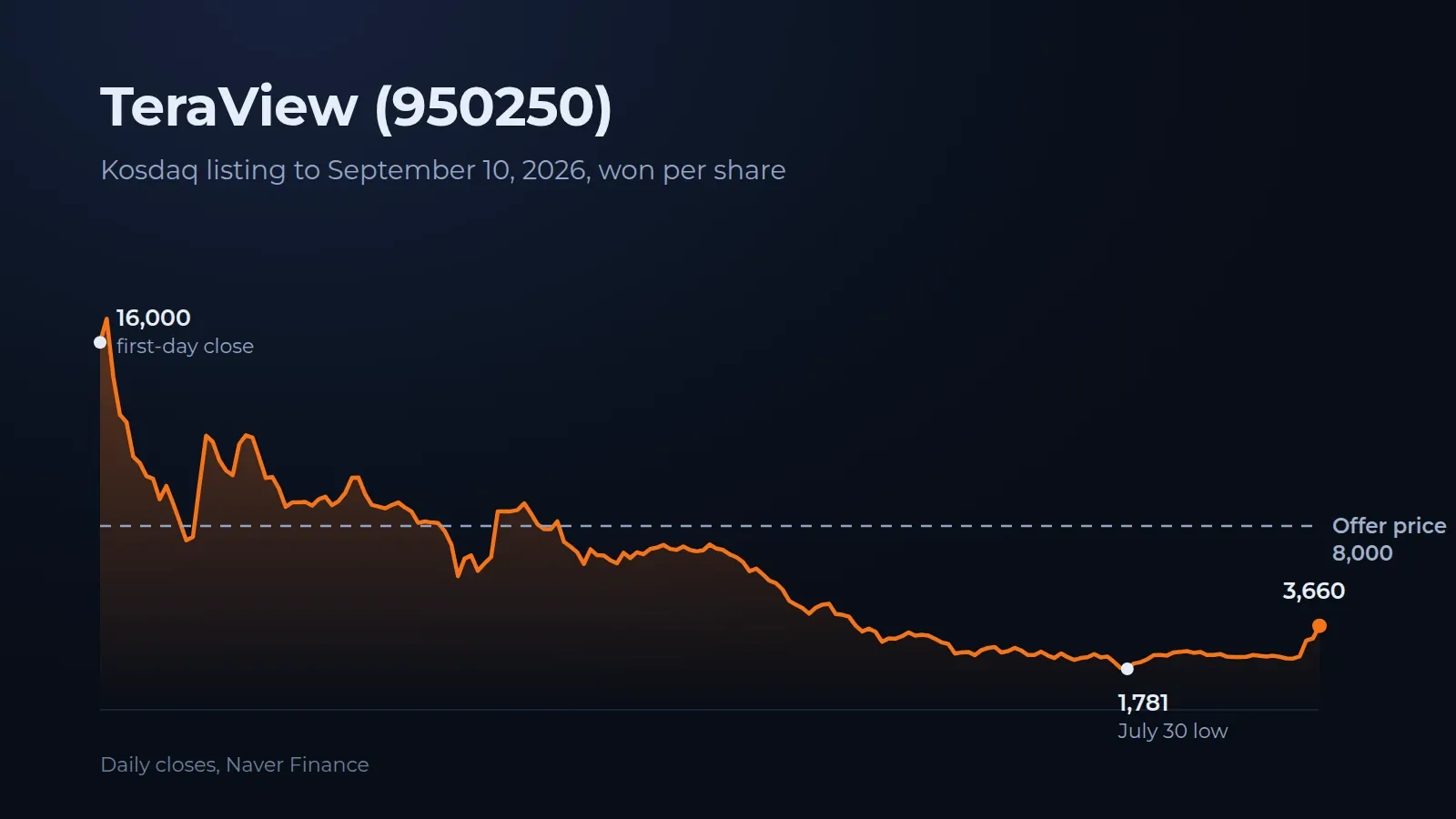
It hit the 30 percent daily limit on Tuesday, rose another 2.99 percent on Wednesday, and gained 17.87 percent on Thursday to close at 3,660 won. Even after that rally, the stock remains about 54 percent below its 8,000 won offer price and 77 percent below its first-day close of 16,000 won. It hasn't closed above the offer price since March 25.
What TeraView makes
The company measures things with terahertz light, which sits between microwaves and infrared. Its systems find faults inside advanced chip packages, check paint layers on cars, inspect battery electrodes and test pharmaceutical tablets. TeraView was spun out of research in Cambridge, England, and it listed in Seoul on December 9, 2025, the first British company to do so. Chief executive Don Arnone said at the time that Korea and Asia are the company's main market and that major customers are based there, which is why it chose Seoul.
Korean market commentary has tied this week's move to Nvidia and 6G, on the reading that terahertz frequencies are part of the next generation of wireless. That reading is not new. Geumgang Ilbo (금강일보) ran it in March, the last time the stock moved like this, reporting that Nvidia had presented terahertz frequencies, AI-based radio access networks and digital twins as core infrastructure for 6G. Nvidia does have a 6G program, including its AI-RAN work and a digital twin for radio networks. We couldn't find an Nvidia document about terahertz bands specifically, and TeraView has announced nothing linking itself to any of it.
The filings show something more concrete, though it stops short of a name. On June 30 TeraView disclosed an order for semiconductor inspection equipment worth $1,661,000, or about a third of its annual revenue. The customer isn't named. The filing describes the buyer only as a "Global AI chip provider" and lists its main business as "GPU." TeraView said the name is withheld at the customer's request until May 2027. Two more overseas orders landed this year, one on March 10 for $920,000 and one on August 18 for $670,700.
Those numbers are large next to the business they sit in. TeraView reported revenue of 7.83 billion won ($5.85M) for the year ended April 30, up 3.3 percent, and an operating loss of 9.33 billion won ($6.98M), which widened by 31 percent. The company said the wider loss came from advisory and legal fees tied to becoming a listed company and from hiring.
TeraView is one of a small number of foreign companies testing the Kosdaq, and the offer price is where several of them are being judged. Ingenia Therapeutics, a Boston biotech that listed on August 4, was the only debut from that month still above its offer price at the end of August, according to Financial News (파이낸셜뉴스).
The answer to the exchange is due at 6 p.m. Friday in Seoul.
Disclosure documents are translated from Korean. Won figures are converted at 1,346 won to the dollar, the Naver Finance rate on September 10, 2026. Dollar contract values are the figures given in the company's own filings.