Trump talks with Thune as Senate stalls data center power-cost bill

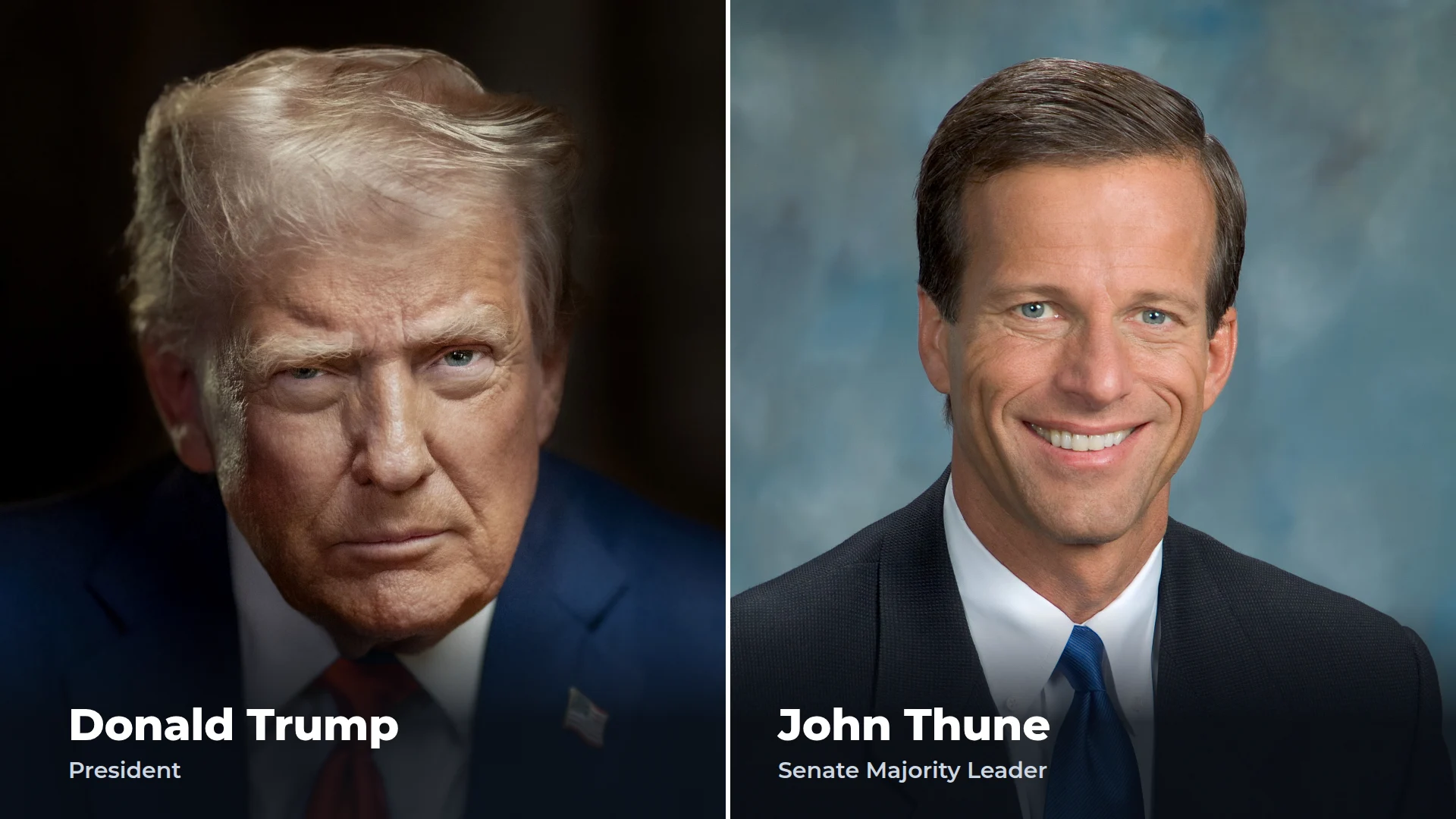
President Donald Trump and Senate Majority Leader John Thune

Official portraits of President Donald Trump and Senator John Thune. Public domain.

Key points

  • Trump is talking with Thune about a data center power bill
  • The goal is shielding households from higher bills
  • A House bill passed but stalled in the Senate
  • States are already acting on their own

President Donald Trump said on Friday he is talking with Senate Majority Leader John Thune about a bill to protect households from rising electricity costs tied to data centers. "Well, I'm talking to him about it. We'll see what happens," Trump told reporters, according to Reuters.

Congress already has a version of the idea. The House passed the Ratepayer Protection Act 417 to 3 this week. A Republican push to move it quickly through the Senate failed on Thursday.

What the bill would do

The Ratepayer Protection Act would require state utility regulators to consider a federal standard under which large electricity users, including data centers, pay the full cost of new power and transmission infrastructure built to serve them. The bill would not set that requirement directly; state regulators would retain control over whether to adopt it.

The Senate effort stalled over how far the bill would go. Senator Jon Husted, a Republican and the sponsor, asked for a vote by unanimous consent, without a roll call. Senator Martin Heinrich, the top Democrat on the Energy Committee, objected that the bill would only ask states and developers to act voluntarily instead of requiring it.

Some states are not waiting for Washington. Virginia unveiled its own framework on Friday to shift more of those costs onto data centers, following similar moves in New York, Texas, and Pennsylvania.

Frequently asked questions

What is Trump proposing on data center electricity costs?

President Trump said on September 18, 2026 that he is talking with Senate Majority Leader John Thune about bringing a bill to the Senate floor to protect households from rising electricity costs tied to data centers. He was noncommittal, telling reporters, 'Well, I'm talking to him about it. We'll see what happens.'

What is the Ratepayer Protection Act?

It would require state utility regulators to consider a federal standard under which large electricity users, including data centers, pay the full cost of new power and transmission infrastructure built to serve them. The bill would not impose that requirement directly; states would keep control over whether to adopt it. The House passed it 417 to 3.

Why did the bill stall in the Senate?

A Republican effort to pass the Ratepayer Protection Act by unanimous consent failed on September 17, 2026. Senator Jon Husted, the sponsor, sought a quick vote without a roll call, and Senator Martin Heinrich, the top Democrat on the Energy Committee, objected that the bill relied too heavily on voluntary commitments from states and developers.

Are states doing anything about data center power costs?

Yes. Virginia unveiled a Data Center Accountability Framework on September 18, 2026 to shift more power costs onto data centers, following similar moves by New York, Texas, and Pennsylvania.

More coverage

Dennis Singleton
Dennis Singleton

Dennis Singleton has spent years following the markets, but what keeps his attention is how AI is built. He writes about the companies behind the technology, from semiconductor designers and advanced packaging to photonics, memory, networking, and the hardware powering modern AI. His approach starts with filings, earnings, and industry research, then translates the important details into clear, straightforward analysis without unnecessary hype.