Key points
- Local resistance is shaping where data centers get built
- Republican campaign officials warn that voter perceptions are negative
- Pennsylvania has fully permitted five of more than 100 projects
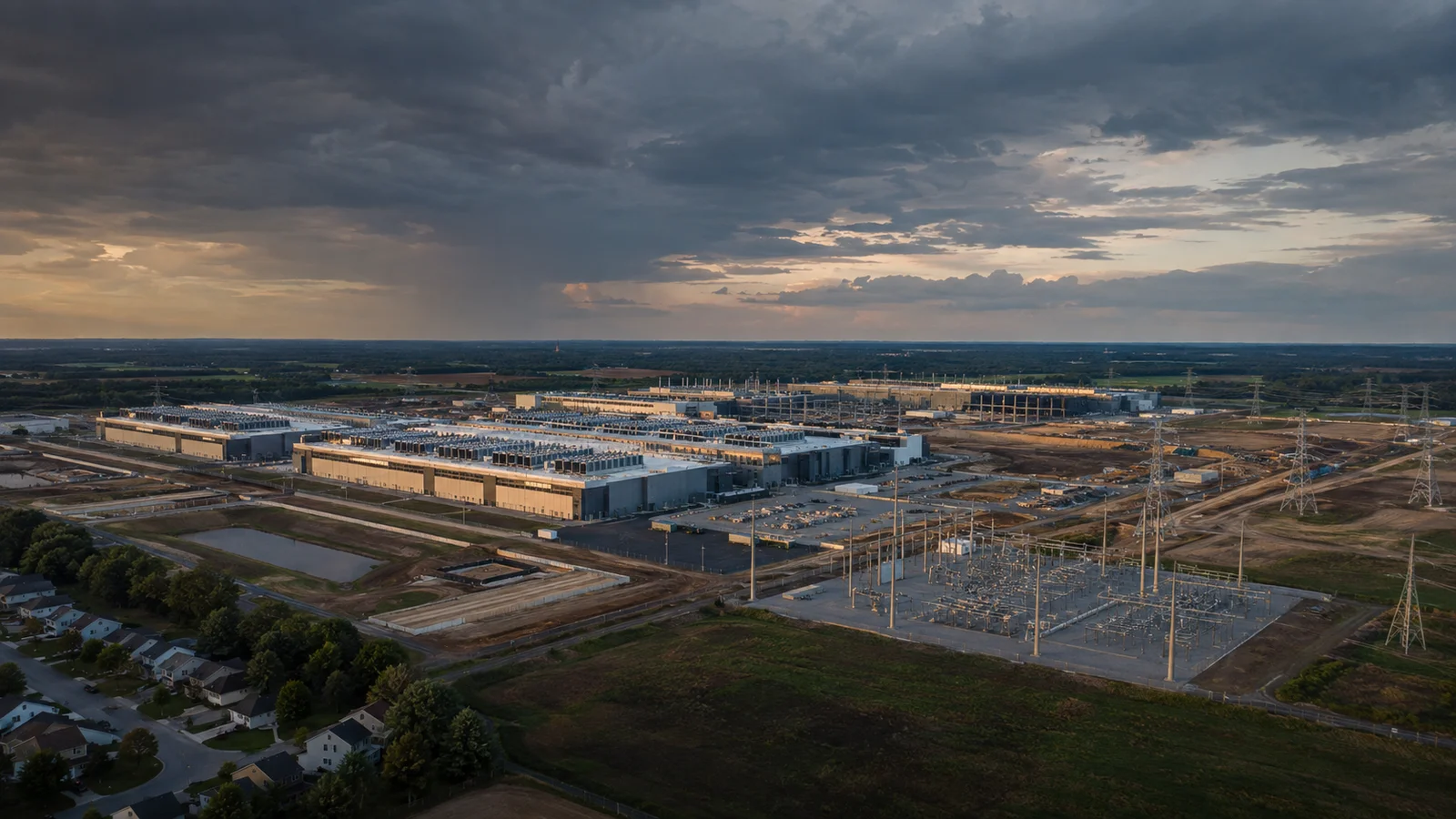
The backlash against data centers is starting to change where they get built and how long they take. Donald Trump is urging communities to accept the projects, while candidates in both parties answer to voters who oppose them and states hand more of the decision to local governments.
The anger has a specific cause. Data centers draw enormous amounts of electricity, and PJM's market monitor says customers across the region are paying part of the resulting capacity, energy and transmission costs. That is how a zoning fight over a warehouse full of servers turned into an election issue.
The resulting constraint is already measurable in permit data. Pennsylvania won't issue a state permit until a project holds all its local approvals, and the state's own disclosure follows the same projects narrowing at every stage: more than 100 in public databases, 58 that engaged with the environment department, 15 that applied for permits, five fully permitted for first-phase development.
Permitting is only one filter. Four states now publish both the electricity demand data centers request and the amount those states actually expect to serve, and utilities and regulators throw out most of the requested figure before it reaches a planning number. We track the gap between announced and expected demand on the AI Bubble Index.
Suppliers are building ways around the delay rather than waiting for utilities to catch up. Vertiv (VRT) has agreed to pay about $1.45 billion at closing for UtilityInnovation Group, with up to $1.15 billion more if earnings targets are met. A site with onsite generation can secure power with less dependence on utility-interconnection timelines. Vertiv said faster access to power is a central rationale for the acquisition. The deal needs regulatory approval and is expected to close in the fourth quarter.
What the campaigns are saying
In remarks on Friday, September 4, posted by Wall St Engine, Trump said whoever wins with AI wins, that the race is between the United States and China, and that a state wanting to get rich will want data centers. He made the same case on Truth Social on August 31, writing that communities refusing them will "end up being backwards and poor" and that if they want to be rich, "let Data Reign."
Three days before that post, the National Republican Senatorial Committee told its own candidates the ground had shifted. In an August 28 memo reported by CNBC, the committee said "the current perception is negative" and warned that "if voters' perceptions of data centers are not fixed quickly, the campaign against them will expand far beyond Ohio." The NRSC's concern is the perception rather than the projects, and its remedy is to fix the image. It said private polling shows Jon Husted in a "dead heat" with Sherrod Brown in Ohio's Senate special election, and called data centers "the new ingredient (and the new problem)."
Opposition crosses party lines because the fights are local, even though its intensity varies by party. A CNN analysis cited by Fortune found the backlash is bipartisan for that reason. In Pennsylvania, Republican Stacy Garrity is running to the left of Governor Josh Shapiro, attacking an Amazon deal in her first television ad. In Wisconsin, Republican Tom Tiffany brands his opponent "Data Center David Crowley." In Georgia, Democrat Keisha Lance Bottoms backs a moratorium, Republican nominee Rick Jackson opposes one, and Governor Brian Kemp says the call belongs to local communities.
Two national polls, asking different questions, point the same way. Marquette Law School asked whether the costs of data centers outweigh the benefits and got 73% saying yes in July, up from 62% in January, running 66% among Republicans and 80% among Democrats. Gallup asked a different question, whether people would oppose one being built in their own area, and got 71% opposed, including 48% strongly opposed.
What the projects deliver locally
The local economic case is also drawing greater scrutiny. Research on Virginia, the largest data center market in the country, found projects there create one permanent job for every $54 million invested, against 17 jobs per $1 million across the broader economy, Fortune reported. At least 10 states are losing more than $100 million a year in revenue to data center tax incentives.
The industry is responding with community spending. Meta launched a $1 billion fund for communities where it operates data centers in August, against 2026 capital-spending guidance of $130 billion to $145 billion.
None of this halts construction. It can push projects toward more welcoming states, add months to the ones that stay, and make the sites that already have their power and permits worth more. Election day is November 3.