Key points
- Kratos Defense (KTOS) CEO Eric DeMarco sold $19.3 million of stock on August 14.
- It showed up as two filings the same day: a Form 144 notice before the sale, and a Form 4 record after it.
- The sale ran on a 10b5-1 plan set back in March, so it is a scheduled sale, not a signal.
I keep a tab open on insider filings the way some people keep one open on a ballgame. Most days are quiet. Last Thursday one line stood out. Kratos Defense (KTOS) showed a $19.3 million sale by the man who runs it, chief executive Eric DeMarco. A sale that size by the person at the top makes you sit up.
Then I opened the filings and the story got calmer. Two of them landed the same day, and together they explain a document most people skip right past: the Form 144.
The filing that comes before the sale
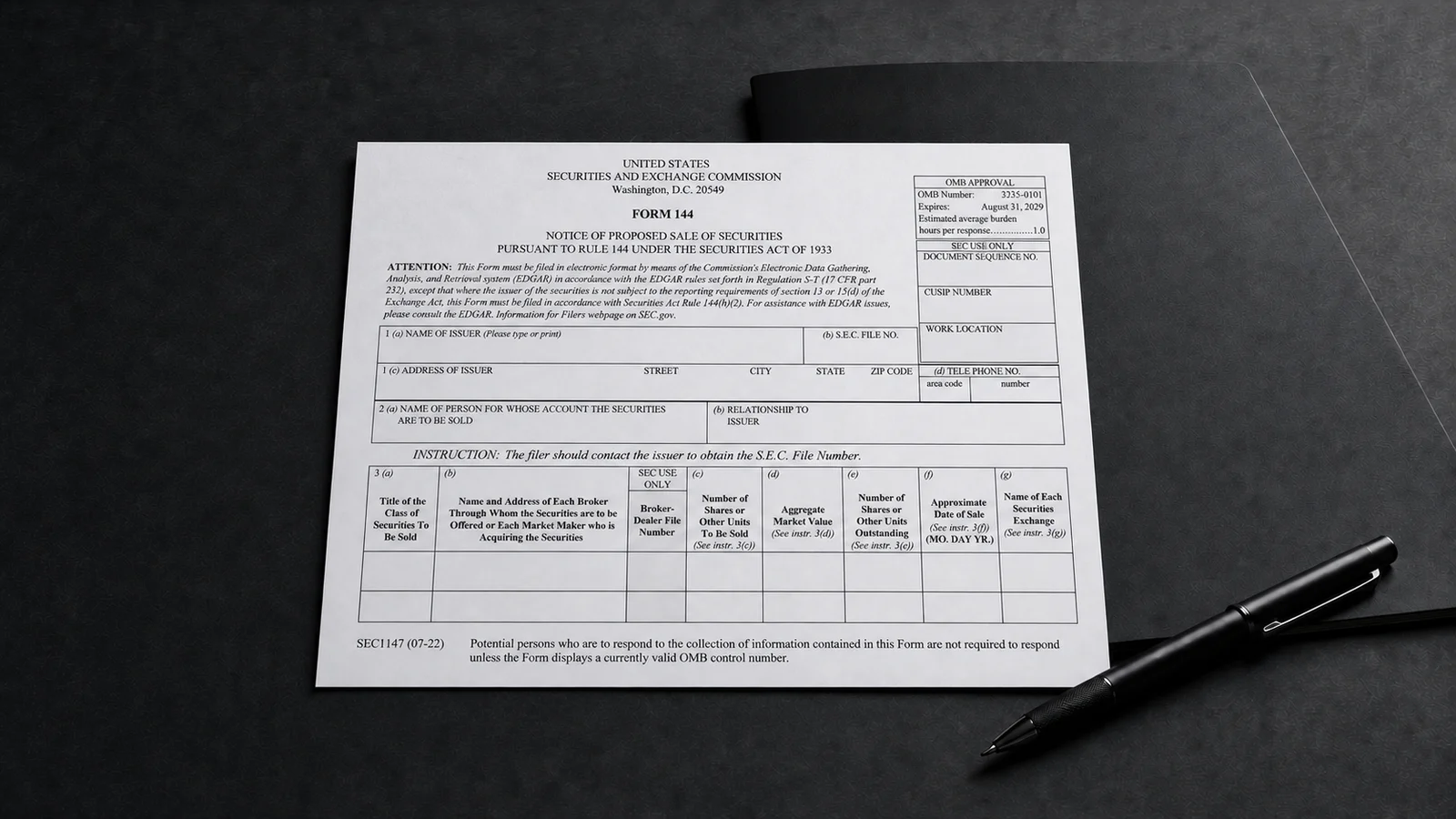
A Form 144 is an advance notice to the market that a sale is coming. An officer or director who plans to sell restricted or control stock has to file it with the SEC first, before a single share trades. Rule 144 makes them do that once the sale clears a small threshold. The notice names the broker, the share count, and an estimated value.
DeMarco's notice said he planned to sell 300,000 KTOS shares through Morgan Stanley, out of an account held by the Saved Family Trust. The estimated value was $18.837 million. Think of the whole thing as a heads-up. It flags an intention. The price on it is a guess, and the real sale still has to clear.
The Form 4 is where you find out that it did. That's the report an insider files within two business days of an actual trade, and DeMarco filed his the same day as the notice. The Form 4 recorded 300,000 KTOS shares sold in four batches for about $19.3 million. The prices ran from $63.33 to $66.17. For the full walk-through of that form, we've written one here: how to read a Form 4.
So the two dollar figures on this one sale both belong. The $18.837 million is the estimate on the notice. The $19.3 million is the receipt.
| The KTOS sale | Form 144 | Form 4 |
|---|---|---|
| When it is filed | Before | After |
| What it shows | A plan to sell | The finished sale |
| Shares | 300,000 | 300,000 |
| Dollar figure | $18.84M est. | $19.30M actual |
Why the word "routine" changes the read
One footnote made the $19 million look a lot less dramatic. Both filings point to a Rule 10b5-1 plan, and DeMarco's Form 4 spells it out: "This transaction was effected pursuant to a 10b5-1 trading plan adopted by the reporting person on March 6, 2026 and modified on May 15, 2026."
A 10b5-1 plan is a sale schedule an executive sets in advance. He picks it at a time when he holds no inside information, then lets it run on its own. We laid out the mechanics and the catches in this piece on 10b5-1 plans. The short version for this sale: DeMarco set it in motion back in March, well before last week. Kratos was a very different stock then. KTOS slid to about $43 by late July, then climbed back near $64 by mid-August. The sale ran into that recovery, but the order behind it had been sitting for months.
That's the whole reason a scheduled sale sits near the bottom of the insider-signal pile. It's the mirror image of a CEO buying shares on the open market with his own cash, which is a fresh decision made in real time. Same beat, opposite meaning.
It also helps to look at what DeMarco kept. With the 300,000 shares gone, DeMarco still holds 761,632 KTOS shares through the Saved Family Trust and another 63,036 in his own name. His Form 4 lists 745,000 vested stock units on a five-year deferral and 750,000 more that are still unvested. The $19 million is real money, and it's a slice off a much larger stake he's holding on to.
None of that turns the sale into a real signal by itself. Cash is cash, and a plan can be built around a genuine view. But on its own, a Form 144 carries a short list of facts: a sale was scheduled, a broker will handle it, and the paperwork went in on time. It says little about where DeMarco thinks KTOS is headed. So the next time a "$19 million insider sale" alert lands in your feed, open both filings and look for the plan date. You can watch these notices land in real time on our insider filings tracker, or straight from SEC EDGAR. And for the honest answer on whether any of this is worth acting on, we dug into that in should you copy hedge funds, Congress, or insiders.